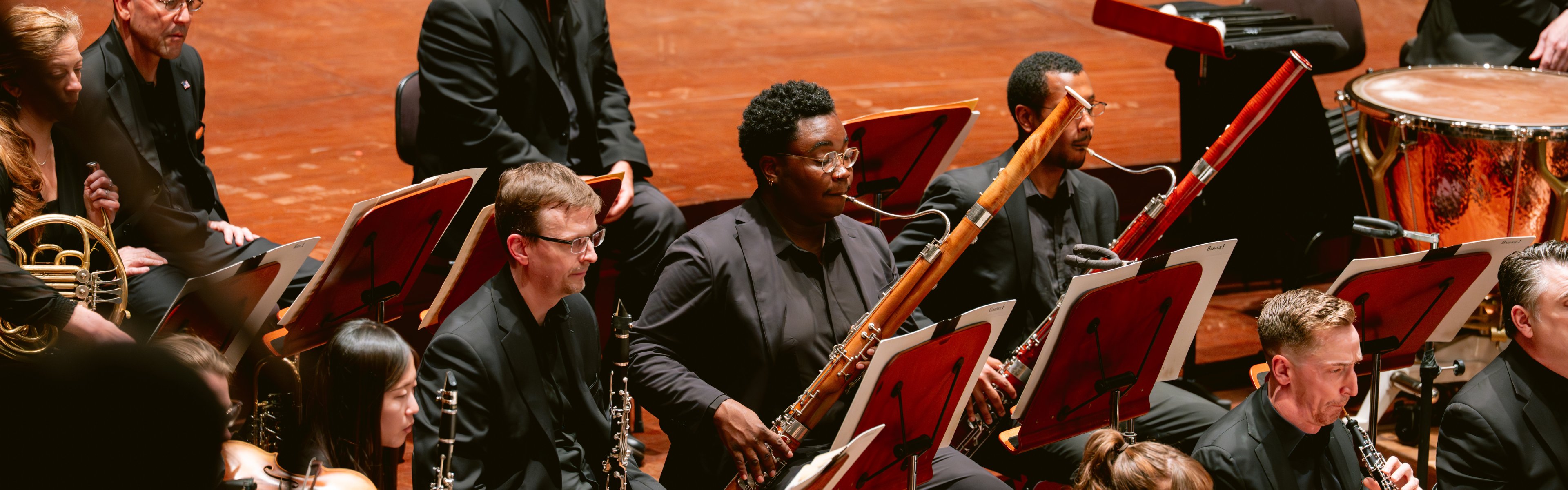
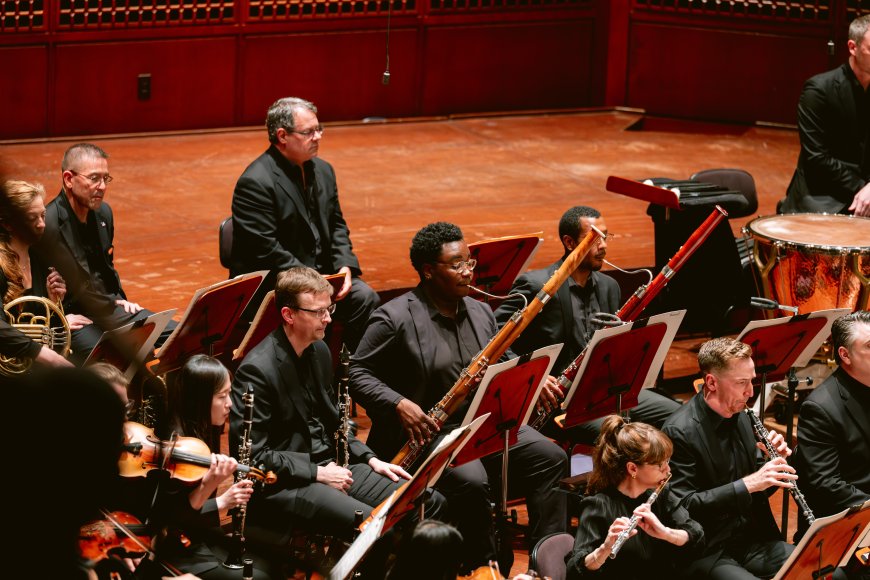
When Joshua Elmore plays the bassoon, he evokes a river.
In his principal position with the San Francisco Symphony, there is a steady, forward-moving current to Elmore’s playing: melodic themes by Carl Maria von Weber sound like water undulating over river rocks. In a Stravinsky score, gently pinging raindrops preceding an impeding storm improbably resonate with deep foreboding, and in Shostakovich’s works, the turbulence of torrential rapids powerfully surface.
Elmore’s artistry always makes a splash. Mere hours after his appointment to principal bassoonist was announced in March 2025, he plunged into the opening of Igor Stravinsky’s The Rite of Spring under Music Director Esa-Pekka Salonen — it was as if he was born to play the orchestral solo.
Elmore’s musical path began at age 8 in Cleveland, Ohio. He started with piano, dabbled with recorder in the fourth grade, and explored the clarinet and played violin in the fifth grade. Soon after, Elmore discovered the bassoon and there was no turning back.
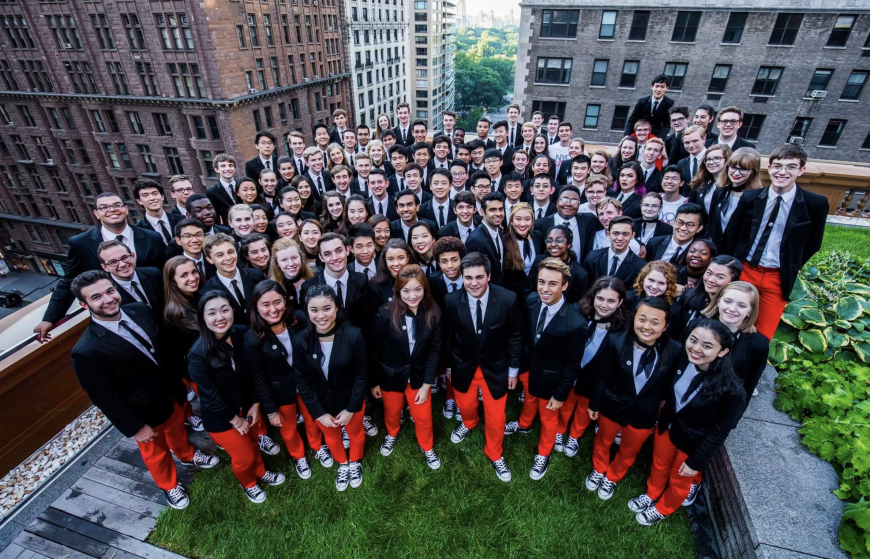
During high school, he was principal bassoon of the Cleveland Youth Wind Symphony and a member of the Cleveland Orchestra Youth Orchestra. He also toured internationally with the National Youth Orchestra of the United States.
Elmore went on to graduate from the Juilliard School. He also holds a professional studies certificate from the Colburn School and contributed to a Grammy Award–nominated album with the National Orchestra Institute.
Prior to joining SFS, Elmore served as principal bassoon of the Fort Worth Symphony. His appearances along the way included the Boston Symphony, New York Philharmonic, Chineke! Orchestra, and Gateways Festival Orchestra — the first all–African American orchestra to appear at Carnegie Hall. Elmore performs as principal bassoon at the Bellingham Festival of Music each summer.
SF Classical Voice spoke with Elmore about his musical journey, the SF Symphony’s programming, and his favorite works and hobbies.
Could you explain how you were introduced to music during your childhood years in Cleveland?
I started with piano lessons. I liked the musical aspect, but I hated the piano. It was unusual to me: one hand doing one thing and the other doing something completely unrelated… I never practiced or applied myself to it.
Fourth grade, we were introduced to the recorder. I remember having a more natural connection, not that I became any kind of virtuoso.
I began playing violin in the 5th grade orchestra, to follow in [my mom’s] footsteps — she had told me she was a violinist when in school. It inspired me to play the violin. It was one thing I could do that she did. I admired her.
And outside of music?
I wasn’t doing much other than that. When I began playing the bassoon, it was the one thing I did every waking hour. I actually had to be told to stop.
I was banned from playing in my aunt’s house due to my inability to stop. In school, I would skip recess from 6th grade on. I’d stay after school so I could practice and take a later bus home. I’d go home, start practicing, and be told to stop eventually so I could do my homework. There had to be a cap put on where and how much I could practice.
Once I found the bassoon, it just clicked.
Do you ever think about that “click” and what generated it?
I was fascinated by the instrument. The peculiar way it looked and also the way it sounded were the initial things that drew me to it. I was intrigued by… the Super Mario Bassoon Quartet performed by the Oberlin Bassoon Quartet on YouTube.
You’ve now been with the Symphony more than a year. How have your technical and performance skills grown?
Coming from an orchestra like Fort Worth, which is a fine regional ensemble but (not the same) caliber of the San Francisco Symphony, being surrounded by the talent of my colleagues is one of the things that’s helped me to grow the most. Hearing how they play [and] handle adversity, it helps me to be surrounded by people like that.
My listening abilities have been sharpened because of the nuance and detail an orchestra at this level plays with. My ability to change my sound, after hearing others change around me, allowed me to learn by hearing instead of executing change in a practice room.
You told me you’re excited to perform Beethoven’s Ninth with SFS this June. Why might a bassoonist find the piece challenging or enticing?
The first time I performed this piece was at the BBC Proms with the Chineke! Orchestra — the majority-Black, ethnically diverse orchestra based in London. I quickly realized Beethoven only wrote for two of each woodwind instrument. The work was very involved and tiring. [In the Ninth Symphony] woodwinds add not only color but carry a lot of the melodies and counter melodies. Making sure it was being played in a stylistically appropriate way was important.
[In] the first movement, the bassoon part is quite fun. There are singing melodies with the other woodwinds and also with the strings. The second movement is one of my favorites of any Beethoven symphonies. I love the character of it, the energy is infectious. There’s a wonderful bassoon duet that all the woodwinds join that is just magical.
[In] the fourth movement, the choir joins in and the main solo Beethoven Nine is known for comes in. During the main statement, on top of the basses and cellos, there’s a beautiful counter melody for the bassoon over the theme everybody knows. It’s one of the most beautiful moments in bassoon literature. It feels triumphant and it’s just a ball to the end.
Tell me about composers whose work is glorious for a bassoonist to perform.
I always say the bassoon peaked in the Baroque era. Antonio Vivaldi wrote hundreds of concerti for the instrument that are very virtuosic.
Shostakovich uses it a lot. Most notably, the Ninth Symphony bassoon solo takes the entire fourth movement. It’s a big honor, especially considering the political content of the work. The bassoon depicts people of the Soviet Union crying out under the oppression of Stalin, the tyrannical government. That sadness — certain composers like Shostakovich were able to use the bassoon to depict emotion and give voice to the voiceless.
Stravinsky pushed the bassoon to its limits with the Rite of Spring. He said if he’d known how beautiful it would sound he would have written it a third higher, but I appreciate he did not.
Tchaikovsky has written masterfully for the bassoon. Verdi’s Requiem has one of the most wonderful bassoon parts in the repertoire. Mahler wrote incredible bassoon parts that push the player to greater technical facility.
Which living composers might be pushing the instrument forward?
Wynton Marsalis. He wrote a bassoon quartet named “Meeelaan” after his dear friend [Milan Turković]. Marsalis as a composer for bassoon excites me.
You are SFS’s first Black principal player in more than 50 years. What are your thoughts on the topic?
What’s so important about representation is people seeing people doing certain things tend to gravitate to those things. One may say a lot of African Americans become athletes because [they see] themselves in Black athletes. While that is one reason, I think in seeing yourself reflected back, you feel you have a place and belong.
Classical music [can be perceived as an] only white art form — [it] can have that image to someone from the outside who doesn’t really know. That’s why my presence [and success] is so valuable. The concept of applying yourself with undeniable desire to be successful is what matters.
What is your leadership philosophy?
It is very much being written as we speak. I taught eight weeks at the conservatory this past semester. It taught me each student is an individual. That’s not earth-shattering, but it bears mentioning because it’s one thing that separates a good teacher from a great teacher.
Each student deserves and needs the teacher to meet them where they are. There’s not a cookie cutter method. Especially for college undergraduate students, a teacher is as much a professional musician as they are a parental figure, a person who’s friendly in their lives and someone who they can grow with in their time of studying.
Let’s wrap up with something fun. Tell me about those 50-plus plants you live with.
They’re mostly Monsteras and Pothos, my favorite houseplants. I grew up in a house with plants: my grandmother had a large collection.
Plants are dual purpose; something to take care of and home decor. I turned out to have a green thumb. I got into it and actually moved from Fort Worth with as many plants as I could have in my Honda Accord.