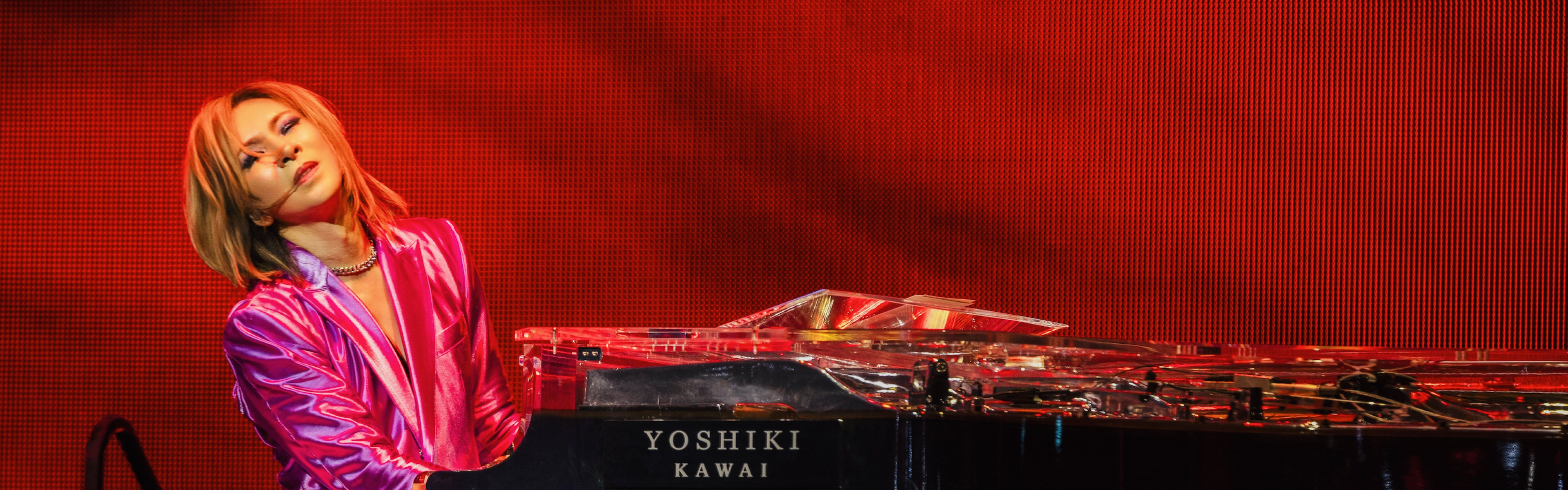
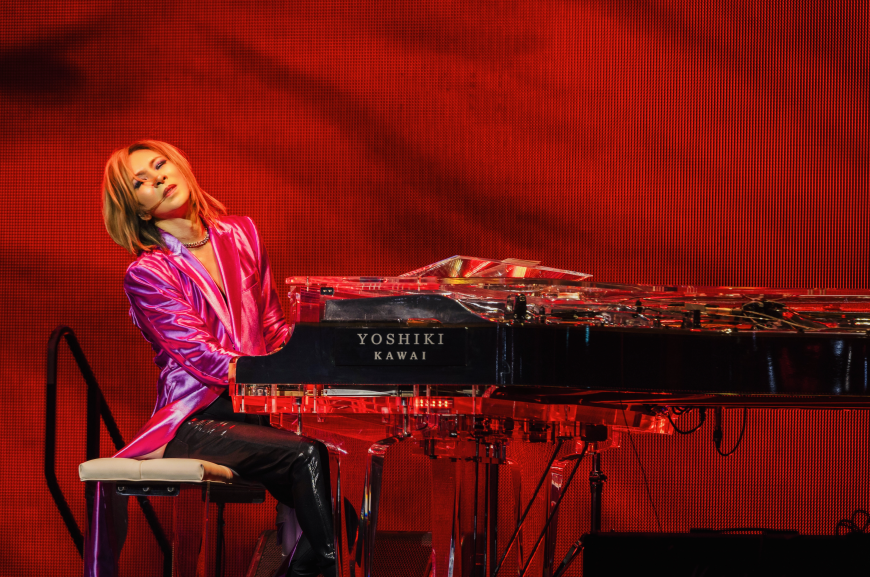
Yoshiki is a rock star defined by contradictions.
The multihyphenate is at home in both the classical music of his youth and the rock music that would come to define his career domestically and abroad. His unshakeable desire to actualize art in all its forms has resulted in a historic career as one of Japan’s most important musicians of all time.
He co-founded X Japan, a band which was foundational to the development of Japanese metal and visual kei — Japan’s homegrown subculture that has contributed to global musical phenomena, like K-pop. His flagship symphonic work, the prog-metal symphony Art of Life (1993), topped the nation’s music chart, Oricon, and cemented X Japan and Yoshiki as singular talents.
He has received numerous awards and accolades in Japan and abroad, including writing and performing an original piano concerto for the Japanese imperial family. But make no mistake: he’s not just big in Japan. He has collaborated with an impressively varied roster of musicians like Skrillex, Bono, and St. Vincent, and more recently even shared the stage with the very bands that inspired him to make rock music: KISS and Queen.
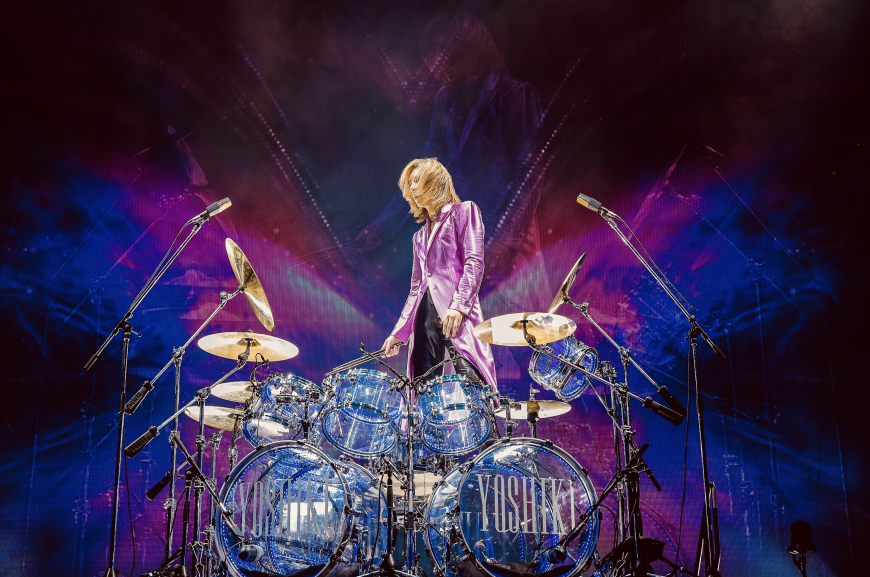
In addition to his musical activities, Yoshiki has made massive waves as a fashion designer — he was recognized by The New York Times as a pivotal figure in fashion among contemporaries like Yohji Yamamoto and Rei Kawakubo. He also made his directorial debut in his documentary Yoshiki: Under the Sky in 2023, and has had a long career as a philanthropist, most recently fundraising for Ukraine and volunteering on behalf of the Los Angeles fire victims.
In anticipation of his two-night concert event in Los Angeles at Walt Disney Concert Hall on July 16-17, Yoshiki spoke with SF Classical Voice about his musical origins and career milestones. He also shared powerful insight into his feelings around rebellion and tradition — how these both inform the paths young artists must tread in the wake of a rapidly changing musical landscape.
Your father was a jazz pianist who made a concerted effort to give you a rich early education in classical music. Which composers were most formative for you?
You are right, my father used to come home every day and bring me classical music records. It is hard to pick just one. I grew up playing Bach, Beethoven, Tchaikovsky, Chopin… if I had to pick one, I’d say Beethoven’s symphonies. Yes, Beethoven.
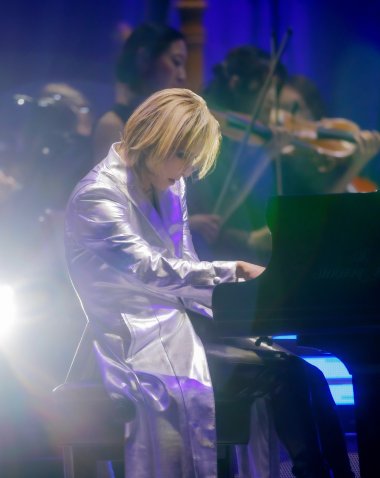
You have had incredible successes across a wide array of disciplines, both within music as a multi-instrumentalist, composer, and producer and also in other creative fields like fashion design. Tell me more about the origins of your interdisciplinary artistry.
Growing up, I played music from a young age. My parents were musicians, but my family profession was in making kimonos. I was the oldest son, so I was expected to one day take over the business. I used to go to the record store with my father a lot. When he passed away, I went to the record store [and] I saw a new album by the rock band KISS that looked at me with this kind of crazy makeup.
Lots of visual kei bands were inspired by them! There must have been something familiar in their trademark corpse paint, which was itself inspired by Kabuki.
Yes, you are right. So, I was listening a lot to bands like that. And one day, I asked my mother if I could go see them play a show in Tokyo — I grew up in Chiba Prefecture. So we went to the concert, I was about 11 or 12 years old, and my mother of course wore a kimono, very traditional. She didn’t know she would get covered in blood!
Later on, after making rock music for many years, I decided to return to fashion. I thought, the most natural thing was to start with kimono. I met with a kimono business coming from Kyoto running for 150 years. We started creating a crazy rock and roll edgy kimono on top of the traditional version.
With classical music, I'm kind of doing the same thing. I am just interested in art. No matter whether it is music or anything else, it is all engaging to me. More than anything, I am always inspired by whatever is edgy — I have a rebel streak. And I think that has informed what I do.
You've worked with some of the greatest artists of the last 40 years. What have been some standout collaborations for you? Are there any remaining collaborations you dream of?
It’s hard to choose just one. They are so different from each other, it’s hard to compare.
I would say KISS. I got to perform with them in 2019, before COVID. Also, Queen. It was a [remote] COVID performance, we performed my song “Endless Rain.” I had collaborated with Roger Taylor decades ago [“Foreign Sand,” 1994], also, but yes.
Increasingly, musicians are becoming more genre-fluid in their work and ethos. What is your hope for them as music continues to become more accessible to listeners and would-be composers, all while the music industry is facing rapid technological disruption?
It is hard to give an answer. I can say something, and then one day, one week from now, there could be some new technology and everything will be very different. I would say: be true to yourself. Don’t write for other people, don’t listen to what other people say.
In 1993 I worked with George Martin, who was also producer for The Beatles. He produced Art of Life [X Japan’s symphonic metal album]. Later, I asked him to teach me how to orchestrate my own songs, which he did. I have had other orchestration teachers since then too. When the label heard [Art of Life, a 29-minute piece], they asked me, “can you make this eight or ten minutes?” I told them no. I did not want my art to be compromised, you know? So, I told them not to cut it. These modern distribution formats, they are modern. Do not write a song just because “oh, on streaming, every song should be two minutes and thirty seconds.” Write only for you.
You need to stay true to yourself. Don’t write for anyone else. If other people hear what you’re doing and think “hey, that’s great,” then good, but don’t worry about it. It will come. I know I am saying this to you, but I am also saying this to myself.
You have a deep reverence for the classical tradition but also have this rebellious streak that led you to rock music — it is a fascinating contradiction that is present throughout your music, particularly songs like “Rose of Pain.” What inspired you to quote the Bach “Great” Organ Fugue in that piece?
When I wrote “Rose of Pain” I wanted of course to write a really heavy song, and also for it to have a very classic, classical feeling. So I thought to quote Bach’s organ fuga. I thought after recording the song at the end to go back and record myself playing the organ at the beginning of the song.
Let’s say you get up and go to the piano first thing in the morning. What's your go-to warm-up piece?
That’s a good question. So, it depends on how much time I have in the day and when I get up in the morning, you know. If I don’t have all day, of course, I might spend a couple of hours. I start with the exercises from Hanon, an hour of that at least. And then probably Bach. I also like playing Rachmaninoff [and] Chopin.
What can we expect to hear at your upcoming concerts?
I am still finalizing the set list. Last month in Japan I was doing some rock shows, and for those I was always changing the set list. I like to keep things fresh. Maybe I’ll change a few songs per show. I’d say about 40% will be classical repertoire: Rachmaninoff, Tchaikovsky, some songs by Chopin. And then 60% will be my music, my own orchestrations