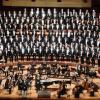
Stephen Schwartz views the San Francisco Gay Men’s Chorus as the picture of defiance — “which, as you know,” the songwriter said, “is one of my favorite words.”
“I had never seen a gay men’s chorus before. I walked into the rehearsal and there were 300 gay men onstage. Singing. With joy. And I burst into tears,” Schwartz recalled of his first encounter with the group ahead of their 2012 “Enchantingly Wicked” concert. “I do feel it is a political act, and a cultural act.”
Schwartz will reunite with the Chorus on April 17-18 at the Chan National Queer Arts Center for “The Songs + Stories of Stephen Schwartz.” At the piano, the three-time Oscar-winner, four-time Grammy-winner, and Songwriters Hall of Fame inductee will perform his own songs and share stories from his life in the arts.
Many know Schwartz as the composer and lyricist of the swankified, hit musical Wicked, but his legacy harkens back to the mid-1970’s when his Godspell, Pippin, and The Magic Show ran on Broadway simultaneously. These shows placed a 28-year-old Schwartz at the vanguard of a budding pop-rock musical theater movement.

Schwartz went on to renew and reshape the musical theater landscape. His oeuvre underscores the importance of embracing individuality and has changed many theater fans “for good” as a result.
“I’m certainly not trying to change the world, because if art could change the world, we’d live in a different world. But art can change individuals,” Schwartz said. “It certainly changed me.”
After making his name in the theater, Schwartz turned to film. He collaborated with Alan Menken on songs for Disney’s Pocahontas (1995), The Hunchback of Notre Dame (1996), and Enchanted (2007). By 2008, Schwartz earned a star on the Hollywood Walk of Fame.
The songwriter finally made his star turn onscreen in the first Wicked installment (2024) with a one-liner that stars Cynthia Erivo and Ariana Grande famously urged Bay Area director Jon M. Chu to include in the film.
This weekend, Schwartz and the Chorus will perform “Testimony,” a confessional choral piece that Schwartz wrote specifically for the Chorus in 2012. "Testimony" was inspired by “It Gets Better,” a global anti-bullying campaign launched by author and activist Dan Savage and his husband Terry Miller in response to suicides among LGBTQ+ youth — the project helped teens understand that their lives would improve.
“The song is a tapestry of my life,” a Chorus member said before the 2012 world premiere of “Testimony” at Davies Symphony Hall.
“It's one of the things that I've written in my life of which I am most proud, and it exists because of the San Francisco Gay Men’s Chorus,” Schwartz said. “Now, it's been performed all over the place.”
That sense of gratitude extends to the ensemble’s leader.
At the end of this season, Chris Verdugo will step down as CEO of the Chorus after 10 years in the role. Schwartz and Verdugo are good friends, having met when Verdugo worked for the Gay Men’s Chorus of Los Angeles more than a decade ago.
“I really felt a desire to be part of his last season,” Schwartz said. “It’s my way of saying thank you to him.”
SF Classical Voice spoke with Schwartz ahead of his upcoming engagement with the SF Gay Men’s Chorus.

Q: Let’s start with a very serious question. During “One Short Day” in the first Wicked movie, you delivered the most important line of the show, “The Wizard will see you now!” I bet you did some really intense character work to inform that line reading.
A: Oh yes, of course. I had to. “The Wizard will see you now.”
Q: Interesting emphasis. A bold choice, in fact.
A: “The Wizard will see you now?”
Q: So many options! Do you consider the palace guard to be a gay icon?
A: Obviously yes. He has been since 1939. What was most important to me about the character was the mustache — I felt like everything was contained in the mustache. I do want you to know that when I went into hair and makeup, they were going to put a thinner mustache on me as a possibility.
Q: Horrifying.
A: Your response was exactly like mine. Absolutely not.
I now have an increased respect for movie actors. What you’re really worried about is hitting your mark. Your hand can't be too high or too low when you make a gesture because you have to stay within frame. You're pretending to look at something that's not there, and while you're doing that a giant boom camera is coming towards you and looks exactly as if it's going to hit you in the head. But you can't even have a flick of your eye over to look at the giant boom camera. So, the truth is that I did the line about four times, and I had no idea what I said.
Q: Could you share more about why you're excited to collaborate with the Chorus?
A: This is a historically significant organization. [Founded in 1978 as the world’s first openly gay chorus,] it was formed during the Harvey Milk time as an act of defiance. They chose to come together as a group and openly, with confidence and joy, sing.
Maybe there have been some times over the course of the Chorus's history, particularly in San Francisco, where the bravery and significance of that act got taken for granted. But don't forget, this is a group that did the Lavender Tour [a string of performances at high schools in the Deep South in the wake of rising anti-LGBTQ sentiments after Donald Trump’s 2016 presidential win].
They probably saved lives. That’s not a metaphor. They probably literally saved some kids from killing themselves. So, this is an organization for which I have enormous admiration.
Q: You are going to join the Chorus onstage. How do you approach performing your own works?
A: I figure that people understand they're not going to hear the finest singer in the world. That's not my billing. I just try to be relaxed, keep the whole thing very casual, and tell myself this is going to be fun and informative.
There's a certain insight you get from hearing the writer perform, especially if you’re not accustomed to hearing [the song] performed by the songwriter. I think there's something interesting about the phrasing, and where the songwriter might take some license, and where they won't.
I do like there to be a quote “definitive version” that shows my intention when I wrote the song. But after that, I feel it's up for grabs… Sondheim, to my knowledge, did not feel that way. He wanted you to sing exactly what he wrote.

Q: Broadway’s Michael McCorry Rose (A Gentleman’s Guide To Love and Murder, Wicked) and Taylor Iman Jones (Six, Groundhog Day) will be your guest soloists this weekend. What do you hope they bring to your material?
A: I expect them to make the songs their own. To tell the emotional story of the song, but through their own filters. You want an artist to bring an interpretation, otherwise they're just mechanical.
Q: The musical theater robot who can kick their face.
A: You don't want a musical theater robot. You want an actual flesh and blood human being [for whom] every performance is slightly different.
Q: Many people have fallen in love with musical theater thanks to Wicked. When was the moment you caught the theater bug?
A: It happened very, very early for me. I grew up on Long Island. Next door to us lived a composer, his name was George Kleinsinger. He'd had some success with concept albums, and one of them was being turned into a Broadway show called Shinbone Alley.
My parents and I would go next door from time to time, and George would play us what he was working on. I'm told, though I don't remember, that I would go over to the piano and try to play a little bit of what I'd heard. I was not bad at it, considering that I'd never played the piano. After a couple of times, George said, “I think you should get him some piano lessons.” So, my parents got a little upright piano.

A couple of years later, when his show briefly played on Broadway, [my parents] took me to see it. My fate was sealed.
Q: If you could step into the shoes of any of your characters, who would it be and why?
A: I have never been asked that before. I'm going to give you three answers.
My very first thought was Elphaba. She was a character that I got right away. As soon as I heard about the book, something was resonating for me with her. And of course it would be great to have magic, and certainly to fly.
My second answer is the character that was the most fun to write. This is not someone I’d want to be for long — Frollo, the villain in The Hunchback of Notre Dame. [While writing for the character], it was so interesting to briefly go to that dark side, to become a character who cannot see any fault in himself, who can only project what's rotten and perverse inside of him onto other people, and believe it of them.
[For] those of us who live with any degrees of guilt or shame or self-reproach, there's something exhilarating about being a character who simply cannot feel that. What does the world look like through eyes like that? I think I know, because I wrote it. But it would be interesting to have that knowledge from an internal point of view. Maybe it would make me understand some people more than I do.
My third answer for you: I think it would be good to be the Jesus who is in Godspell, who is so full of forgiveness and so able to accept the foibles of those around him without judgment and without anger, and to come to that with constant good humor. Someone who is living his life by “those words” — always treat others as you would have them treat you. That would be a good way to be able to live.
Of course, if we could live like that, then we wouldn't be human.
Q: Those are such interesting answers, because I feel like your selection encompasses the full spectrum of human experience.
A: Well, a lot of it, anyway.

Q: You are beloved by the queer community. How has the LGBTQ+ community influenced or inspired your compositions?
A: I always come to everything from the point of view of someone who is a bit outside. That's what I write about over and over and over again — someone who feels him or herself outside the mainstream of society. I think [that is] the experience for anyone in the queer community, but it's not limited to the LGBTQ community.
Anyone who experiences him or herself in that way starts with an initial longing to belong. When they're young, [they have] to go through a process of coming to terms with not fitting in. There's such an urge to want to change, to want to be what other people want you to be. But the question is, at what cost to yourself? Elphaba finally sings, “If that's love, it comes at much too high a cost.”
I think that's a lesson that all of us, if we're lucky, will learn. And then we go from there.
This story is provided in partnership with the San Francisco Chronicle.