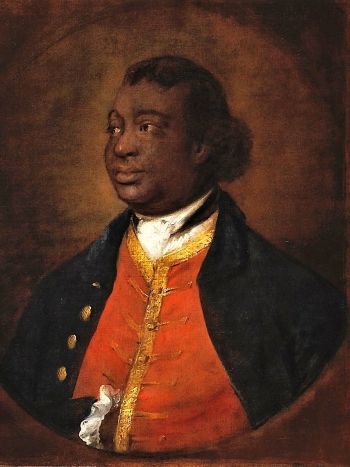
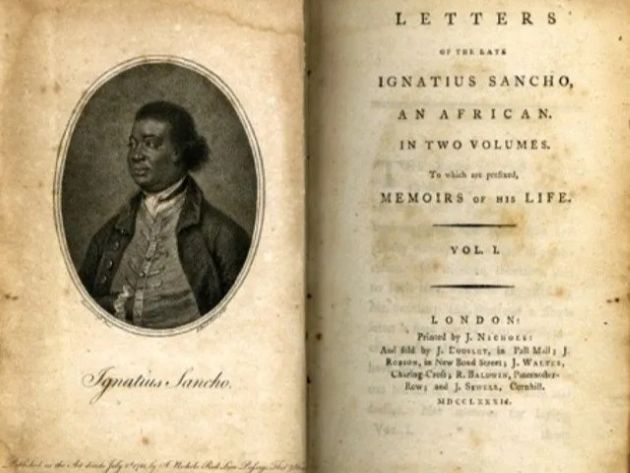
The man in the portrait looks every bit the refined English gentleman. Gold buttons down a dark jacket, with a rich red waistcoat beneath, and one hand tucked inside. A flash of white lace at his collar. And above it all, one arched brow. Unquestionably, he belongs here.
Yet this painting — and this man’s career — are highly improbable.
This is Ignatius Sancho. A Black man born into slavery in 1729, he went on to become a celebrated writer, abolitionist, playwright, and businessman in 18th-century London, as well as one of the earliest known Black Britons to vote in a British election. Sancho was also a composer, and the first person of African descent in Europe to publish his music.
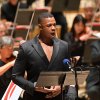
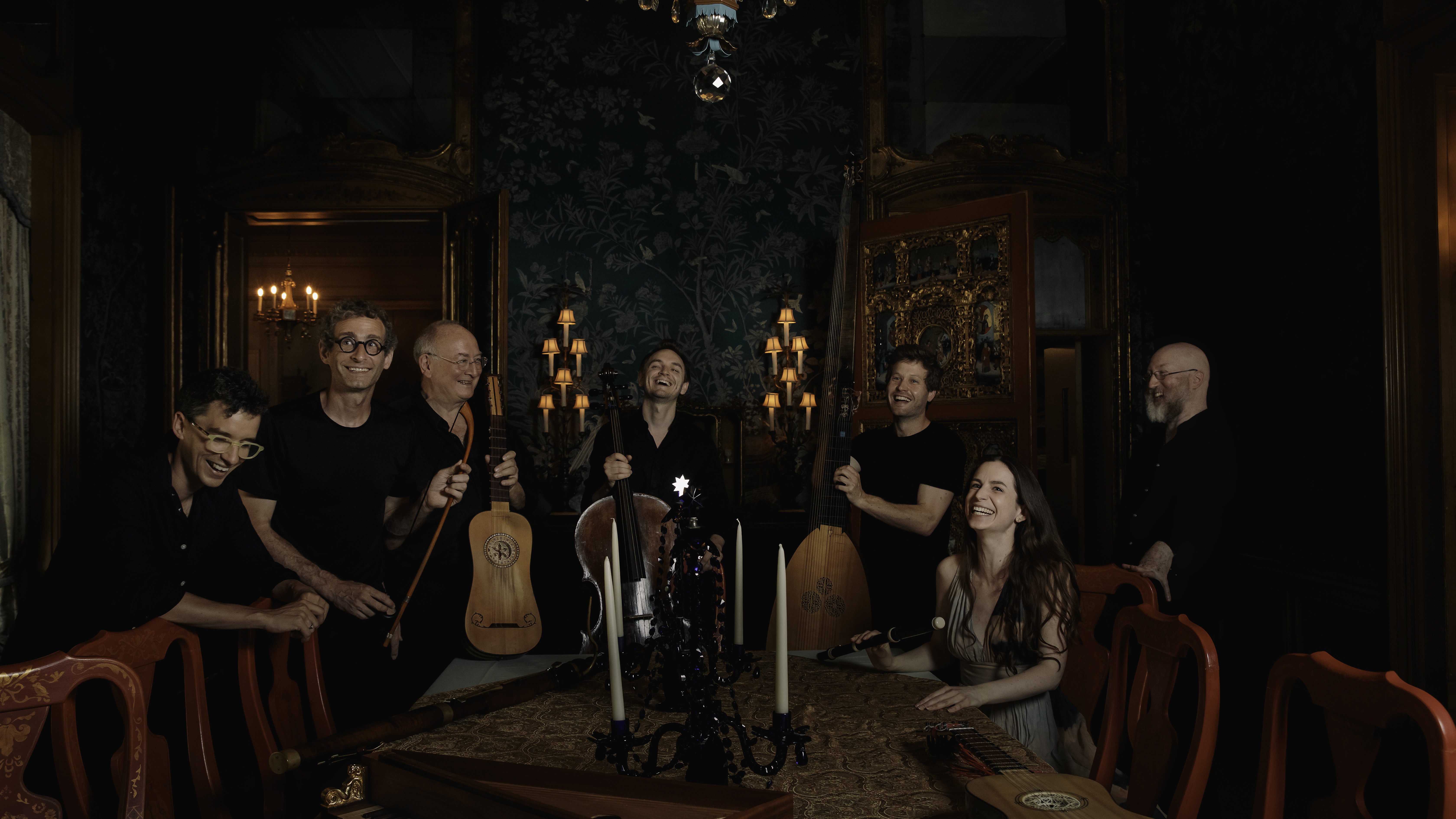
Sancho’s portrait is currently featured in Gainsborough: The Fashion of Portraiture at the Frick Collection in New York. The exhibition explores the role of fashion and portraiture in British society. The portrait is the only one by the renowned painter Thomas Gainsborough depicting a Black sitter. On April 19, the Frick will present the music of the man in the portrait alongside works by George Frideric Handel in a program performed by the Baroque band Ruckus, countertenor Reginald Mobley, flutist Emi Ferguson, and violinist Rachell Ellen Wong.
It’s unlikely that Sancho and Handel, both 18th-century composers working in London, ever met, but their work is in natural conversation. Mobley points out that “these are two men who, through completely different circumstances, became Britons. They were both men on the inside from the outside.” From Sancho’s letters, we know that he admired Handel, 44 years his senior and the dominant musical figure of the age. They shared a patron in John Montagu, the 2nd Duke of Montagu, who oversaw King George II’s commission of Handel’s Music for the Royal Fireworks (1749) — and who hired a water taxi to ferry Sancho across the Thames to attend the performance. And both wrote dances for the ballrooms, taverns, and gardens of London.
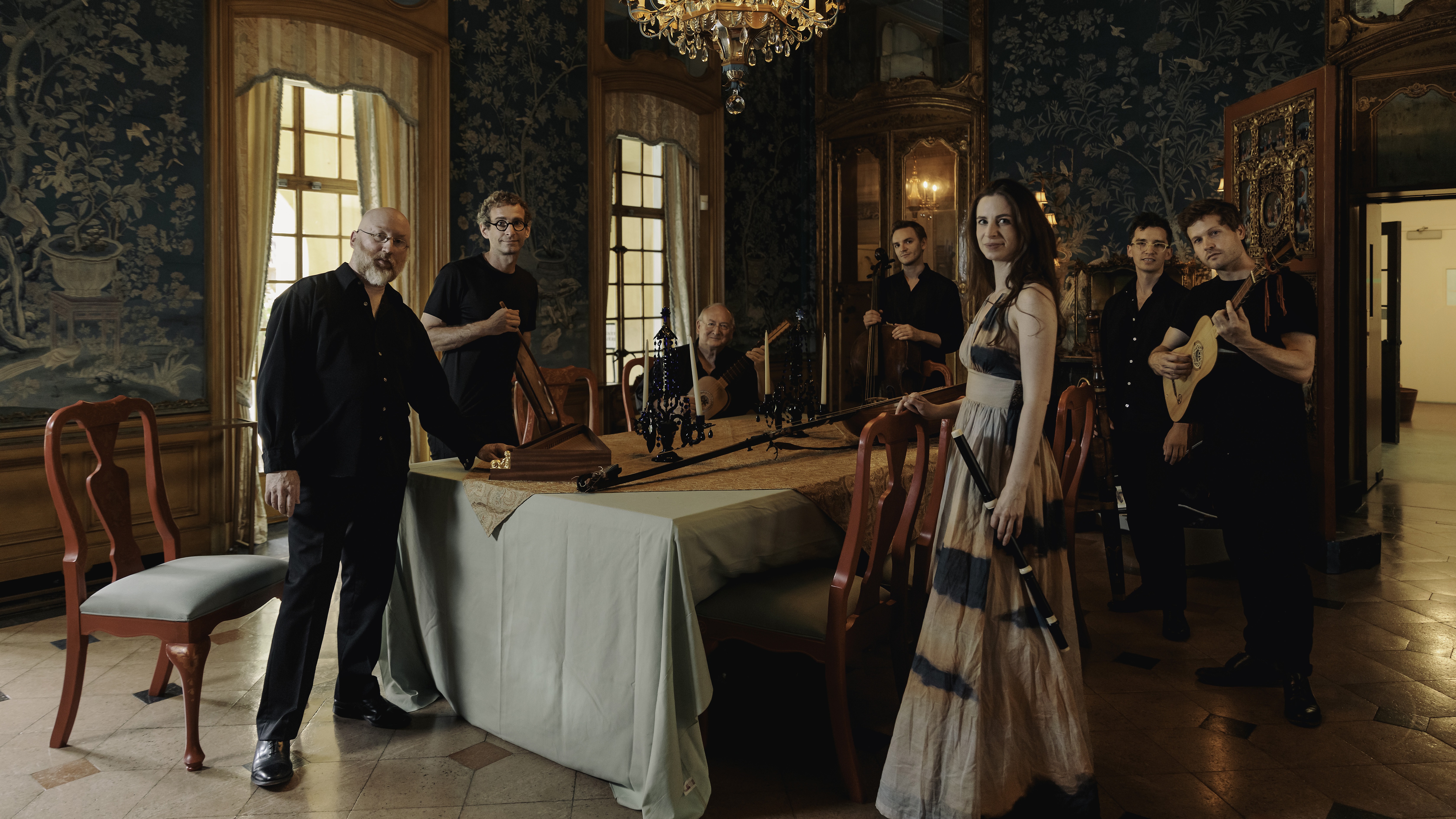
The Frick presentation grew out of Ruckus’s deep immersion in English country dance, a tradition that touched every stratum of society. Flutist and frequent Ruckus collaborator Emi Ferguson — co-author of the illustrated children’s book Iconic Composers, which features Sancho — introduced Sancho’s music to Clay Zeller-Townson, baroque bassoonist, Ruckus’s founder and artistic director. As soon as he saw Sancho’s 12 Country Dances, Zeller-Townson says, “it was a lightning bolt situation, because they are clearly meant for us to play.”
As an early music band with rock-star energy, Ruckus builds its arrangements through improvisation; Sancho’s dances, rarely for the time, feature both melody and harmony, providing both the foundation and freedom to improvise. The 12 Country Dances also espouse a joy central to the band’s ethos. Their titles and characters evoke the people, places, and even desserts of Sancho’s world: Bushy Park, Trip to Dillington, Strawberries and Cream. “The Duchess of Devonshire seemed to have been a party gal, and that’s definitely in the music — more than Lady Mary Montagu, who seems quite refined,” Zeller-Townson says, adding, “Come for the Handel, stay for the Sancho.”
In both composers’ music, Ruckus balances two sides: rustic and elegant. “When a piece wants to be elegant, we let it be elegant. But there are moments when we emphasize Handel as having a messier, fiery energy, and emphasizing the elegance in Sancho, too. Both composers get equal weight of refined and rustic, because they both have it in them,” Zeller-Townson says. “It’s what Ruckus is always looking for: ways that we can make 18th-century music feel homey rather than just elegant.”
The program alternates between Sancho “sets” — 12 Country Dances, interspersed with selections from his single surviving book of vocal music, Collection of New Songs — and Handel trios, with each Sancho section built to match the scale of a Handel trio. If any reminder were needed that these are functional dances, Sancho wrote choreography for each one, right there in the score.
Mobley, a leading Sancho scholar and champion for diversity in music, joins Ruckus to give voice to the songs, which draw on texts by poets including Shakespeare and David Garrick. Each evokes its own style and character, Mobley notes, but all are rooted in the dance rhythms that pervade Sancho’s music. Change instruments, eras, and tempi, and still “the spirit of dance never fades.”
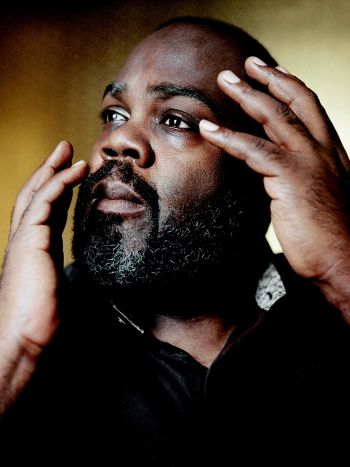
Mobley spearheads the CounterTenor Project, a research initiative funded by the United Kingdom’s Arts and Humanities Research Council to uncover composers from underrepresented backgrounds, with Sancho as a central focus. When first learning about Sancho nearly 20 years ago, Mobley says, “I felt a connection and a commonality that made him a hero, and a cause.” Performing Sancho’s music “feels more of an invocation than a performance.”
Sancho’s story began on a slave ship. He was born sailing from Guinea to the Spanish West Indies, where his mother died of disease, and his father escaped slavery via suicide. At the age of two, Sancho was taken to London. He spent nearly 20 years as a domestic servant for three sisters, who gave him the demeaning name “Sancho” after Don Quixote’s comic servant Sancho Panza. He later wrote that the family “judged ignorance the best and only security for obedience”; in secret, and with the encouragement of the Duke of Montagu, a family friend, Sancho taught himself to read and write.
Sancho ultimately ran away to the Duchess of Montagu (the Duke had died), and toward self-determination. She employed him as a butler and further encouraged his education. (The Montagus likely commissioned the Gainsborough portrait in 1768 — Sancho himself would not have had the means.) In 1774, Sancho struck out on his own, opening a grocery store in Westminster that became a hub of social, political, and intellectual life.
Sancho’s many facets converge in his copious letters to friends, mentees, and public figures.
While never intended for public consumption, his correspondence was published posthumously as the two-volume Letters of the Late Ignatius Sancho, An African, and became an instant bestseller. The letters capture a devoted family man and bon vivant, written in a signature flowery style that belied his gregarious wit — and likely also performed respectability in white society.
But Sancho’s politesse coexisted with fierce opposition to slavery. In 1766, in his most oft-cited letter, he implored the English novelist Laurence Sterne to use his influence to help end the slave trade. At the Frick performance, Ferguson will read aloud excerpts from the first letter in Book 2, to a young friend, Jack Wingrave, his most vehement condemnation of slavery:
I say it is with reluctance, that I must observe your country’s conduct has been uniformly wicked in the East—West—Indies — and even on the coast of Guinea. —The grand object of English navigators — indeed of all Christian navigators — is money—money—money. ...
In Africa, the poor wretched natives — blessed with the most fertile and luxuriant soil — are rendered so much the more miserable for what Providence meant as a blessing: — the Christians’ abominable traffic for slaves — and the horrid cruelty and treachery of the petty Kings — encouraged by their Christian customers — who carry them strong liquors — to enflame their national madness — and powder — and bad fire-arms — to furnish them with the hellish means of killing and kidnapping.— But enough — it is a subject that sours my blood. ..."
Yet later in the same letter, he reached for grace:
"Make human nature thy study — wherever thou residest — whatever the religion — or the complexion — study their hearts. —Simplicity, kindness, and charity be thy guide."
Sancho’s abolitionist spirit shows up in his music too, though far more discreetly. As one example, the title of the 12th country dance, “Mungo’s Delight,” likely refers to the blackface character Mungo from the popular comic opera The Padlock. Black Britons ultimately adopted the term themselves, “in a kind of ‘flip the script’ way,” says Mobley. “That could have endeared it to him even more, since his own name of Sancho was given to him in a mocking way.”
The portrait, too, suggests a man of many layers. “I can see a person,” says Zeller-Townson. “We all know that eyebrow. ... ‘I see you. I see what you’re doing.’” Mobley, on the other hand, points to how Gainsborough captured Sancho’s insatiable curiosity and bright-eyed attentiveness. “There’s an energy behind the eyes that betrays an incredibly active mind,” he says. “He’s not looking toward, but he’s looking at!”