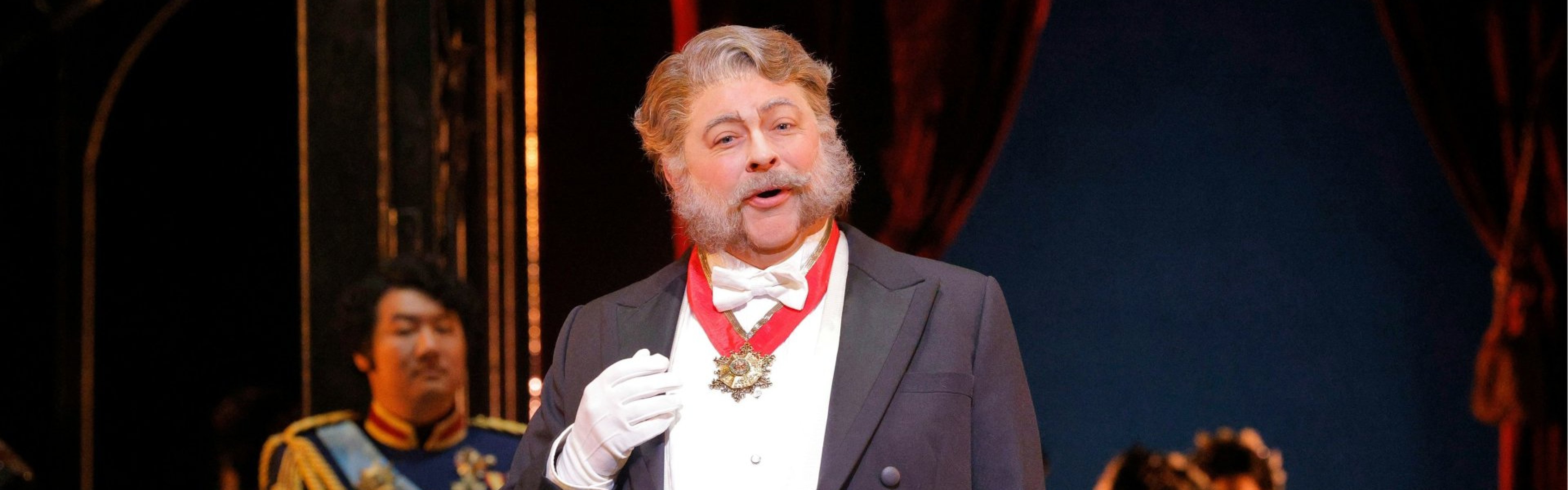
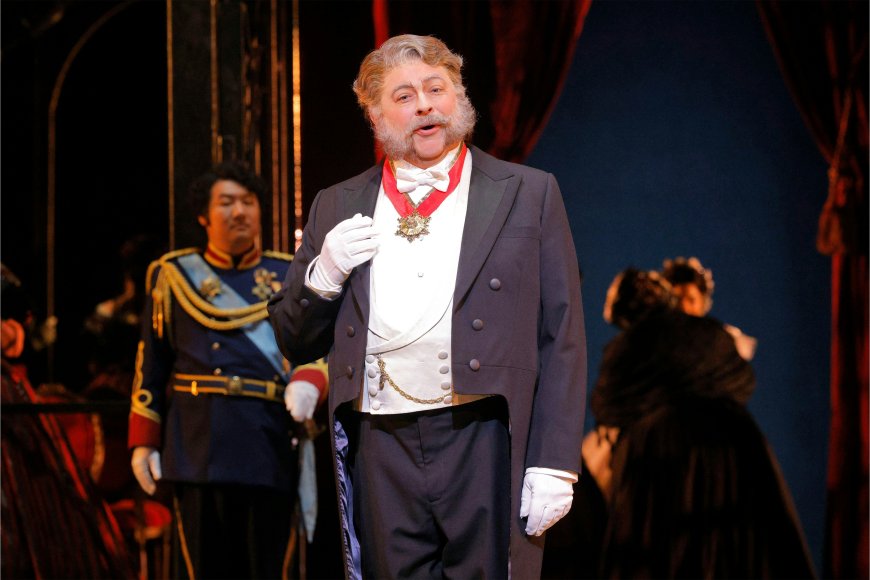
A Los Angeles Opera favorite, internationally acclaimed bass-baritone Craig Colclough has performed in more than a dozen roles with the company since making his debut in 2008 as Guccio in Giacomo Puccini’s Gianni Schicchi. Fans will be delighted, then, as Colclough takes the stage in another comic masterpiece, singing the titular role in Verdi’s Falstaff, which runs April 18 – May 10 at the Dorothy Chandler Pavilion.
Born in Claremont, California — where he still resides with his wife and three children — this native son initially studied as a cellist, while also acting in musicals in high school. He received his Master of Music degree through the University of Redlands Conservatory of Music, and began his career appearing in several roles with LA Opera before later training with Florida Grand Opera and Wolf Trap Opera. Indeed, during the 2020–2021 season, LA Opera awarded Colclough the Eva and Marc Stern Artist Award, recognizing his deep connection to the company.
Beyond Los Angeles, the singer made his Metropolitan Opera debut in Verdi’s Macbeth (2019), a role he’s also sung at Lyric Opera of Chicago, Bayerische Staatsoper, and Luxembourg Opera. He’s also performed Wagner roles in Europe.
In addition, the 44-year-old singer has collaborated with conductor Gustavo Dudamel for performances of Turandot with the Simón Bolívar Symphony Orchestra of Venezuela, and Beethoven’s Ninth Symphony with the Los Angeles Philharmonic.
SF Classical Voice spoke with Colclough by phone for a conversation that took a deep dive into Falstaff and the release of his first book.
You’re a hometown boy and LA Opera stalwart. So, how does performing in Los Angeles differ from singing anywhere else?
It’s been my dream ever since I was a kid; that’s the major difference. Getting to have all my friends and family come, and the many years of relationships that I’ve built with people at the company, in the administration, stage management, the music staff, and knowing everyone, it feels more like a home to me.
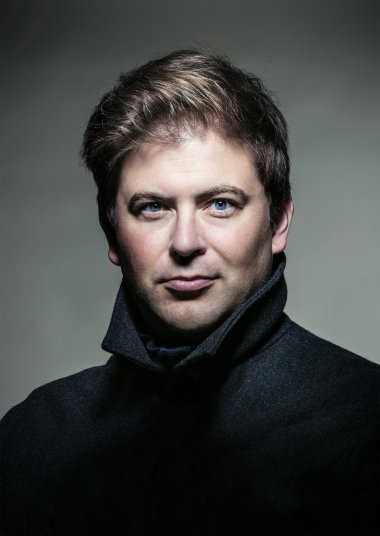
Your next role is Falstaff, the extravagant and, shall we say, rotund knight, one of opera’s great comic creations. What draws you to him and the opera?
There’s so much turmoil going on in the world right now that we are taking every opportunity we can to spark joy and spit in the face of depression as Falstaff does personally, and kind of thumb our noses at the decay of both the body and the world.
How does LA’s production differ from Christoph Waltz’s production that you starred in at Belgium’s Opera Vlaanderen? And have you worked with the director of LAO’s production, Shawna Lucey, or any of the other cast members before?
With Christoph, we were in a smaller European house, and our goal was to reduce the more stereotypical slapstick idea of Falstaff and bring to it an incredible sincerity. It was much more akin to film, and not about posturing or the commedia dell’arte format.
It was deeply sincere, which expanded my understanding of [the character], and also of the text. It was one of the best experiences, [and more like] being an actor within the musical theater world.
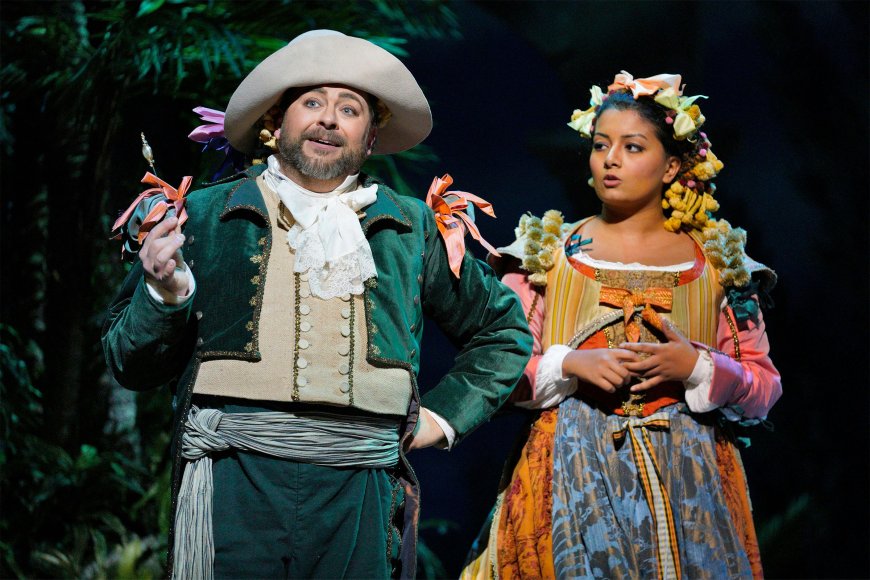
I have worked with Shawna before. She’s hilarious and a joy to work with personally, in addition to crafting a really buoyant production that’s full of bubbly, joyous energy. I did a Don Pasquale with Deanna Breiwick, who is our Nannetta, and this is the first I’ve worked with her in a long time.
[As for] Anthony León [Fenton], we did Don Giovanni together at LA Opera [2023], and he’s a wonderful rising star. Actually, my youngest child is named Fenton, so it is quite special to have such an angelic voice singing my favorite music. Everybody’s here with sincere intentions and is doing the art for the right reasons. The camaraderie of the ensemble is palpable.
What aspects of Falstaff’s personality resonate with you and which parts are the biggest stretch — and what about fat shaming, no pun intended?
What’s interesting is that there are people who mock his physicality, that mock his body type, but the thing I connect with most with Falstaff is that he is undeterred in his optimism. He is a force of nature for loving life, for loving himself, no matter what society says. Although there are parts of the text that are very mean, he actually is the force that counters that, and says, “You know what? Who I am is beautiful and my insanity, my rascally nature and the truth of myself, is valuable. The world continually tries to knock us down, and I’m the power that picks us back up. I’m the power that brings flavor to life.”
And he has a self-love that is deeply healthy. What do I connect with? That insistence on joy is something I work to bring, also with my personal mission as an artist — that the nurturing power of the art is part of my calling.
Even though he’s a rascal and gets into trouble and has certain foolish idiosyncrasies that I don’t share on a functional level, his unstoppable spirit is something that I insist upon for myself.
Verdi wrote this role late in his life, and with incredible nuance. What details in the score help you shape your interpretation?
He wrote every emotional turn with such articulate accuracy that he spells it out for you. I’m not a huge aria fan, because my original background was in acting, comedic improv, and musical theater, so my personal joy is the theatrical side. When a proper aria comes along, the actor part of you has to take a back seat to a pretty melody.
[But] what I love about Falstaff is everything that I say is directly instructing the feeling and the subtext, and he’s able to — like for most musical theater shows, even if the words are set beautifully — you have to write in your own subtext.
And the insanely brilliant thing about this score is that Verdi’s able to express the hidden words in the music itself, because so much of the text that we deliver is deceitful, or only a half truth, and the fact that he could write music that communicates that you are not being forthcoming, that is a multi-level nuance.
You’ve become known for your portrayals of complex, often dark characters like Baron Scarpia and Macbeth. How does stepping into a comedic role shift your artistic mindset?
Comedy is actually harder. It is more precise. Some people make the mistake that it arises out of charisma, but comedy is actually mathematic — in the preparation, the beat leading up to a joke, and then the landing of the joke. There is also more articulate craft that goes into comedy blocking, which is one of the reasons it’s incredibly helpful to have done comedic roles multiple times: you can take structural beats and things from one production to another, even though the production is being directed by another person.
Darker characters rely solely on the situation and the behavior that’s already written in the score. If you simply go through and be the horrible person that’s on the page, the audience is gonna go, “That’s horrible.” [With] comedy, you have to craft moments that bring about surprise and that counter expectations so that that magical, indescribable moment of giggles and laughter erupts sincerely for someone.
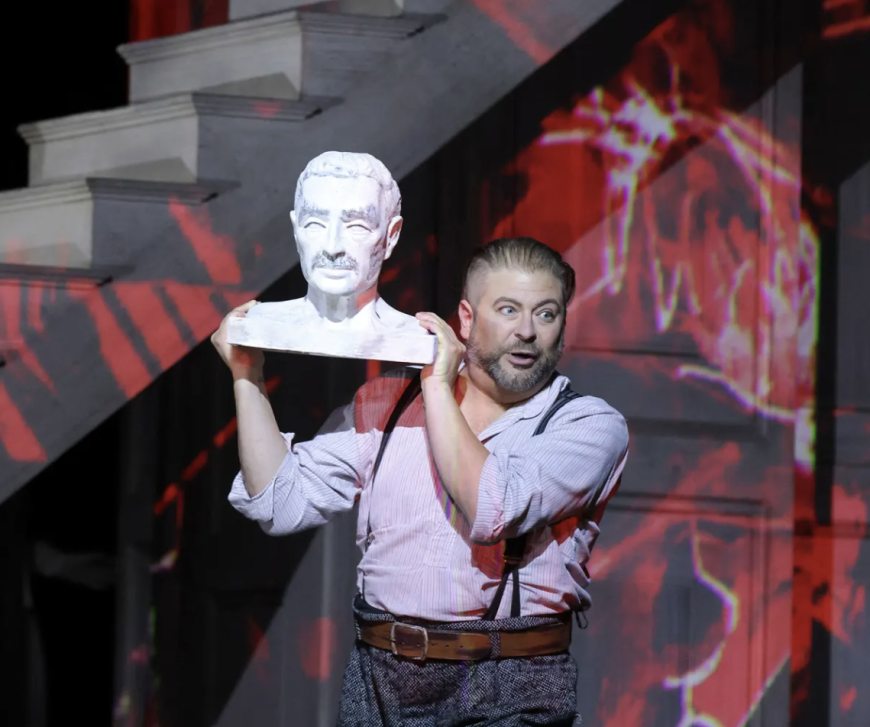
In addition to your fiendishly busy schedule, you’ve written a book, Classical Voice: The Theory of Everything, and you can also be heard on audiobooks reading B.R. O’Hagan’s Thomas Scoundrel series.
I had no intention of writing a book. It was not on my to-do list. But I found myself repeating [lessons] over and over to my students of any level — emerging, professional — that it suddenly clicked. I’ve discovered a description of what we are doing and a way of explaining it within our resonators that other people do not teach. I’d been developing this theory for years and this book poured out of me in two months.
For the audiobooks, B.R. O’Hagan engaged me for a six-book historical fiction series. The books are incredibly detailed and action-packed, [with] so many accents and characters I have had to research.
Well, you speak plenty of languages in opera! Seriously, Craig, what are your thoughts on the state of opera today?
I think it is poised in a very optimal position, as artificial intelligence is rendering everything we see online questionable. As people become more exhausted with the artificial, it’s had its heyday, [and] CGI has reached a place that’s [sometimes] indistinguishable from reality.
I firmly believe that there’s going to be a backlash from people who are sick of nauseating fakeness, that suddenly theater has a new opportunity and a new place to claim authenticity. [So] come and experience the human voice and theater that hits your body physically from one person to another. I think the hunger for that is going to reignite the art form.