My first exposure to David Byrne occurred in a car with my parents. I recall feeling pure confusion upon hearing the eclectic musician’s lyrics, “This is not my beautiful house / this is not my beautiful wife.” It was not until much later that I realized confusion is a central part of the David Byrne experience.
The 73-year-old Talking Heads frontman took to the stage at Stanford’s Frost Amphitheater last Thursday, the latest stop on his “Who Is the Sky?” tour. Most audience members were my parents’ age — early sixties — and loudly sang along to hits like “Once in a Lifetime.”
I was a little nervous to attend the show. Could a performer I’d mostly encountered through my parents’ nostalgia hold up against my own expectations? Luckily, the magic of Byrne lies in his presence — he has a complete, almost childlike absorption in his music that invites listeners to grow accustomed to the unfamiliar. Byrne’s enthusiasm was contagious — the crowed easily picked it up, and so did I.

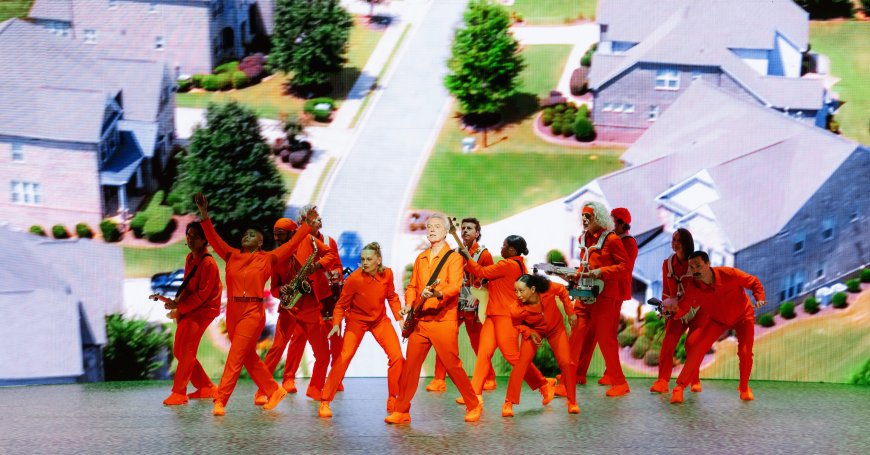
The concert opened with “Heaven,” a song from Talking Heads’ third studio album, Fear of Music. Byrne and his musicians wore bright orange astronaut-like outfits and shoes that glowed. The show’s excellent graphic design utilized three screens surrounding the performers to place them in outer space. The largest central panel showed Earth from a distance.
As he finished the song, Byrne turned around to look at the planet. “There she is. As seen on T.V. a few days ago. Our heaven. The only one we know.”
This remark was met with cheers from the crowd, which grew stronger as the concert became increasingly political.
Byrne’s new song “T Shirt,” released in late 2025, stood out as a satirical, politically salient piece. The catchy, upbeat song was written alongside producer Brian Eno, a longtime Talking Heads collaborator, as a commentary on how people often fail to effectively communicate with each other beyond pithy slogans.
Byrne and his band drew applause from the audience when certain catchphrases were projected. The loudest reactions came after “Make America Gay Again,” “No Kings,” and “I love Stanford” — ironically proving the song’s point, that we gravitate toward overly simplistic expressions of identity and expression to find community.
Byrne oscillated between songs from the band and songs from his solo career, and ultimately rewarded longtime fans with an encore of “Burning Down the House.”
What particularly struck me about the show as a whole was its fluidity and interconnectedness.
The drummers consistently interacted with the dancers, often joining in movement despite their limited mobility. The movement, mostly choreographed with room for individual artistic expression, was woven into the video projection. Byrne often joined in the dancing as well, creating the feel of a unified community onstage rather than a star and his backup performers.
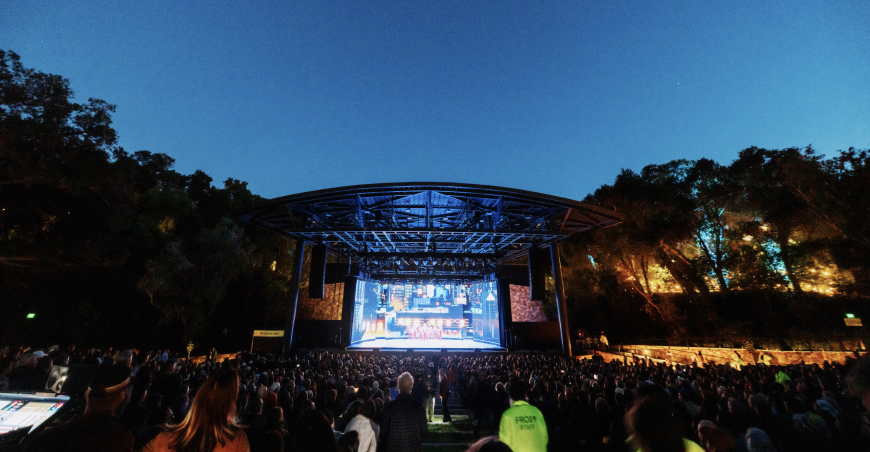
The audience clearly felt this closeness. When Byrne introduced a song, he spoke as if talking to an old friend in his living room, leaving space for spectators to respond with affirmations or reactions to his jokes.
There is something almost radical, in 2026, about a performer who asks nothing of his audience except their full attention — and earns it. By the encore, the “Who Is the Sky?” tour had made its case: that joy can be collective, that confusion can be a doorway rather than a wall, and that a stage full of people moving together invites its audience in.
I came to Frost Amphitheater as a secondhand fan, inheriting David Byrne from my parents. I left having claimed him for myself.