“Am I really living on the edge? Or am I playing it too safe?”
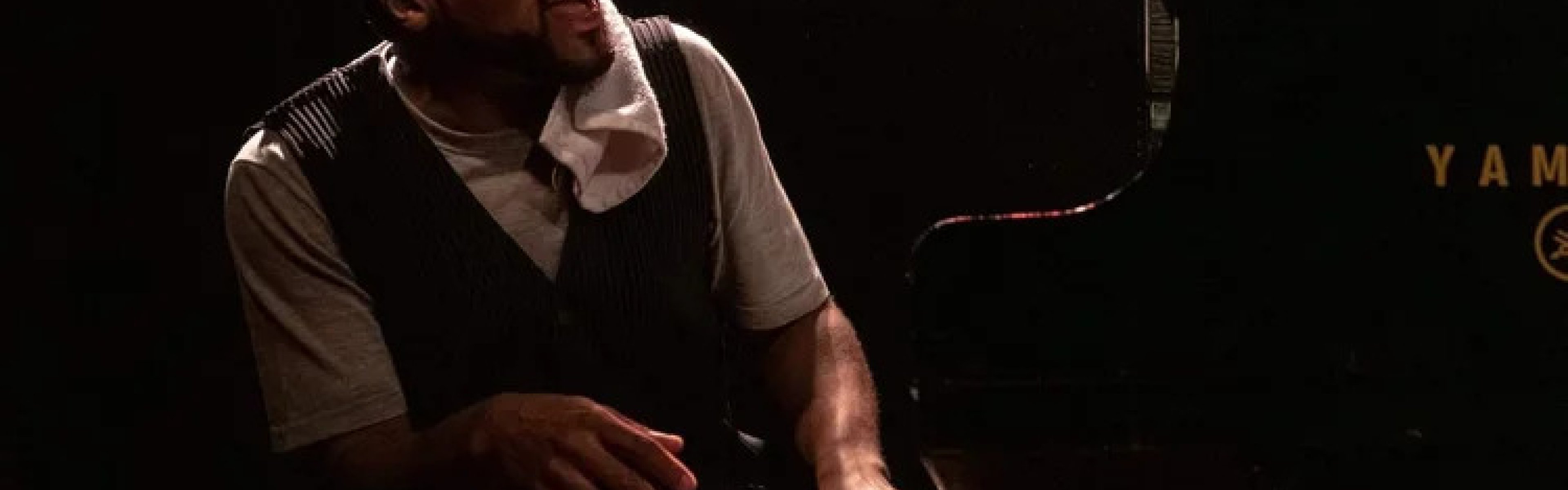
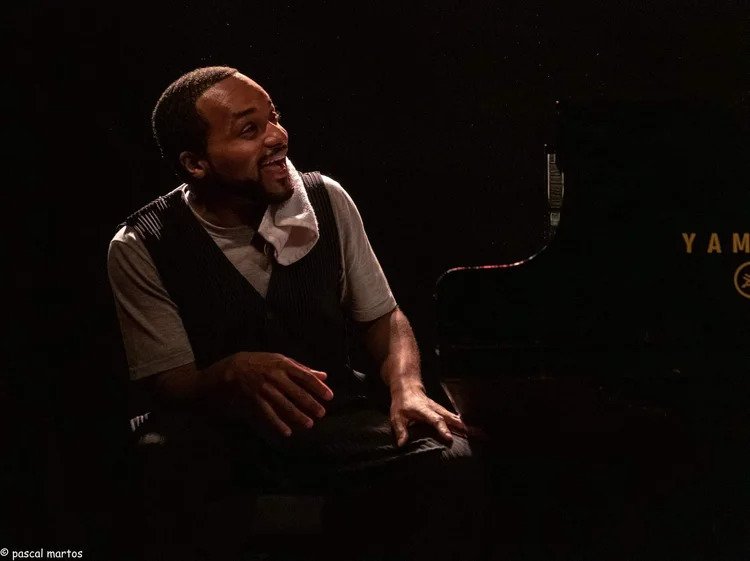
Sullivan Fortner, Jr. posed these questions a year ago in a master class organized by fellow jazz pianist Joe Warner at Geoffrey’s Inner Circle in Oakland. Most of the assembled keyboard enthusiasts were well aware that Fortner, now 39, has lived and played safely and successfully within a panoply of different genres. In the process, he has won or shared three Grammys and glamouring audiences with his flexibility and ingenuity.
Fortner was raised by a musical New Orleans family, who had him playing organ in churches throughout the city by age nine. He studied at the New Orleans Center for Creative Arts while also attending McDonogh 35 College Preparatory High School, where he graduated as valedictorian. He went on to bachelor’s and master’s degrees in jazz performance from Oberlin Conservatory and the Manhattan School of Music, respectively.
The late Roy Hargrove employed Fortner from 2010 to 2017, during which period the pianist also studied with Barry Harris and won the 2015 American Piano Awards’ Cole Porter Fellowship. Fortner has recorded and toured repeatedly with singer Cécile McLorin Salvant in recent years, appearing with her locally at SFJAZZ and Cal Performances.
He is set to return to SFJAZZ with his trio — including Kayvon Gordon on drums and Tyrone Allen II on bass — on April 25, and they’ll perform at Bach Dancing & Dynamite in Half Moon Bay on April 26 and at the Kuumbwa Jazz Center in Santa Cruz on April 27. Fortner spoke with SFCV from his New York home.
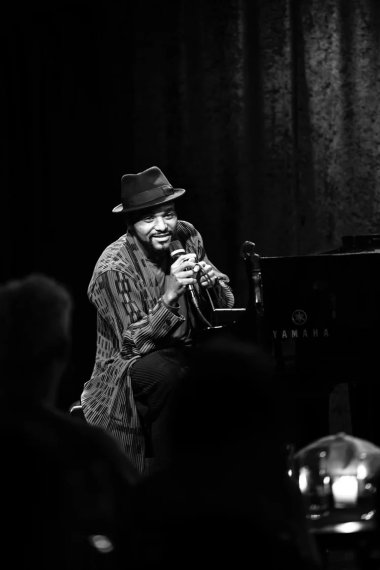
I attended your master class last May during your stint at SFJAZZ with Cécile, and I got a glimpse of how you work the theatricality you share with her, even on “safe” songs from the American songbook.
Cécile can take a song that a lot of people normally do and make you see something different. She’s one of the age’s best storytellers. And that’s something I’m trying to translate to piano playing. It’s the whole etiquette of having your whole body be involved and invested in everything you play, not just playing a note and leaving it.
There’s a whole choreography involved in piano playing . . . having your hands close to the keyboard and allowing your body to kind of be inside the sound — not just your hands, but your whole body. Classical musicians have to do that all the time.
Does some of that spirit date back to your days in the church?
Yeah, absolutely. There’s a whole lot of drama and spirit in church. I grew up in the Missionary Baptist Church, and Mom would sit next to me at the organ and sing and act out the chords, so to speak — smiling for major chords, making a sad face for minor chords, and turning her head to the side and contorting her face if it was a diminished chord. I learned how to play music through body language. And there’s a certain type of expression that comes out of that, whether it be crying, or shouting, or screaming, sometimes people in a state of ecstasy, where they start speaking in tongues.
And that’s still with you.
Yeah. And I’ve been playing at the Concord Baptist Church of Christ in Brooklyn ever since I moved to New York in 2008.
At the master class, talking about the dynamics of the keyboard, you cited Beethoven and Robert Schumann. Did you have a lot of classical company at Oberlin?
We didn’t do a whole lot of intermingling. But we did have to take theory, ear training, and composition, which were tied in with the classical department. So, I got familiar with the sonata form and fugues a little bit. And they had a very strong vocal department, so I would sit in the back and just watch Marilyn Horne or Thomas Hampson give master classes.
That’s my appreciation of singing, the acting and the story. And with playing, we have to understand the importance of lineage and syntax. There’s a way of saying things with a certain type of intention that has been passed on, not just from our jazz greats, but from Palestrina and Bach, all the way up through 21st Century music. And I do play Bach every morning.
Outside of the academy, what did you learn from Barry Harris?
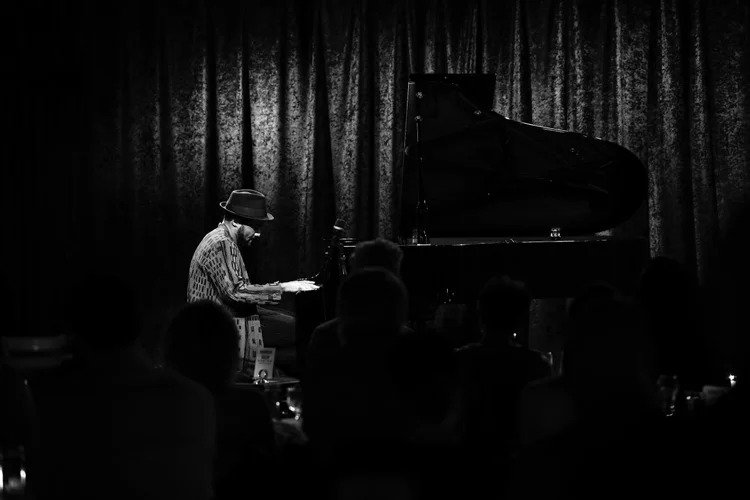
I was with Barry from 2011 until he died in 2021. When I wasn’t on the road, on a Tuesday night, I was at his class, or in his house. It was partly the history unto itself, all the stories, him studying with Bud Powell, and living with Thelonious Monk, priceless stuff. And there was his whole concept of harmony — scalar movement, moving from a six to a diminished chord. I remember asking him, how do you play in slow tempos, and he said, “Well, fast is slow.”
Are you finding your place in that legacy?
Not so much. If I could just get a crumb or a speck of whatever Barry or Duke Ellington or Nat King Cole or Bud Powell or Fats Waller or Art Tatum knew, I’d be alright.
On the list of whom you’ve served as sideman to, I noticed Paul Simon. How was that relationship?
He was one of the most patient people I’ve ever met. He’s one of those people who can say, look, if I hate it, I’m going to tell you, but then we’re going to sit together and we’re going to figure out why. I remember working on one song with him for eight hours.
When I last saw you with Cécile, two months ago, you’d just won a Grammy for Best Jazz Instrumental Album for Southern Nights [Artwork Records]. We might assume that the title tune was a nod to its songwriter, Allen Toussaint, and to your hometown of New Orleans, but that’s not all.
The album is basically the result of a week I did at the Village Vanguard with Marcus Gilmore and Peter Washington, probably my second time as a leader there. Cécile had this idea, why don’t you just record this. But the Vanguard wouldn’t allow me to do that, so we decided to get a studio, Sear Sound, right in the middle of our week. We recorded in the same room, no isolation, no editing, maybe we used the first take on most of the tracks, and that was it.
What about the sequence of the tracks?
We recorded the set as we played it [at the Vanguard]. And from my time with Roy Hargrove, his sets were very similar to this. He would start with something a little grooving, then go upstairs a little bit and do something faster, then come back down with maybe a waltz and a straight eight tune, maybe an original. The middle of the set would be the ballad. And then he would climb back upstairs and close out with something medium. I organized my set the way Roy would, so it’s kind of like my tribute to him.
Beautiful! I loved what Roy did; we lost him much too soon. What will you be exploring next? I’ve heard you have a choral family album on deck.
Yeah, but I haven’t written for it yet. I come from a family of singers, so there’ll be some arrangements of spirituals. Maybe a choir of 40 — mom, sisters, aunts, uncles, cousins, nephews, and so on. We might record it around the holidays in New Orleans, but it wouldn’t be out till 2028. I have a a pair of albums coming out with the trio, Kayvon and Tyrone. One, fingers crossed, in August of this year, kind of revisiting my solo album. And a Village Vanguard album that will be out in June of next year, with some [Georges] Bizet and [Gabriel] Fauré, but also some stuff by Bob Hurst, Duke Ellington, and some blues. And I’m writing a string quartet, commissioned by the Owls.
Have you ever composed in a chamber format?
Not at all. Never. This is a brand-new adventure. And this is my first commission.
Are you boning up on your classical chops?
I’m getting ready to get back into some counterpoint lessons. Any type of situation where I’m learning, it really excites me. Like right now, I’m learning (George) Gershwin’s Rhapsody in Blue, which I’ll be doing with the Atlanta Symphony in October. There’s so much I’m learning with that, from a compositional standpoint and from a pianistic standpoint. You learn about your instrument and about the people you’re making the music with. And maybe they can learn something about me.