
“Middle East” is certainly a misnomer; a name left over from a world in which Europe was the origin and reference point. “Near East,” the sometimes-offered alternative, doesn’t exactly fix the problem. How to actually describe — let alone name — this part of the world, whose history and culture are as diverse as they are old? Leave it to the San Francisco-based Qadim Ensemble to offer an answer. In an April 18 program that stretched from Iberia to Yemen to North Africa, the Qadim Ensemble adventurously mixed sounds and styles, drawing worlds together not in a clash but in harmony.
The program, titled “Wandering Dove — An Offering of Hebrew and Arabic Song,” centered music and poetry that featured the dove: a multifaceted symbol, across cultures, of the soul, peace, and a longing for home. But it was a piece without doves that showcased the Qadim Ensemble’s potent musical alchemy.
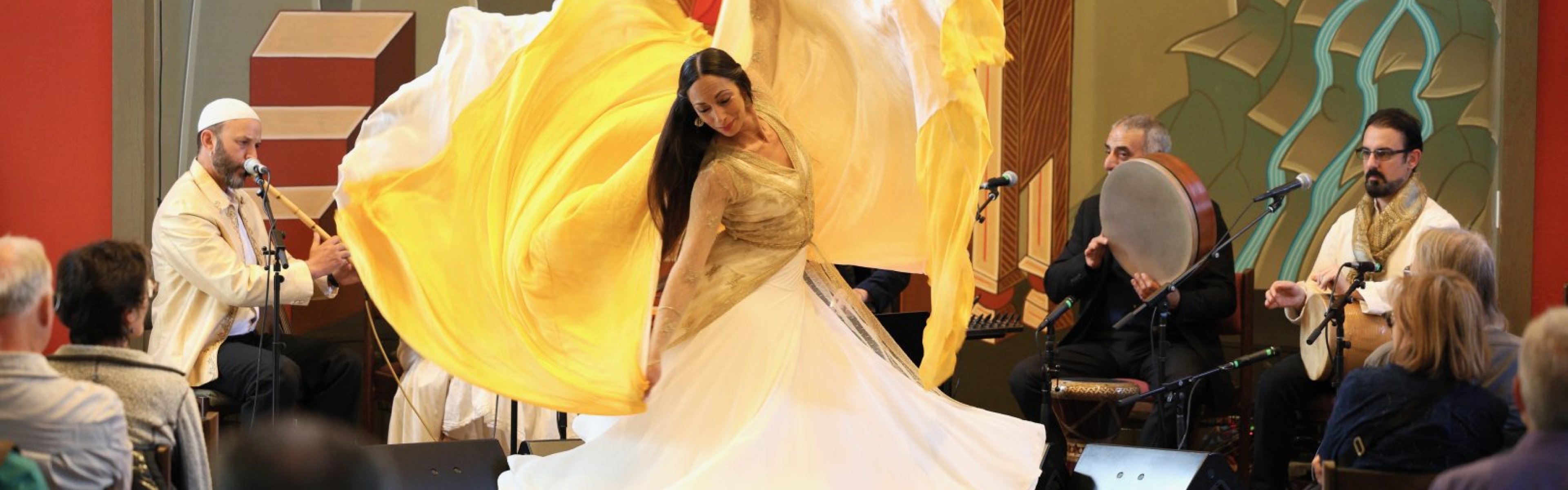
Istanbul Nights is a 2010 composition by Eliyahu Sills, one of the founders of the ensemble. It has a familiar form: a refrain separated by long solo sections for different instruments. But this description barely captures its magic. It opened with a ruminative, shifting song played by Sills on the ney, a reed flute (and one of the oldest instruments still played today). Soon, the tempo picked up, and the rest of the ensemble joined in with the refrain: a Turkish-style folk melody, whose mixed and changing meters kept it teetering on the edge of a sprint. This refrain was broken up by long solo sections for individual instruments: the ney again; the qanun, a zither whose 76 strings span microtones not included in Western scales; the darbukkah, a goblet drum used across the ancient world; and the zarb, a smaller Iranian goblet drum.

The combination of solos and ensemble playing was the Qadim Ensemble at its best, providing room for individual talents and styles while also showing how seamlessly they combined.
To really appreciate this feat, you have to know a bit about the maqam, a musical system central to the the Middle East and parts of North Africa. The maqam is like a Western musical mode, insofar as it establishes the pitches for the music. But it does a lot more: it contains short phrases, which serve as the building blocks for the music’s melody and ornamentation. The musician is responsible for combining and interpreting these fragments. So, the maqam is like a set of tools; the performer does not simply read this music but builds it in real time and alongside others.
The Qadim Ensemble showed just how much complexity and feeling is made possible by this music. The medley “Mi Nishagani/Ya Rait W’allah” paired two traditional Yemenite melodies: one, a lively ode to a beloved, the second, a melancholy plea for protection. Rachel Valfer, who offered reflections on the idea of home in between pieces, conveyed this introspection in her singing, which toggled between the two seamlessly. (Miriam Peretz offered counterpoint in dance, incorporating Sufi whirling in a mesmerizing performance.) “Ya Rait W’allah” was Paris’s feature: on the qanun (certainly the harmonic foundation of the ensemble), he played with such ease that it was impossible to believe he was manipulating so many strings.
The Qadim Ensemble’s ability to meld so many musical traditions is no surprise. They are all experts, drawing on experience in genres from across the world. Sills and Valfer studied Middle Eastern musics from Istanbul to Palestine to New York before joining the Berkeley musical group Za’atar, where they met, married, and cofounded the Qadim Ensemble. The other members, Faisal Zedan, Amir Etemadzadeh, Peretz, and guest star Ali Paris, add even more dimensions, drawing on musical training from Syria, Morocco, Israel, and Iran. (Berkeley should be proud: Valfer and Peretz are Berkeley natives and stars of the musical community.)
Only one thing bugged me: When the Qadim Ensemble played a medley of songs, one from Algeria in 1973 and the other a Moroccan melody from the 16th century, the transition was as smooth as everything else on the program. But I wondered, shouldn’t the two pieces, four hundred-plus years apart, sound more … different? I longed for something other than the sound of the whole ensemble: a solo piece, maybe, or smaller combinations of the instruments (like the thrilling percussion duet in Istanbul Nights).

If the program demonstrated the fluidity of style and culture, this sameness risked flattening these worlds. There is a certain inevitability to this, given the number of instrumentalists and the nature of their collaboration. But, given the sheer talent present in the Qadim Ensemble, there’s no question that we might hear even more in their music, even if it already contains multitudes.