Curated and hosted by composer, violinist, and vocalist Gabriella Smith, Tuesday evening’s Green Umbrella program cast Disney Hall into an exploratory and theatrical sonic environment. Palm fronds rustled beside amplified cactus, a solo bassoonist appeared in the organ loft, and the thunderous resonance of bass drums sent shockwaves through the entirety of the auditorium, vibrating through seats and bodies alike.
Smith engaged the audience with warm anecdotes and good-humored explanations. Introducing John Cage’s Branches, she referred to the composer’s text score as “beautifully illegible” — an entirely accurate description. Smith’s commitment to foregrounding environmental themes and ecological listening in her music feels both admirable and compelling, a fruitful avenue of artistic inquiry that continues to produce genuinely surprising work. Her sonic curiosity and aesthetic openness have already led to artistic success in works like Carrot Revolution, Tumblebird Contrails, and her collaborations with the adventurous LA-based string ensemble Delirium Musicum.
Michael Gordon’s 2bd, written for LA Phil Principal Percussionist Matthew Howard, opened the evening with a minimalist aesthetic built from subtle changes and deliberate formal trajectories. The dynamic range stretched from the barest whisper to auditorium-shaking intensity that only an instrument like the bass drum can truly achieve. The audience did not so much hear the drum as physically feel its shockwaves moving through the hall. There was something deeply satisfying about the embodied motion of Howard’s performance — the right-left-right-left choreography of arms dancing above the instrument unleashing massive waves of sound.
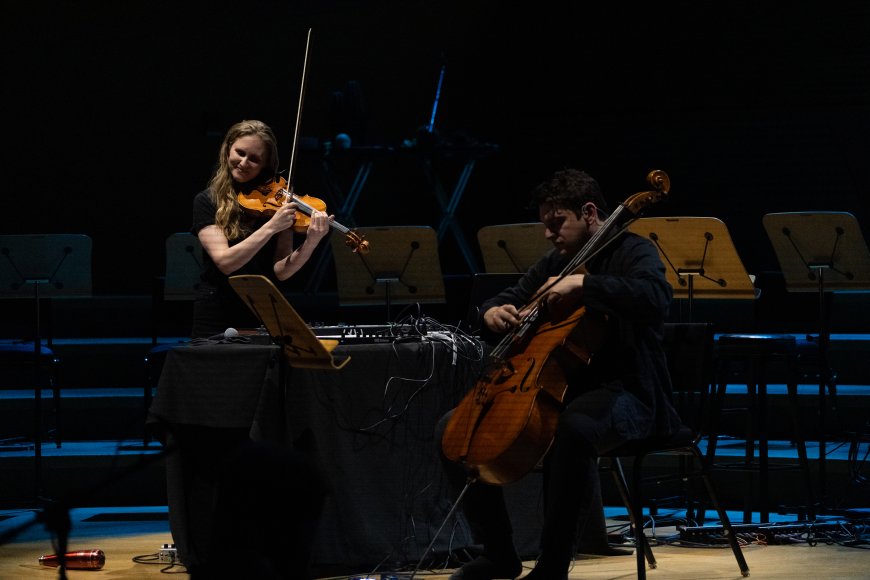
The evening’s central collaboration, Duos, by Smith and cellist Gabriel Cabezas, occupied gently liminal terrain. The longtime collaborators layered violin, cello, vocals, electronics, and prerecorded tracks into densely kaleidoscopic textures. The most rewarding parts to witness were the in-between moments: a kind of environmental tension and release created through texture, density, and timbral transformation.
Still, I found myself longing for more melody and narrative. There were many intriguing musical ideas that, given space to develop, could have become something singular instead of dissolving just as they began to generate dramatic momentum. New elements layered atop one another, but didn’t always accumulate into a larger sense of direction. That said, the textures Smith and Cabezas created were often beautiful, compelling, and immersive — a fascinating hybrid of concert hall experimentalism and ambient dance-club atmosphere.
Esa-Pekka Salonen’s Vignette for Bassoon provided a mercurial, hyperkinetic contrast: a pyrotechnically off-kilter, delightfully extemporaneous soliloquy that showcased bassoonist Evan Kuhlmann’s remarkable clarity, technique, and range from the instrument’s lowest rumbles to its highest stratospheric register.
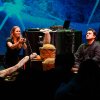
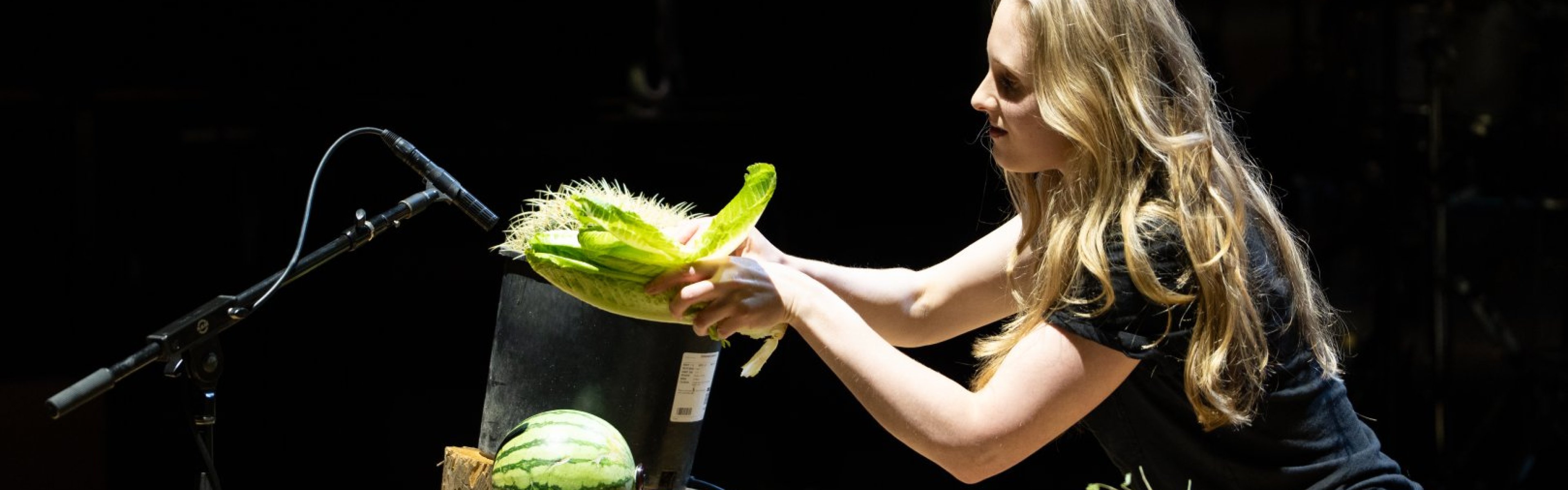
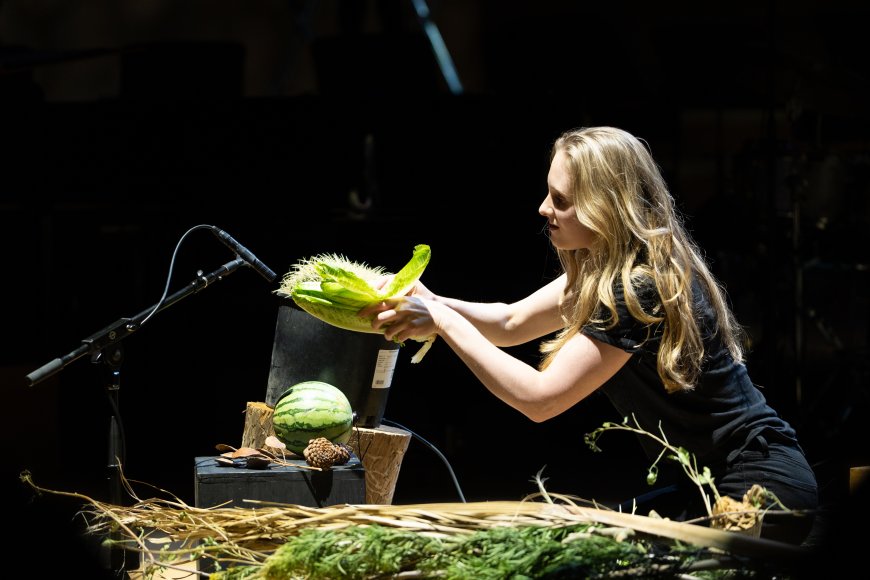
John Cage’s Branches followed, with seven performers in dramatic array around the front of the hall, surrounded by tables of organic instruments — palm fronds, sticks, gourds, rattling seed pods, and, as Smith quipped, “everyone’s favorite instrument,” the amplified cactus (yes, you read that right). The work occupied an intriguing space between the improvisational and the theatrical. Some stretches lost dramatic focus, an unavoidable result of experimentalist vitality. But moments of rustling counterpoint and confluence revealed emergent structures with Cage’s characteristic eye-twinkle.
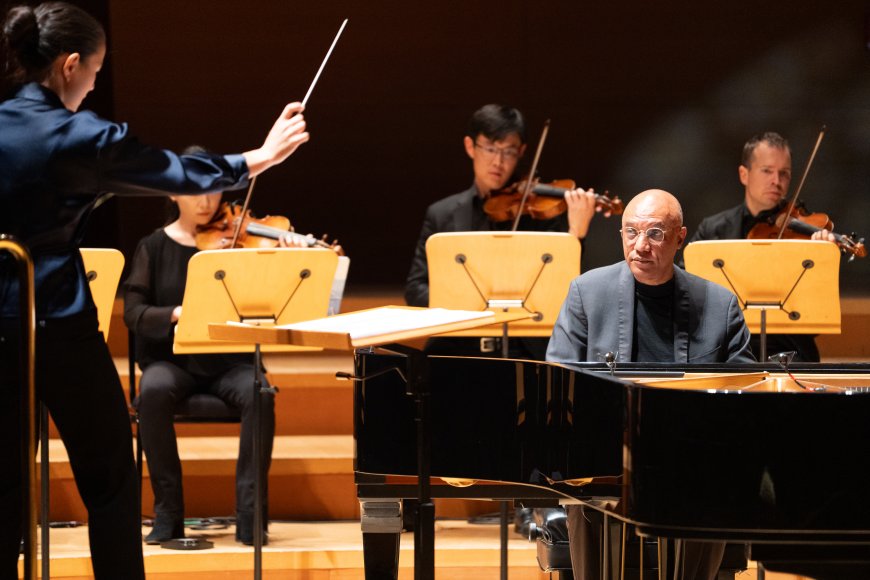
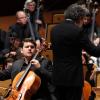
The evening found its clearest synthesis in Billy Childs’s My Roots Spread Far and Wide. Conducted with crisp kinetic precision by Molly Turner, the work fused the telepathic interplay of Childs, bassist Dan “Chimy” Chmielinski, and drummer Christian Euman with shimmering, ricocheting gestures in the strings. Childs’s writing was joyfully, viscerally engaging. Small fluttering ideas bounced around the ensemble with delightful panoramic effect, at times evoking contemporary textural writing, at others, the lush jazz and disco string writing of the 1970s. Heads bobbed appreciatively throughout the hall.
Smith’s closing work, 25, ended the evening in a dazzling-yet-brief blur of exuberance. Overall, the concert offered a night of experimentation, risk-taking, and sonic exploration, driven by curiosity.