Walking into Monk Space for Brightwork’s monthly Tuesday night residency is like coming home. A warm smile greets you and directs you to the small-but-charming courtyard where refreshments are served before the show.
The feeling is casual and cozy, a result of Brightwork newmusic’s commitment to making all music more accessible, paired with Monk Space’s dedication to providing a welcoming space for creative exploration. And so, the atmosphere tends toward the casual. The sounds of easy, muted chatter bubble up in the room right up until the moment the lights dim and the first performers take the stage.
This Tuesday’s program featured works by composers from across North America and the Pacific. The March 17 concert featured works by Raven Chacon, Jerod Impichchaachaaha’ Tate, Brent Michael Davids, Connor Chee, Leilehua Lanzilotti, and Jack Langdon. The concert’s title, “From The Americas,” points to a multiplicity of Indigenous voices within the continents, each grounded in relationships to land, community, language, and history, and each making music that invites the listener to encounter those perspectives.
Raven Chacon is a Pulitzer Prize-winning Diné (Navajo) composer, performer, and installation artist from Fort Defiance, Arizona, known for creating work that engages with the cultural and political realities of Indigenous life in the United States. His artistic practice explores relationships among sound, space, and people, often through works that collaboratively engage performers and environments.
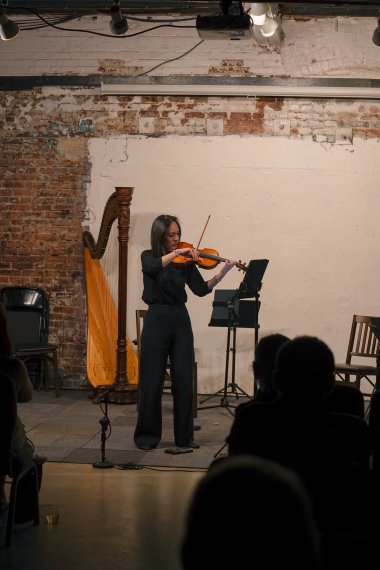
His piece “Journey of the Horizontal People” opened the concert with a sonic travelogue of a people “traveling from west to east, across the written page, contrary to the movement of the sun.” Its story is told through the vivid evocation of what those people might have heard during their wandering: kinfolk, nature, and the massive sound of the land itself. Masterfully wrought textures in the performance replaced any sense of traditional harmony and created an immersive experience for listeners.
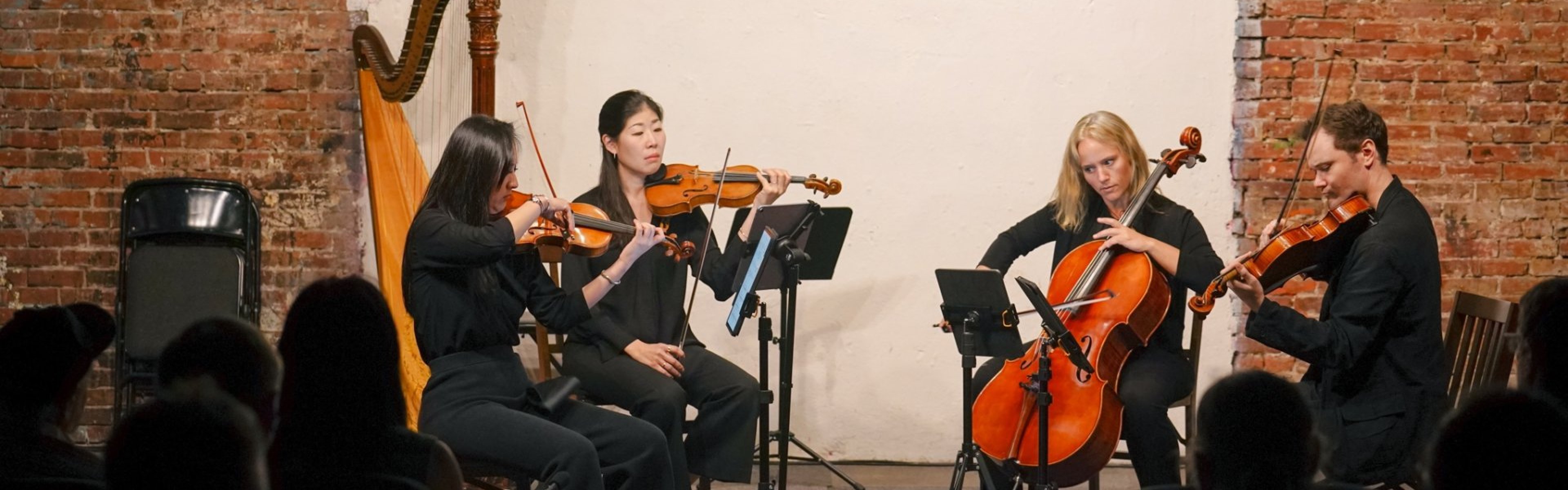
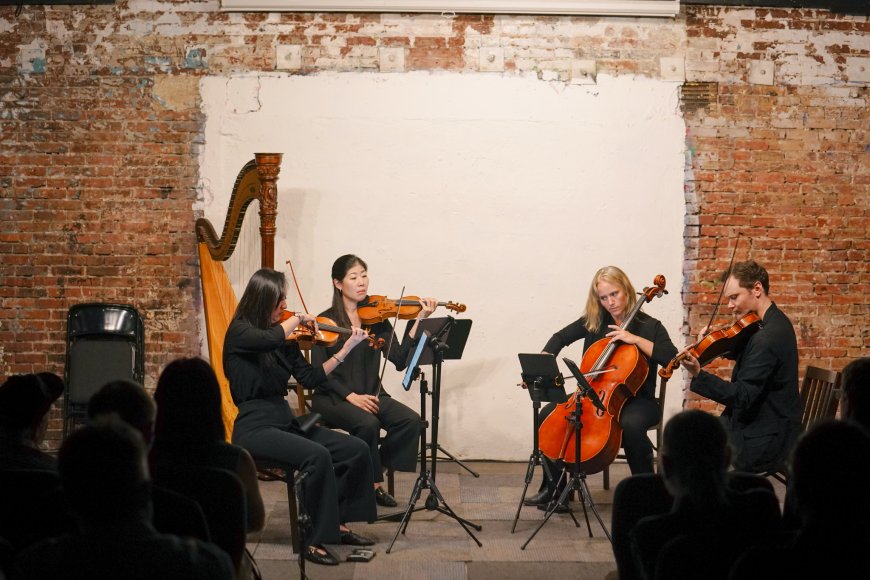
Leilehua Lanzilotti is a Kanaka Maoli (Hawaiian) composer, violist, and interdisciplinary artist. Their work explores ideas of time and memory through sound. Lanzilotti’s composition “ahupuaʻa” welcomed the audience into an unhurried space of delicate gestures from the string quartet featuring violinists Mona Tian and Ji Young An, violist Carson Rick, and cellist Mia Barcia-Colombo.
There is patience and joy in Lanzilotti’s work. Textures build and recede; the most sparing melodies slowly dance about one another. The score and the nuanced performances by the quartet gave the impression of slow, meditative breath.
Brent Michael Davids’s “Wood that Sings” for solo violin closed out the concert’s first half with propulsion and Paganini-esque brilliance. The piece was both hypnotic in its repetition and exciting in its trajectory — no small feat for a solo violin work. Davids describes himself as “an experimenter at heart,” someone “walking in non-Mohican society as a professional composer… yet carrying the heart of Indigenous song.” Davids’s music offers a clear window into what that means for an artist engaging in that kind of hybridity.
Connor Chee is a Navajo composer and pianist who is also active as an educator and guest artist. His work is inspired by traditional Navajo stories, beliefs, chants, and songs, and reflects a commitment to sharing Navajo culture through music. His “Three Vocables” were originally written for piano, but were here arranged for solo harp and harp-cello duet. The triptych was simplicity itself, beautifully conceived and executed. Its melodies and harmonies were elegantly spare, encouraging the audience, through repetition, to revel in the music’s humanity and subtlety. Here Barcia-Colombo was joined by harpist Alison Bjorkedal, whose technique gave clarity to every musical gesture.
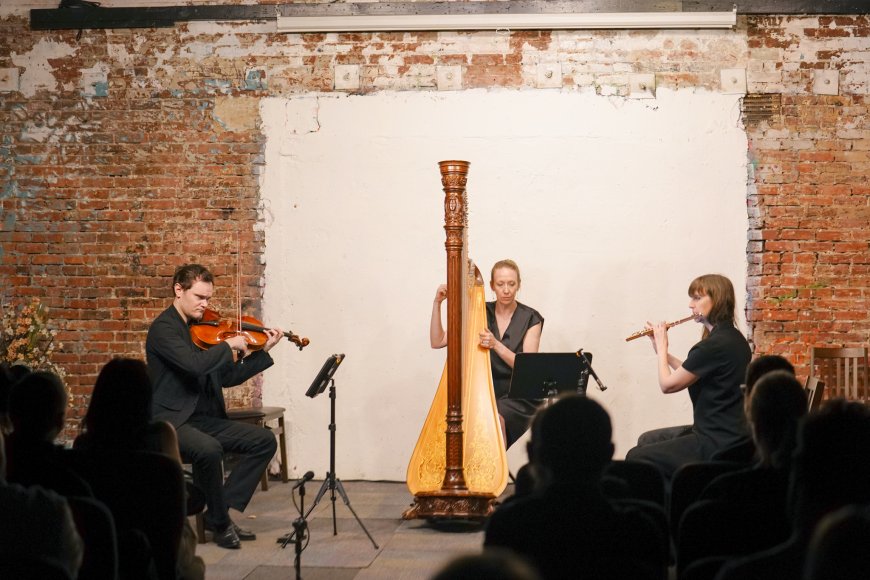
Jack Langdon is a musician, filmmaker, writer, and citizen of the Sault Ste. Marie Tribe of Chippewa Indians. His work moves across music, film, and writing, often bringing these practices into close dialogue. His contribution to the program, “Fish Laying Egg in a Circle,” joined flautist Rachel Beetz with Rick and Bjorkedal in a gently unfolding piece. Like Leilehua Lanzilotti’s work in the first half, Langdon’s work offered a space to meditate on gentle juxtaposition as it slowly gathered its diaphanous musical materials, allowed them to momentarily gel into chords, then gently pulled them apart once more to finish.
Jerod Impichchaachaaha’ Tate’s “Pisachi (Reveal)” closed the evening with surging momentum. Tate is a composer and citizen of the Chickasaw Nation, born in Norman, Oklahoma. His work is dedicated to the development of American Indian classical composition and draws directly on Chickasaw culture, language, and musical traditions. Here, Tate also honored “his Southwest Indian cousins” with references to Hopi Buffalo Dance and Hopi Elk Dance music. The string quartet was the perfect counterweight to Raven Chacon’s opener. It began like the rising sun slowly revealing the landscape below before growing to an incandescent finale.
It’s a small thing, maybe. To be welcomed into a space, and then into the music itself, without pretense or pressure — a room, a gathering, a way of listening. Brightwork understands this, and builds its evenings around it, from the first greeting at the door to the final notes on stage.