
As a journalist who covers the arts, I have written many stories about the healing power of music. Numerous scientific studies suggest listening to music can benefit everyone from recovering surgical patients to the chronically depressed.
But the past few painful months have brought this truth home to me in an intensely visceral way.
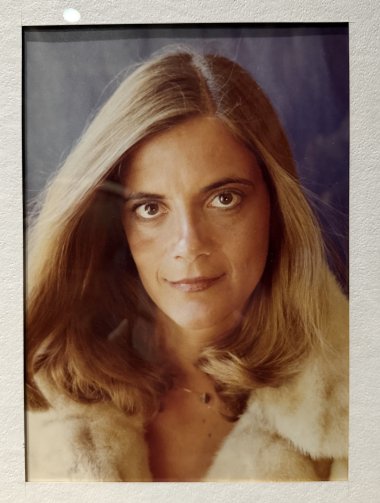
On February 15th, Genie, my romantic partner of 38 years, died of breast cancer. She was an amateur pianist with a great ear who regularly attended concerts with me until her Multiple Sclerosis severely restricted her ability to walk. We continued to happily share concerts on YouTube, including the Chopin Competition from Warsaw this past fall. She had definite opinions about the performances, which did not always align with those of the judges.
I recall with special fondness a trip we took together to Walt Disney Concert Hall many years ago to hear one of her favorite pieces, Deryck Cooke’s realization of Gustav Mahler’s unfinished 10th Symphony. There’s a solo flute melody towards the beginning of the final movement she always found particularly moving, and I’m glad she got to hear it live in that amazing hall.
As her death grew nearer — she opted for hospice care at home, so she could enjoy familiar surroundings to the very end — I naturally turned to music for solace. First came the Requiems: the well-known Mozart (another of her best-loved pieces), the powerful Brahms, the subtle but exquisite Fauré and Duruflé.
The music was beautiful, but the texts offered little comfort. Although I was raised Catholic, I have been a devout agnostic since high school. Singing of heavenly rewards means little when you don’t believe in the Christian version of the afterlife.
Next, I turned to orchestral works that are haunted by death: Benjamin Britten’s Sinfonia da Requiem, in which the composer honored his late parents, and John Corigliano’s First Symphony, in which he mourns for the victims of AIDS. Their deep sadness (and, in Corigliano’s case, anger) more effectively hit home.
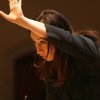
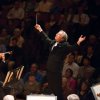
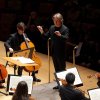
When I made arrangements to hear Simone Young and the Los Angeles Philharmonic perform Olivier Messiaen’s massive Turangalîla Symphony April 12th, I was not thinking in terms of mourning. I just wanted to hear that strange but stunning piece live for the first time.
But as it turns out, the work spoke directly and immediately to me as a grieving person, mirroring my turbulent emotional state to an almost terrifying degree.
I was tipped off that this might happen during the pre-concert lecture by Kristi Brown-Montesano, a musicologist from UCLA. She noted that Messiaen was obsessed with the Tristan and Isolde myth, which, according to Messiaen, depicts “a love that transcends the body and spirit and extends to the cosmos.” Like Wagner, he was attempting to depict that romantic-era ideal in musical form.
Of greater interest to me, however, was her disclosure that Messiaen was forced to put his beloved wife into a nursing home due to early-onset dementia while he was writing the piece in the late-1940s. Like me, he had essentially lost the person he thought would be his life partner.
I realize Turangalîla isn’t about that painful experience. But how could his writing not have been impacted by this enormous change in his life? (Many years later, after his first wife’s death, the composer remarried, which suggests that as fascinated as he was by Tristan, he wasn’t willing to personally take on the role.)
In his review of the concert, my friend Rick Ginell correctly noted that the nearly 80-minute work is, at one point or another, “ecstatic, noisy, libidinous, complex, deeply meditative, visionary.” Given how much Turangalîla encompasses, different listeners can connect with it in radically different ways. I ended up hearing the piece through a very personal lens, but one I think the composer would understand.
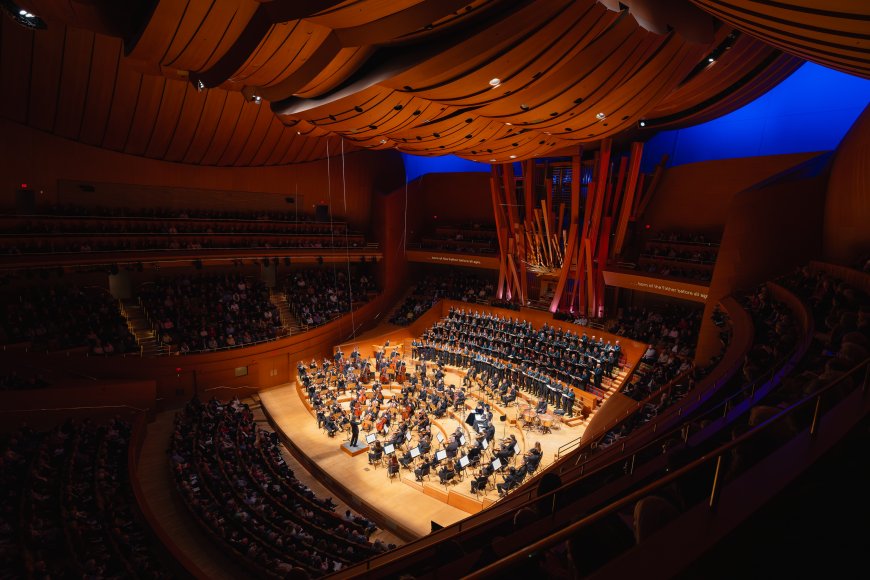
Messiaen called the loud, insistent motif blasted by the brass to kick off the work the “statue theme,” explaining it conveys “the heavy, terrifying brutality of old Mexican monuments.” In Disney Hall, where thundering outbursts are heard with crystal clarity, I felt the terrifying brutality, all right. But to me, these sounds signified the finality of death. “Her life is over,” the music declared. “That door is closed forever.”
That fierce proclamation recurs at various points in the piece, which felt right to me emotionally. To the surviving partner, denial inevitably kicks in — as painful as it is, there is a need to be reawakened to this horrible reality again and again before it fully sinks in.
Between those bursts, the work features a lot of creative cacophony. Sharp dissonances are frequent, but a love theme is threaded through all the shattering sounds of the huge, percussion-heavy orchestra.
Perhaps Messiaen was thinking of Tristan and Isolde; perhaps he was thinking about pianist Yvonne Loriod, who would eventually become wife number two. But the tender music said something else entirely to me: Even amidst the emotional turbulence of dealing with death, love lives on — transformed, but real.
Having my own churning emotions echoed back to me in this way was a stunning experience, one that, perhaps paradoxically, lifted me out of my own pain for a time. Catharsis was the last thing I expected going in, but it’s precisely what I experienced.
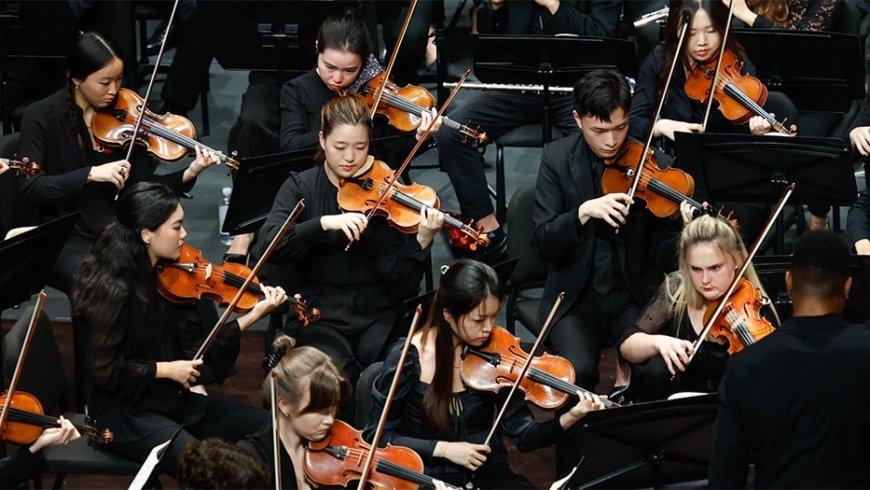
Exactly one week later, I heard the Colburn Orchestra, conducted by Yehuda Gilad, perform an equally expansive but far more conservative 20th-century masterwork: Sergei Rachmaninoff’s Second Symphony. The hour-long piece is full of sweeping, melancholy melodies, as beautiful as they are haunting, so I was not surprised to find my eyes welling with tears more than once.
Yet again, my inner emotional state was mirrored in the music, only this time, it was expressing the deep sadness that underlies my confusion and dislocation. I found it difficult to breathe on the walk out to the car, but in time, a welcome peacefulness settled in.
Although it’s hard not to feel alone in situations like this, the young musicians’ fine performance left me feeling connected to something universal and deeply human. There is great comfort in that. Words often feel inadequate in times of suffering, but music breaks through.
As fans of these two great works know, the final movements of each are quite joyful. While I normally find each ending satisfying, this time I found myself yearning for something different.
From the books I am reading and the wise people I am talking to, the goal of the grieving process is a kind of internal integration. You never “get over” your late loved one. Why would you want to? Rather, in time you fully accept that she is no longer with us, and that she now lives inside you, since your heart and mind were inevitably shaped by your time together. You move forward with your life in a way that acknowledges this internal change and honors her memory.
For me, the perfect ending of a musical work for the grieving would be one in which sad sounds can still be heard, but they no longer dominate. Rather, they are woven into the music, suggesting there’s hope for hard-fought serenity.
Belatedly, it occurred to me that Mahler was the master of that sort of emotional fluidity and nuance. Back home, I pulled out a recording of his 10th Symphony and put on the final movement.
There it was: The heartache, the acceptance, the peace. Genie had shown me the way to what I needed.
Then again, she always did.