Gerald Barry’s Salome grabs you by the lapels and unapologetically yanks you into a fever dream of vocal pyrotechnics, humor, deconstructed narrative, typewriters, desire, Oscar Wilde, Johann Strauss II’s “The Blue Danube,” and murder. It brings absurdity and tragedy so close that the distinction between them is lost. This is a work obsessed with defying expectation at every turn, to great dramatic and comedic effect.
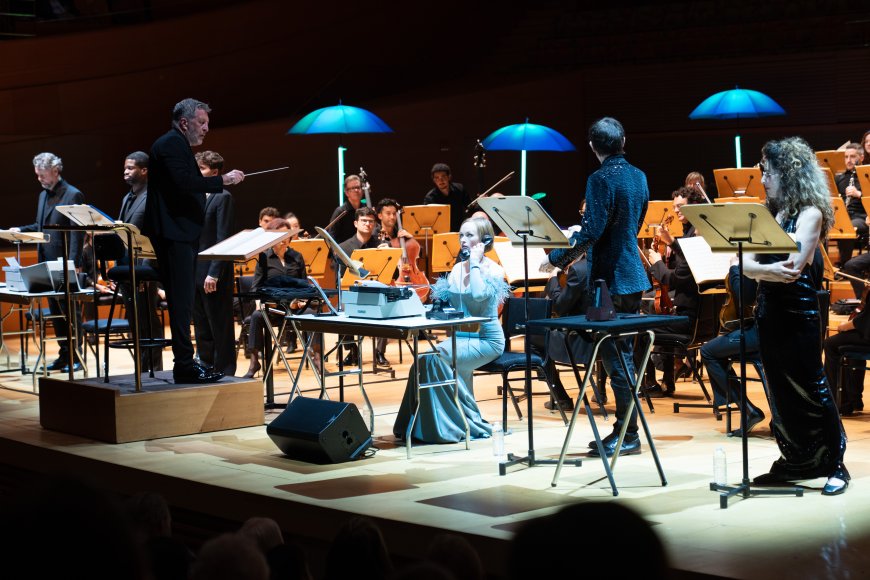
Under the baton of Thomas Adès, the LA Phil New Music Group presented the concertized U.S. premiere of the opera. This isn’t your grandfather’s Salome. The lush lyricism and heightened melodrama of Richard Strauss’s legendary interpretation of the original work — Wilde’s play Salomé — are gone. What remains is a work that is simultaneously stripped-down and overwhelming; unsettling and funny; ironically distant and deeply engaging.
Barry’s Salome leaps from both Wilde’s 1891 play and, more indirectly, from Strauss’s operatic adaptation of it. It has a kind of joyous irreverence toward both. Where Strauss expanded Wilde’s prose into long musical lines, Barry tears it apart through iteration, fragmentation, and recontextualization. Familiar materials surface like hallucinations. A chorale inspired by an entry in Beethoven’s diary appears and disappears.
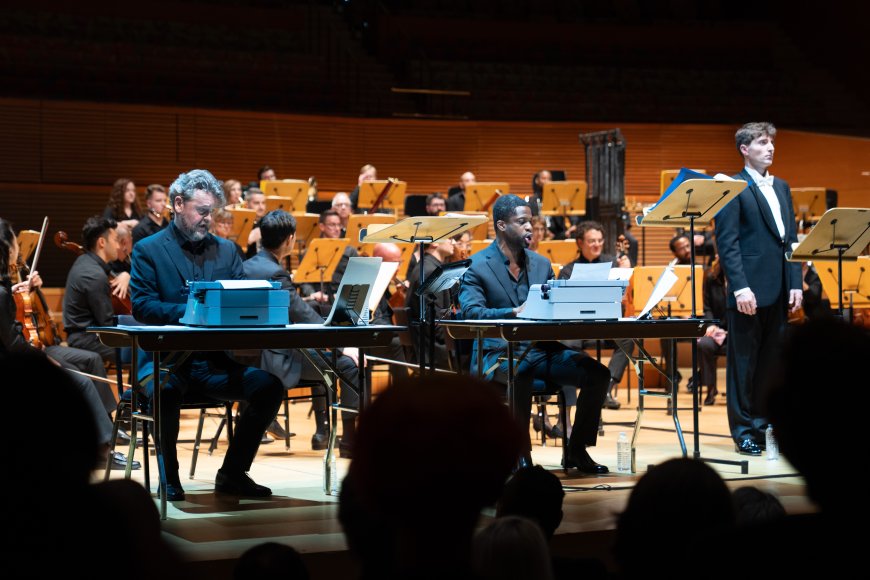
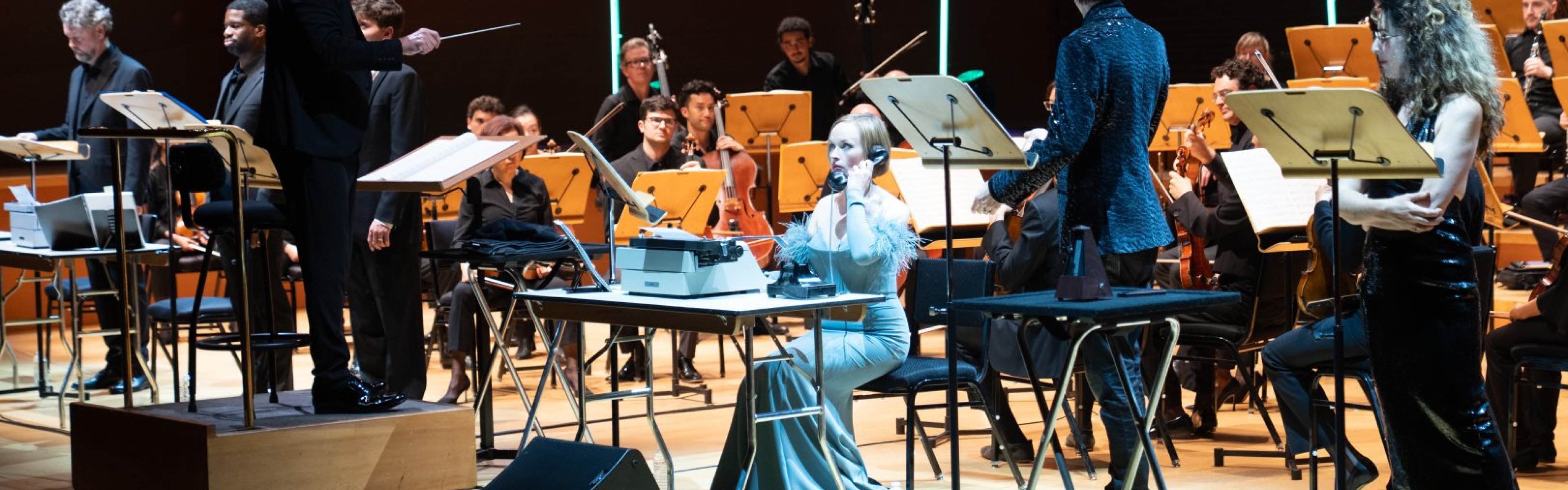
The inexplicable intrusion of The Blue Danube by Johann Strauss II (who bore no relation to his contemporary Richard Strauss) momentarily suggests something more ordered before it too slips away. Typing and metronomic clicks become part of the opera’s rhythmic language; in this interpretation, Salome is a typist, not a dancer. The result resists easy categorization. At times, the music gets caught in obsessive loops, creating phrases that cycle with increasing insistence. At others, it pivots suddenly with mercurial and unpredictable glee. That volatility is a risk Barry assumes. The opera seems always on the verge of breaking apart under its own logic, its tension between stasis and breakneck speed. Astonishingly, it maintains coherence throughout.
Barry’s score, which might risk incomprehensibility in less experienced hands, coalesced beautifully under the direction of Thomas Adès. His unsentimental but precise grip on pacing and dynamics let the music’s obsessively cyclical repetition and non sequitur transitions build or breathe as the narrative demanded. As a composer-conductor very much at home in contemporary opera, Adès brought an insider’s understanding of this musical language. He crafted the extremes of character, timbre, and pacing in the opera with nuance, imbuing the concert’s dramatic arc with direction and momentum.
Soprano Alison Scherzer’s tour-de-force performance as Salome was a wonder of stamina, technique, and control. Even at the role’s most extreme, she dispatched the vocal demands of the part with confidence and striking clarity of line, taking what could have come off as chaos and making it sharply focused and relentlessly surging.
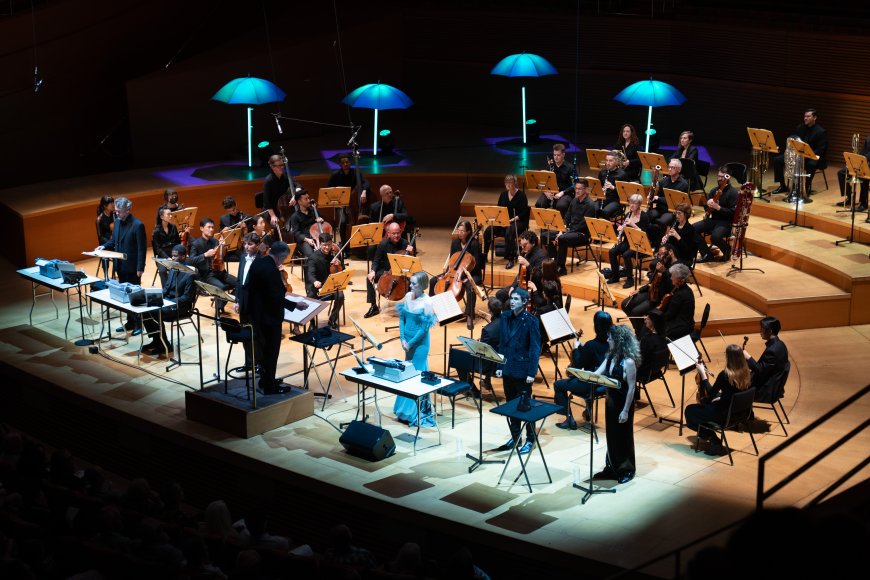
There was something delightfully off-kilter in Vincent Casagrande’s portrayal of The Prisoner. Brisk and boldly theatrical, his approach to the role was humorously unstable, one of the evening’s main sources of laughter. Timur Bekbosunov’s performance as The King expertly struck a middle path between comic unease and declarative excess. Sara Hershkowitz’s Queen was brightly etched, an effective foil to Scherzer’s Salome. Justin Hopkins as The Young Syrian and Karl Huml as The Soldier maintained impressive precision in a score that leaves no room for approximation.
It is no small achievement that such a volatile work can feel so fully realized. Barry’s Salome embraces extremes often eschewed by composers. It risks incoherence in pursuit of something immediate and alive. That it succeeds here, and with such conviction, speaks not only to the strength of the piece, but to the clarity of its performance.