Last weekend, the San Diego Symphony presented a program with a seemingly gift-wrapped theme: “Journeys to California.”
The set list for the April 10–11 concerts served as a model for the shrewdly balanced modern concert program, dovetailing the new (Adam Schoenberg’s 2023 “Cool Cat”), the contemporary (John Adams’s 1997 “Century Rolls”), and the safe crowd-pleaser (Rachmaninoff’s third symphony). Adams — America’s composer emeritus — resides in the Bay Area, and Adam Schoenberg (who bears no relation to “the other Schoenberg”) lives in Los Angeles, as did Rachmaninoff from 1939 to 1943.
Never mind that Rachmaninoff composed his opus 44 in Switzerland, Adams’s thrilling piano concerto is not inspired by anything specifically Californian, and Schoenberg’s brilliant fanfare — while commissioned to celebrate LA’s folk-hero mountain lion, P-22 — owes more to Schoenberg’s relief following life-threatening surgery and his urge to match Adams’s “Short Ride in a Fast Machine.”
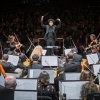
But pianist Conrad Tao, guest conductor Robert Spano, and the San Diego Symphony pulled the event together into a satisfying night of music. The anti-tux Tao — sporting a faded buzz cut and vest — had the full, playful measure of Adams’s gymnastic rhythms. Visibly grooving and grinning at the piece’s jazz-inspired layering, he captured its lurching, mechanical relentlessness while liberating the lyricism within. Adams’s teeming, post-minimalist score is a sonic wonder, especially when the orchestra and conductor’s attunement to its complexities frees the soloist to unlock its expressive potential.

The slam-dunk highlight was the central, slow movement, “Manny’s Gym” (alluding to its commissioner, pianist Emanuel Ax, and the drifting harmonies of Satie’s Gymnopédies). Andrea Overturf’s English horn, Sheryl Renk’s clarinet, Jeff Thayer’s ethereal strings, and the color and pulse provided by Julie Phillips’s harp, Phillip Matsuura’s celesta, and Symphony percussionists united with Tao’s shimmering, floating textures to cast a sensuous, otherworldly spell. As the piece built toward its off-the-cliff close (“Hail Bop”), multiple musicians were rocking to Adams’s infectious rhythmic tide.
Tao’s generous encore was his own transcription of Art Tatum’s 1953 take on Harold Arlen's “Over the Rainbow” (from The Wizard of Oz), showcasing his own compositional skill, jazz chops, and cross-genre instinct.
Though sometimes labeled his “American symphony,” Rachmaninoff’s third symphony reflects little of the composer’s quarter-century exposure to American life. In stepping away from the lush orchestration and big Romantic themes that earned Rachmaninoff fame, the symphony disappointed many at the time. The New York Times’ Olin Downes recommended he take “a pair of shears” to it. The equally prominent Virgil Thomson condemned it as “without much shape [and] curiously lacking in distinction.”

Spano never got that memo. Best known for his four Grammy Awards and 20 years in front of the Atlanta Symphony, Spano recorded an all-Rachmaninoff disc in 2011 and led the San Diego Symphony in this Russian artist’s third piano concerto in 2023. Whatever the symphony’s reputation or weaknesses, Spano and the Symphony played it like an undiscovered masterpiece.
Spano’s micro-pacing and long-line legato were dead on, and the Symphony’s sumptuous, big-boned yet nimble playing was textbook stuff. This was an orchestra locked into each other yet individually virtuosic enough to inject each moment with color and character. The sensational first movement unfolded as a living story, full of reversals, episodic images, rising tension, and the melancholy undertow of Rachmaninoff’s best music. His trademark melodic gestures were there for sure, but Spano never indulged or wallowed in them. Leaning the momentum forward he guided the orchestra in erecting a huge, 4-D sound world. Principal highlights included Benjamin Jaber (horn, and the first musician Spano asked to stand), Rose Lombardo (flute), Sarah Skuster (oboe), Sheryl Renk (clarinet), Frank Renk (bass clarinet), Christopher Smith (trumpet), but the entire string section delivered a master class in rich, unified sheen and emotional timbre.
The Jacobs Music Center audience greeted each movement with applause. After the adagio, Spano turned to face them. Instead of an etiquette lecture, he said: “If anyone tells you not to applaud between movements, tell them to applaud with you. We love applause!” At the symphony’s close, they got it. But is Rachmaninoff's third symphony really a masterpiece? The third movement seems to lack the integration or inspiration of the first two and fails to build on them. But performances like this can make you set doubts aside.
Schoenberg’s confidently-orchestrated “Cool Cat” provided the perfect opening amuse-bouche. With swaggering trombones, samba-like muted trumpet, snare-drum rimshots, and mallet percussion, it built a propulsive, rhythmic momentum that whet audience appetites and warmed the Symphony up for the weightier fare ahead. Schoenberg earned Spano’s curtain call.