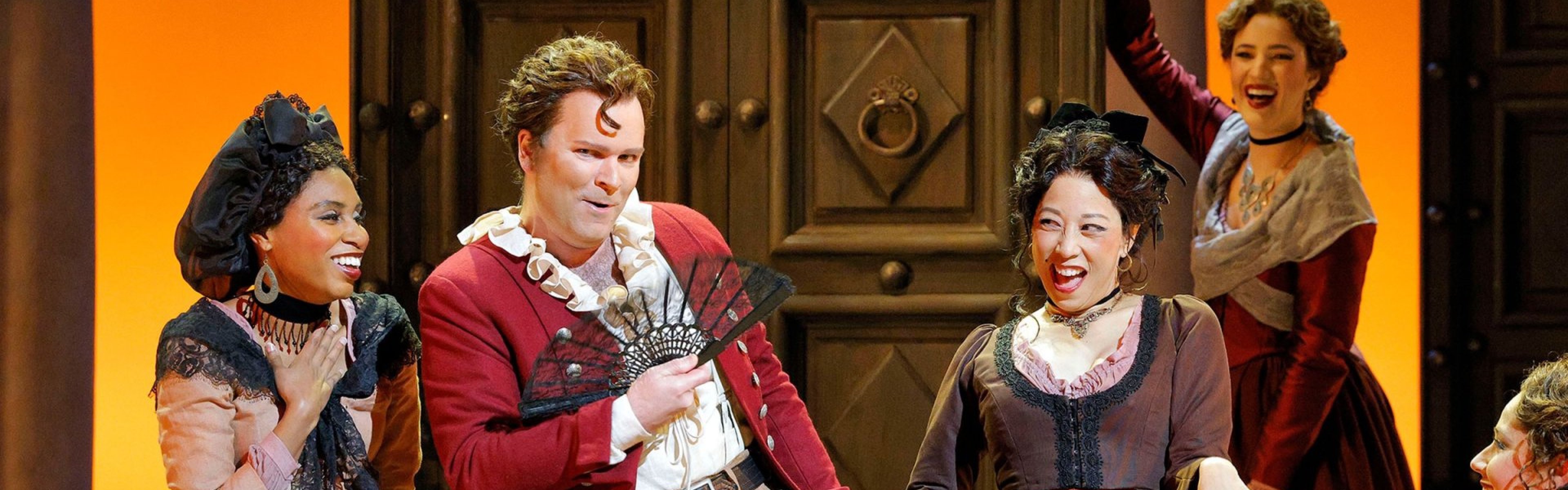
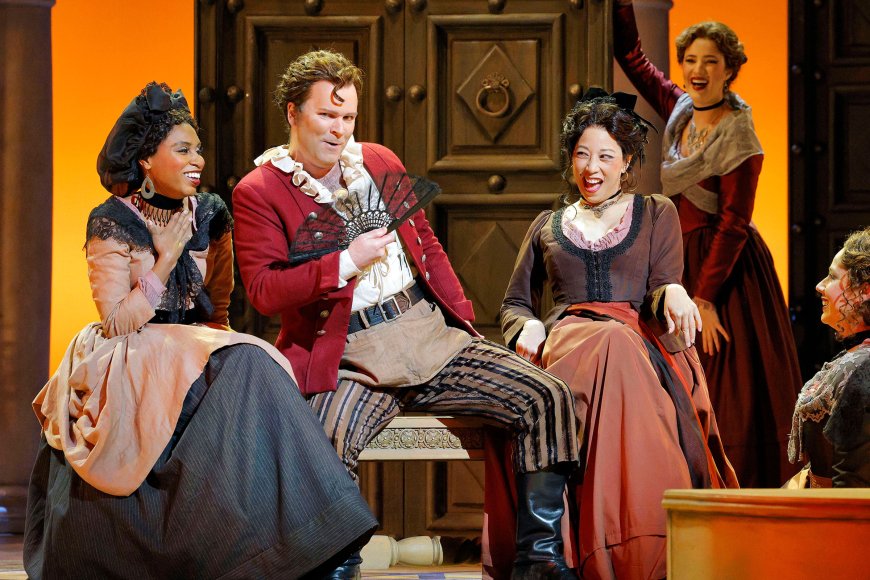
When he takes to the stage of the War Memorial Opera House in San Francisco on May 28, baritone Joshua Hopkins will be singing the role of Figaro in Rossini’s The Barber of Seville for the 75th time — but who’s counting? Seriously, no stranger to San Francisco Opera (SFO), Canadian-born Hopkins is set to kick off the company’s summer season in a role he adores and will share with Justin Austin through June 21.
It’s been a fiendishly busy year for the singer, who made his SFO debut back in 2018 as Harry Bailey in Jake Heggie and Gene Scheer’s It’s a Wonderful Life, and who returned to the Metropolitan Opera last December as Papageno in the holiday run of Mozart’s The Magic Flute. There were also concerts galore, including singing Rachmaninoff’s The Bells under Matthias Pintscher with both the Cincinnati Symphony and the Kansas City Symphony.
Indeed, Hopkins’s journey from Ontario, Canada — which began with his love of musicals — took him to McGill University in Montreal, where he received a master’s degree in 2003, before being accepted into the Houston Grand Opera Studio. As for prizes, the 47-year-old singer has racked up his share: He won a 2021 JUNO Award for his portrayal of Athanaël in the Chandos recording of Massenet’s Thaïs; and in 2023, the baritone received his first Grammy nomination for Matthew Aucoin’s Eurydice (he’d created the role of Orpheus for Los Angeles Opera in 2020), when the Met’s live recording of the work was nominated for Best Opera Recording.
Appearing regularly at the Met, Lyric Opera of Chicago, and Santa Fe Opera, Hopkins continues to create leading roles for world premieres of new works both in the U.S. and in Europe. In 2015, he was instrumental in commissioning Jake Heggie’s song cycle with words by author-poet Margaret Atwood, Songs for Murdered Sisters, which premiered in 2021 and has been performed in Europe, the U.S., and Canada. It has also been presented in multiple formats, including live orchestral and chamber concerts, film, and recordings.
SF Classical Voice spoke with Houston-based Hopkins over Zoom about his attachment to Figaro, what draws him to a role, and the creation of Songs for Murdered Sisters.
Let’s talk Figaro: What excites you most about him, and how many different productions have you done?
I haven’t counted, but I would guess somewhere between nine and 12 productions, maybe more. Obviously, it’s in my brain, [and] this is one of a handful of roles that I could sing tomorrow in terms of being memorized and ready to sing.
What’s exciting is that he’s so intelligent and on top of everything. He’s really running the show in terms of plans that he and the Count are making together [and] is always striving to reach another social status level. He’s also the classic archetype character. If he ever receives money, he’ll just spend it on sausages or something like that.
Because he has this incredible brain, he’s five steps ahead of most everyone else. It’s exciting to bring that kind of intelligence and energy to the role every time I do it.
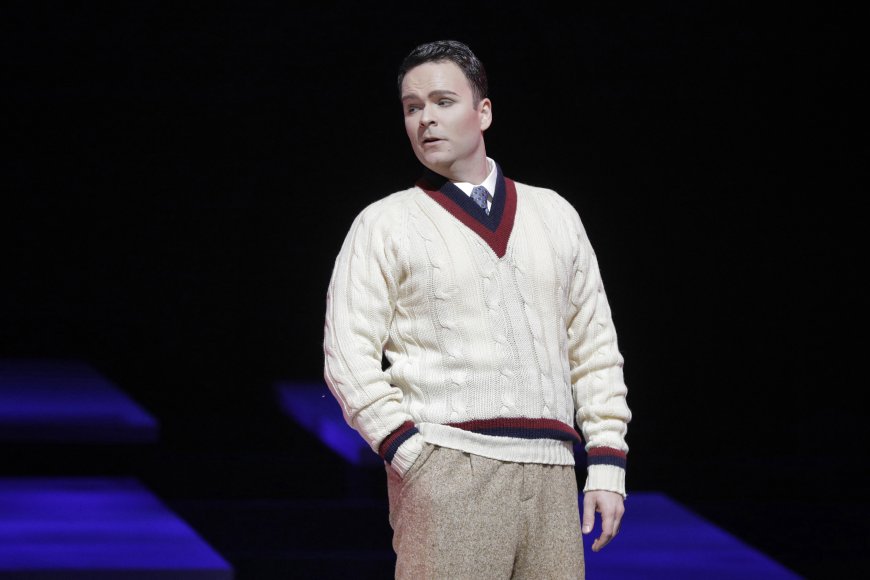
Figaro is obviously larger than life. How do you balance his comedic bravado with real vocal and technical demands?
That’s tricky. Balancing is probably the most challenging thing that faces me singing Figaro, because the role is so dang high. It’s written up in the stratosphere for a baritone, and I’m a true lyric baritone, so I don’t come from that ease into the top naturally.
That was something I’ve worked on for years with my voice teacher, Stephen King, who, coincidentally, also moved to Houston in 2003, the same year I did, and started working with the Houston Grand Opera Studio the same [time] I started my first year there. However, if I give too much of that balance to the performing, something’s going to lose out on my brain thinking about the technique behind it.
With a role like Figaro and an aria, like “Largo al factotum,” which is the very first thing I sing — I feel like I’ve put in my 10,000 hours just on that aria.
Your repertory spans comedy, drama, and contemporary works. What draws you to a role?
For me, there are two different elements of a role in opera: “What is the music like?” and then, “What is the dramatic arc of that role?” If I look at the dramatic side, I always want to try to perform a role that has this arc, or something changes within the character during the opera.
If you search hard enough, you can find that, but sometimes some stock-ish characters cannot really have much of an arc, and you go from beginning to end, but there really wasn’t much to chew on, much juice to it, dramatically.
I think the roles that really attract me have that emotional journey and also some angst. I will say, though, that it’s a heck of a lot of fun to play the villain. The first full-length role of a villain I ever played was Nick Shadow [The Rake’s Progress] at McGill with Opera McGill when I was in my first year of my master’s degree. I probably wouldn’t sing it now, because my voice is sitting higher than it did at that time, but it was so much fun to play the devil because he’s omnipotent and can manipulate people while having such a great time.
Roles like Eugene Onegin or Billy Budd, that really go through this transformative experience of whatever happens to them during the opera — it’s incredible to dig my teeth into.
On the other side of that, there’s the vocality and what draws me to an opera, music-wise. The last role I sang that I adored was Zurga in [Georges Bizet’s] Les pêcheurs de perles. That opera is an underdog in terms of repertory. Sometimes it has cycles, then it’s everywhere. I did it at Théâtre des Champs-Élysées in concert.
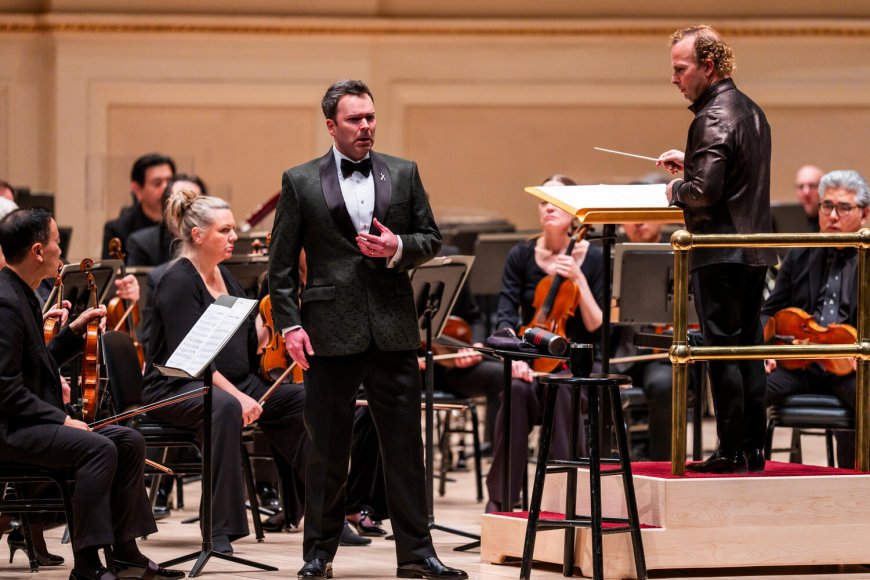
Tell me about Songs for Murdered Sisters, which is based on your sister, Nathalie Warmerdam, who was killed in 2015 by an ex-partner alongside two other women in Ontario, Canada. What gave you the idea of transforming grief into a musical work, and what was the collaborative process like?
I met Jake [Heggie] about 22 years ago in my first year of the Houston Grand Opera Studio, and he was premiering his opera The End of the Affair. I was covering the lead baritone role, Maurice Bendrix, so I got to witness what it is to put together a new opera and see what elements get cut and the changes they make at the last minute for the dramaturgy.
I got to do an outreach event for a group of donors where Jake was playing, and I sang one of Bendrix’s arias. I was so enamored to be able to perform with a composer of the opera, [and] we kind of kept in touch. Then, when we were working together again for It’s a Wonderful Life, once we opened that show, my wife and I had been wanting to approach him to write this work that would honor the memory of my sister and the other two women murdered that day.
This was a project that had been in the works, basically, from a week after my sister’s murder, because it happened that I was in Ottawa at the time working at the National Arts Centre, performing Barber of Seville. I had approached the National Arts Centre Orchestra about the commissioning of a new work, and at that time, in 2015, we had no idea what it would be.
Since I was working with Jake and I have such admiration for his writing, and the way he sets things and the emotion that he brings to the music he creates, I thought he would be perfect for writing something that’s so personal and deeply emotional. We met for lunch, and he was immediately on board to write it, to tell my sister’s story through his music.
And having the brilliant, Booker Prize-winning author Margaret Atwood as librettist?
We had some names, but eventually Margaret Atwood was the person we decided to pursue. Thankfully, she was struck by the project from the start [and] surprised us much sooner than we thought, because we had reached out to her maybe a month previous. Then she sent us an email, and the songs were in an attachment, and she said, “How about something like this?”
Jake and I were floored, because it was something that was so minimalistic and the amount of text that she wrote was so powerful and filled with imagery. Jake said he had the melodies in his head and didn’t change a word of what she wrote, which is very rare for him, or I think for any composer to be able to set words perfectly. Then I had one of those emotional epiphanies the first time Jake sent the music after he had written it and had made a recording of the piano part for me.
I listened to it and the idea from the beginning was always, “How can I channel that loss, that grief and honor the memory of my sister Nathalie through my voice to be able to bring attention to ending gender-based violence?” This piece has really provided me with a way to process that grief. Without it, I think I would probably still be feeling numb about the whole thing.
When I have something that’s so deeply personal written by two masters of their craft, that come together and write something for me, that I’m then able to use my voice to perform, it’s such a gift they’ve given me and the world. Since its premiere, I’ve been thankful that I’ve been able to perform it once or twice each season, bringing it to different audiences around the world and sharing that story with them, and hopefully bringing awareness that violence against women is an epidemic.