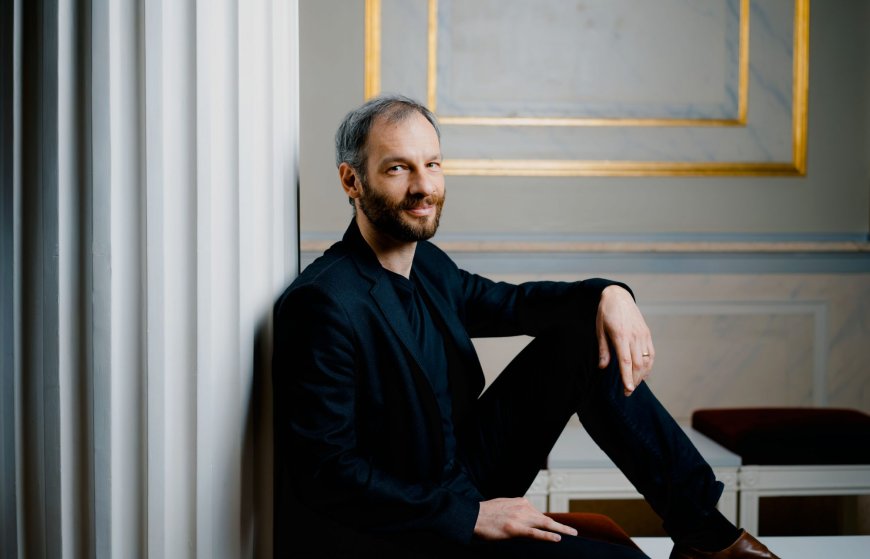
Russian-born Finnish conductor Dima Slobodeniouk is at the top his game.
The 51-year-old is collaborating with the world’s leading orchestras, including the Berlin Philharmonic, the Boston Symphony Orchestra, and the New York Philharmonic. In 2021, Anthony Tommasini of The New York Times wrote that, “Slobodeniouk had one of the most auspicious Philharmonic debuts of recent years.”
The conductor will return to the San Francisco Symphony from May 8-10 in a mixed bill program.
Slobodeniouk first picked up the violin at the Moscow Central Music School. After moving to Finland, he continued his studies at the Conservatory of Central Finland and the Sibelius Academy, where he learned conducting before graduating in 2001.
Flash forward to 2013, the maestro served as Music Director of the Orquesta Sinfónica de Galicia until 2022. During that time, he was also Principal Conductor of the Lahti Symphony Orchestra from 2016-2021.
Known for his musical prowess and interpretive depth, Slobodeniouk is also an acclaimed recording artist. Recent notable recordings include Esa-Pekka Salonen’s Cello Concerto with the Rotterdam Philharmonic Orchestra and Nicolas Altstaedt (Alpha Classics, 2022), which received an International Classical Music Award (ICMA) Award. He has also collaborated with such celebrated soloists as Martha Argerich and Yuja Wang.
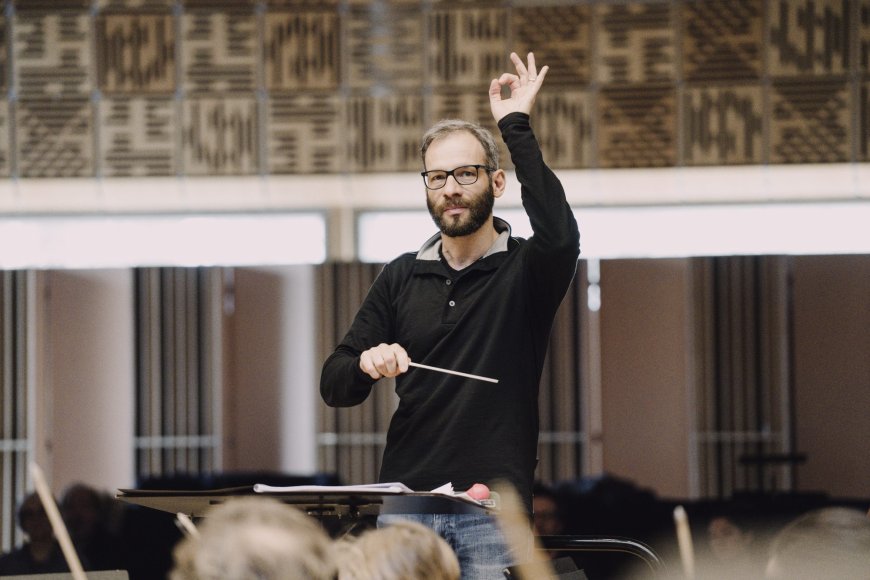
During the 2025-26 season Slobodeniouk returned to the New York Philharmonic, as well as to Boston, Pittsburgh, and Houston Symphony Orchestras. Based in Helsinki, he has upcoming engagements in Belgium, Spain, France and Italy.
SF Classical Voice spoke with Slobodeniouk from Germany. Topics ranged from his upcoming San Francisco Symphony program, to how his career has been shaped by both Russian and Finnish musical traditions.
In San Francisco you’ll be performing Jacques Ibert’s rarely programmed Flute Concerto, Henri Dutilleux’s “Métaboles,” and Tchaikovsky’s Symphony No. 4. How do you normally program a concert, and why this program?
Generally, it’s a puzzle which needs to come together. [It includes] your own artistic vision and aims, or whatever you’re doing during that period of time. [Whether] you’re focusing on a certain repertory or a soloist — and what he can offer in terms of concertos — that also goes overall with the programming of that season.
I’m really happy with this program, because it combines so many different aspects of music-making. The second half, the Tchaikovsky, is very well-known. It’s become a bit of an iconic piece, because it really touches people on many different levels.
When pieces become famous, people often forget where they come from. For me, this [Tchaikovsky] piece is a statement. It’s a strong piece, and also very touching, but not in a way that would make you cry. It underlines the human aspect of overcoming difficulties [and] it's very revealing on an emotional level.
The Ibert concerto is so beautifully written, and we have a beautiful soloist [San Francisco Principal Flute Yubeen Kim]. I think he suggested that, then I came up with Dutilleux’s “Métaboles.”
Is there a particular work or movement in this concert that you feel might reveal something essential about the composer, or you as an interpreter?
For one reason or another, I connect very strongly and easily with French music. I don’t know why, but it’s always been like that. I would say I’m in love with the Dutilleux piece, and I’ve done it many times. He was a slow composer; he would really take his time. The slow composing method versus being nerdy are two different things. He was not being nerdy at all.
His music is very dynamic [and] takes you quickly from one place to another. In this case, it’s a collection of five short pieces, and each explores different ways of touching a listener. Maybe it can be a dynamic, rhythm, or timbre. There are different things a symphony orchestra can offer. In a way, he looks at the orchestra under a microscope, so you see how it functions. You can almost feel how it functions. All in all, it becomes a beautiful arc in these five movements.
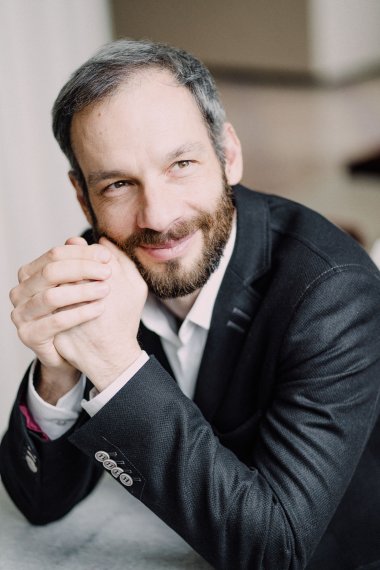
Your career has been shaped by both Russian and Finnish musical traditions. How do these influences co-exist in your conducting style?
You cannot avoid certain things which you absorb when you’re a small kid. I grew up in Moscow and come from a family of musicians; that will always be there.
But when I moved to Finland, I was not really an adult yet — I was 16. Whatever cultural exchange got into my cells, I cannot define any more what is what. It’s really a mixture. But it was a surprise for me how strongly I connected with Finnish culture and music — and not only Sibelius, but with the contemporary scene and cultural scene. It was different than when I grew up in Moscow.
It’s an explosive combination, but I never have to choose. Do I switch on one or another? No, it co-exists. I guess that’s what is unique about my life. I feel quite good in sharing this combination with audiences and with orchestras. Many of my programs involve Russian and Finnish music, but this is a small part of what I do. I also do contemporary music, opera, a lot of German music — Mozart, Brahms — I do quite a lot of everything.
How do you maintain freshness and a curiosity when you’re conducting a repertory that you’ve lived with for many years?
The fact that it’s always different keeps me curious. The further I go into it, the more moving parts there are. And the world also changes around us. That is maybe in a way the trickiest thing. Just when you think you’ve learned — this has to be done like this — then you go to some other place, and you see people that don’t understand what you’re talking about.
[When] people happen to come from different backgrounds and/or maybe represent a new generation, they think about it differently. [So] you rethink and judge the situation from a new standpoint. That is tricky. You have to acknowledge the ever-changing world around you — especially now.
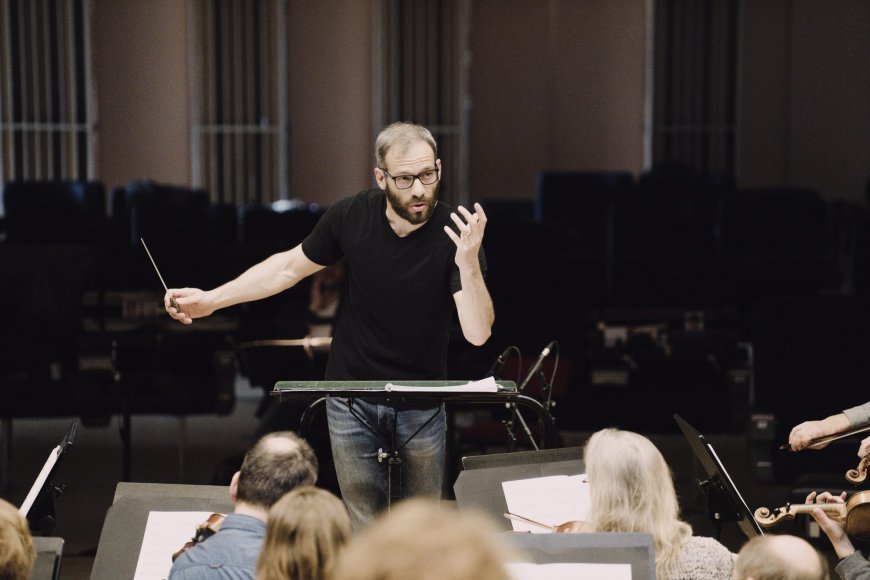
Which conductors or teachers had the most lasting impact on your musical thinking?
I have to name my conducting teachers, Leif Segerstram and Jorma Panula, who was the teacher of Esa-Pekka Salonen. Those two, as well as Atso Almila, were my three main teachers. Later on, I absorbed many other different ways of conducting and ways of thinking about music.
Conducting without musical thinking doesn’t exist. I feel that this musical thinking is an ever-changing thing. The deeper you go into it, the more you walk along the path of your life, the more you question things which you’ve done yesterday. You feel more and more obliged to ask questions. Why am I doing it this way?
Furthering that notion, do you think American orchestras play differently from European ones – or is that just a myth we keep repeating?
No, it’s not a myth. It’s a reality. I hope it stays that way. The moment orchestras around the world start playing the same way, we have lost something. It’s very natural. American orchestras, the way they work, is slightly different; the rehearsal process is shorter. Technically, they’re prepared and capable on the first rehearsal. Things you work on with American orchestras would be different than European orchestras.
Does that affect the final result? Probably it does. It also depends on the hall, of course. Many American halls are big, or let’s say bigger, than some of the European ones. You need to play in a different way. The style of playing should be different. I see it as a richness in our business.
I understand you’re a licensed pilot. Are you still flying and what, if any, connection do you see between flying and conducting?
I flew today, a single engine plane. That is one way of relaxing. It’s the thing which makes you really think about one thing only. I started flying 20 years ago [and] it was connected to a friend of mine who was interested in aviation. That friend gave me as a present a short introductory flight with an instructor. Having done that, there was no return. I said, “I need to do this. I want to learn things about aviation, about aerodynamics.”
You also learn things about the planet, where we are living. And there are so many things you learn about yourself: How do you perform under pressure, how do you separate and prioritize things?
It helps me in my work. As a conductor, you’re constantly making choices in prioritizing. In that given moment, there are a million things to do, but you can only do one thing at a time.