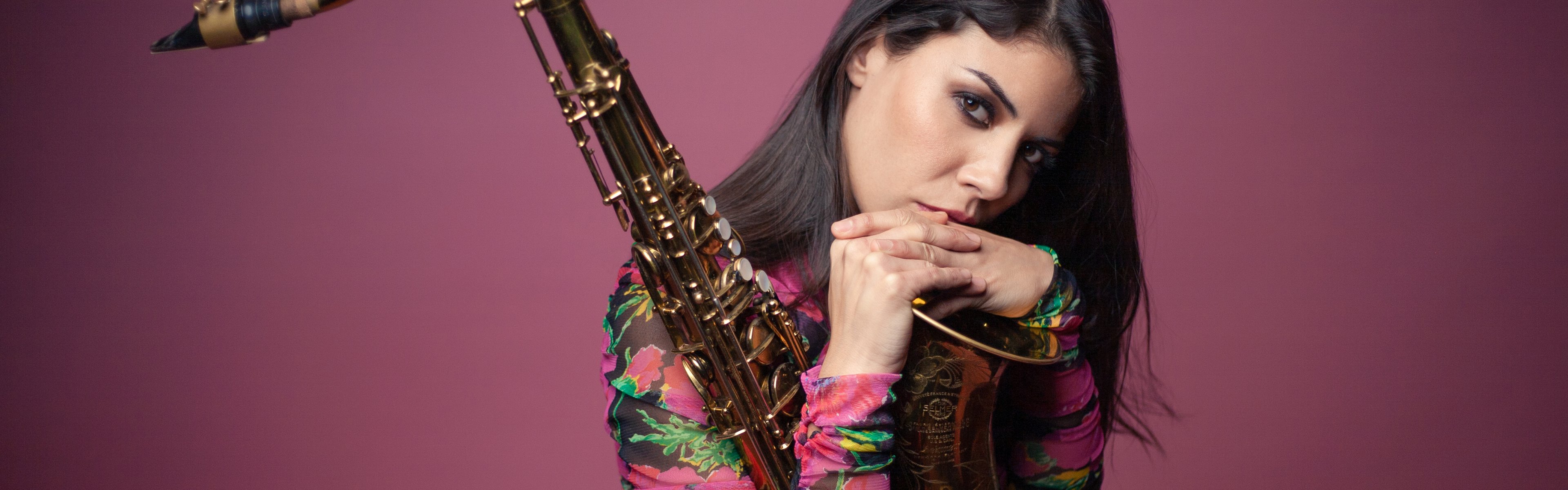
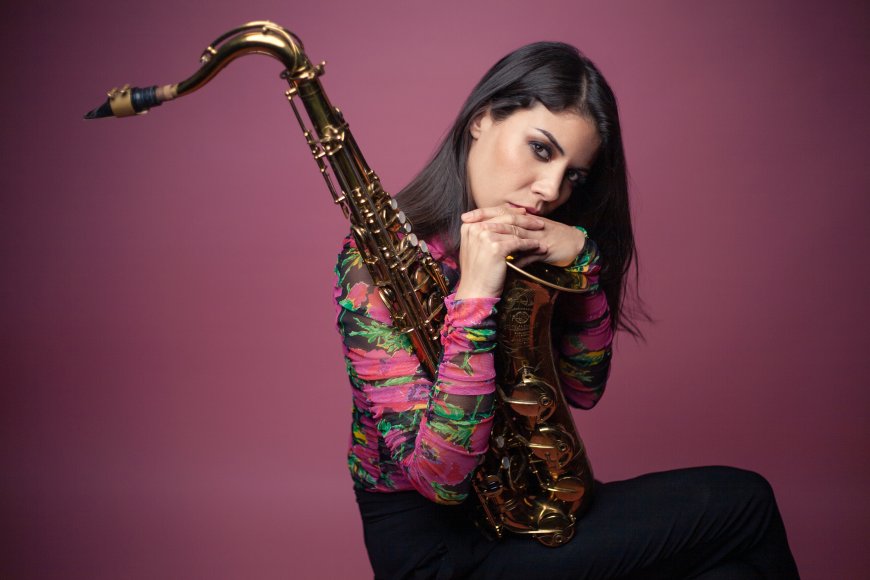
Now nearing the apex of her career as a performing and composing jazz saxophonist, Melissa Aldana, 37, came to her craft by direct transmission.
Her father, Marcos Aldana, raised his daughter in his hometown of Santiago de Chile. By the time she was six, Aldana had picked up her father’s saxophone. That was in 1994, just three years after he’d placed as a semifinalist in the annual Thelonious Monk International Saxophone Competition. (Joshua Redman was that year’s winner, and the late Bay Area legend Andrew Speight was a finalist.)
As a teenager, Melissa began gigging in local clubs, and at the encouragement of visiting pianist Danilo Pérez — whose wife Patricia had studied with Marcos — the younger Aldana auditioned at the Berklee College of Music in Boston. After studying there with the likes of Joe Lovano and George Garzone, she relocated to New York City in 2009 to study with George Coleman.
Aldana recorded her debut album on former tutor Greg Osby’s Inner Circle Music label and performed nationally, with a stop at the Monterey Jazz Festival. In 2013 she followed in her father’s footsteps to the Monk Competition, where she became the first female instrumentalist and first South American musician to win the top prize. More festivals, tours, and honors followed, with Aldana forming her own small groups that were supportive of her questing and passionate approach to jazz and to her instrument.
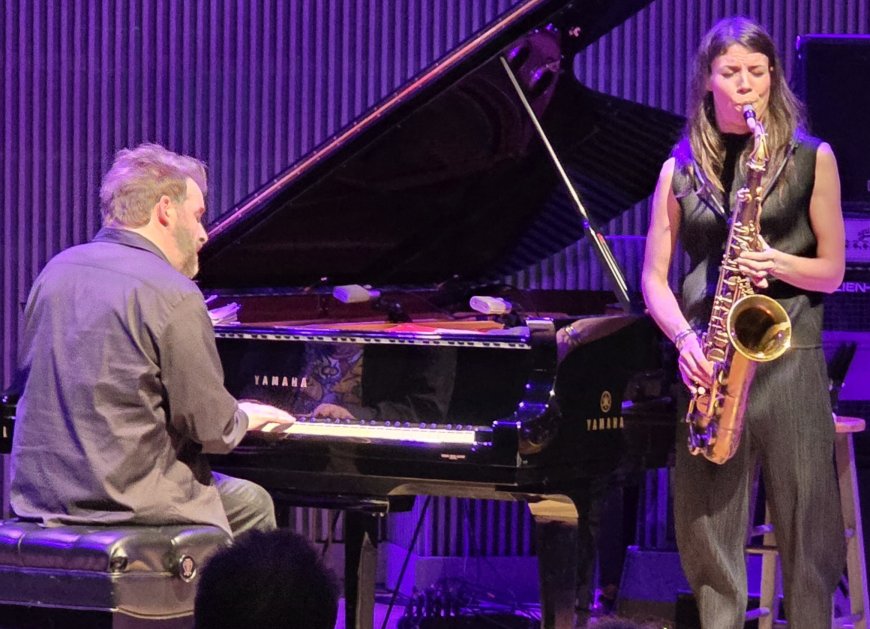
This year, Aldana will appear with the Coltrane 100 project — an international tour marking the 100th anniversary of John Coltrane’s birth — in a quintet alongside sax mentor Joe Lovano. They’ll perform at the Baker-Baum Concert Hall in La Jolla on April 11, at The Freight in Berkeley on April 15, and at Jackson Hall at UC Davis on April 16.
SF Classical Voice spoke with Aldana before her upcoming performances.
What was it like having jazz and the sax so integrated in your family life in Santiago?
My grandfather, “Kiko” Aldana, had been one of the first jazz musicians in Chile during the ’40s and ’50s.
I feel I was lucky with a dad who was like, “This is how you practice,” since I was very young. He was the greatest teacher I ever had in my life. He made me transcribe for hours each day, and he had me imitating [recordings] by ear and memorize everything. I actually didn’t learn how to read music until I was 18.
He would have me connect to the emotional content of how the person was playing. It’s kind of like falling in love with somebody: you get to see the good sides, the bad sides, and the more you transcribe, the closer you can become to the essence of the person.

Whom did your dad invite into your musical family?
The first person was Charlie Parker, but I remember not being fully in love with him.
I’d heard that it was Sonny Rollins who influenced your switch from alto to tenor.
It got to a point where I wanted to be like Sonny, and you can hear that later on some of my recordings with my Crash Trio [with Pablo Menares on bass and Jochen Rueckert on drums]. But as I got older, I realized I’m like every single person I love. I have studied the history of the saxophone, and this is kind of my purpose in life: the deeper you can go, the freer you can become. So the more I know, the less I need to play.
Did jazz require you to leave your father and your country?
It was clear to me when I was 18 that I had to leave Chile, though I didn’t come from a family with money. The only way I could do it was getting a full scholarship to Berklee, where I knew Danilo Pérez, and he and Patricia let me stay at their place.
I always knew that I wanted to live in New York, though it was really competitive there. But I didn’t let those situations eat me alive. You go to a jam session to learn, not to be killing. Still, I kind of questioned myself: why do I feel like shit? I’m playing, but I’m just walking home like a defeated dog with my tail between my legs. The first thing was, I’m a woman. Then I realized, I was just afraid to be vulnerable, to be in the moment.
I’d think the Thelonious Monk win might secure your grip.
After I won, a lot of people made comments about like, oh, her playing is very sensitive because she’s a woman. And for a long time, I tried to run away from that idea. You know, my playing is not different because I’m a woman. But I found I don’t have to do everything, which is the macho side of it. Being empathetic and sensitive is one of the most important aspects of being a musician and an artist.
In keeping with that, early this year, you released an album of ballads, Filin, on Blue Note, which has been beautifully received.
And the inspiration for my album was John Coltrane’s Ballads [1963, Impulse! Records]. That was like the Bible, the sound and how he’s playing melodies, it just hits you in the heart, and you can hear the lyrics through his sound.
Trane was working his magic mostly on standards from the American songbook. What took you in the direction of Cuba for your ballad album?
I basically just felt ready to have a deeper dive into my sound. When I thought about my dream band, I thought about [Cuban pianist and composer] Gonzalo Rubalcaba [who performs on Filin, alongside Peter Washington and Kush Abadey]. Gonzalo mentioned that I should check out a time period called The Feeling [or Filin, in Spanish transliteration]. It happened in Cuba during the ’40s, ’50s, and ’60s, and I fell in love with the music. There is a much deeper connection to the music because of my language. [The source songs all had Spanish lyrics, and some on the album are serenely vocalized in that language by Cécile McLorin Salvant.]
Coming back to Coltrane, I recall your saying if you could swap lives, it would be with his.
There’s something he made me feel through all his recordings, it’s kind of like an out-of-body experience. You can hear somebody that is very pure and on a deep search. Music as a vessel to find peace and love and a way to heal the universe. You can hear how he manipulated sound in order to find his identity, playing with microtones and with, what is the center of the pitch? You know, I wouldn’t be here if it wasn’t for him.
You’re celebrating Coltrane directly now, in his centenary year. How will that feel onstage?
Very spiritual, but also kind of scary, depending on how aware or unconscious you are. It’s like months and months of preparation, every day learning a little bitty thing. Then, leaving my ego at home and just having fun. And it’s not about trying to replicate what Trane did, it’s more about the spirit of his music and how we can channel that through what we play, in our own way.
You’ll be sharing sax parts with Joe Lovano.
You know, he was my teacher at Berklee, so it’s a great experience to be part of his journey. Our performing Coltrane 100 with Jeff “Tain” Watts [drums], Nduduzo [Makhathini, piano] and Linda [May Han Oh, bass] is a dream come true.
Will you be traveling through a lot of Trane?
Yeah, I mean, you have Giant Steps [1960, Atlantic], with Trane’s new way of grouping changes, then Crescent [1964, Impulse!], where he’s going more modal, merging everything. And Live in Japan [1966, Impulse!], where it’s like ‘peace on Earth’ with his wife, Alice. And that’s where I feel I’m heading towards, learning how to let go and be in touch with oneself. Using the saxophone as your vessel.