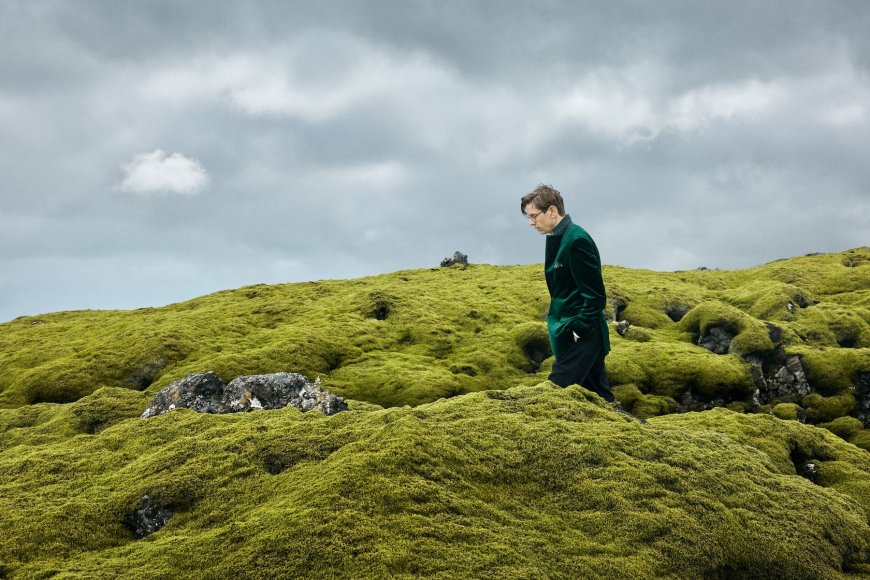
Whether in interstitial remarks during a 16-minute televised NPR Tiny Desk Concert or over two hours of one-on-one with Rick Rubin on the legendary record producer’s Tetragrammaton podcast, Víkingur Ólafsson has shown he can improvise in discourse as impressively as he has on the piano. He has also shown that he can bring enthusiasm, insight, and humor to his repertoire as readily as to explaining that he should be referenced by his given name rather than by his patronymic name, in accordance with Icelandic tradition.
Víkingur was raised in Reykjavík by Ólafur Óskar Axelsson, an architect and amateur composer, and Svana Víkingsdóttir, his first piano teacher. Leaving the island nation, he earned bachelor’s and master’s degrees at the Juilliard School, under the supervision of Jerome Lowenthal and Robert McDonald, while taking outside lessons with Ann Schein Carlyss (who died earlier this month). After three recordings on his own label, Dirrindí, Víkingur’s Deutsche Grammophon debut in 2017 got him dubbed “Iceland’s Glenn Gould” by The New York Times. Subsequent albums and his dynamic yet lyrical live performances drew awards from other periodicals and organizations, including, last year, Musical America’s Instrumentalist of the Year and a Grammy for Best Classical Instrumental Solo, for his take on J.S. Bach’s Goldberg Variations.
Now 42, Víkingur lives in Reykjavík with his children and his wife, Halla Oddný Magnúsdóttir, a pianist with whom he has recorded. He’s been featured with American and European orchestras. His residency with Cal Performances included audience-acclaimed renditions of Beethoven and Ravel with the Philharmonia Orchestra last fall. Cal Performances presents him in a recital at Zellerbach Hall on Wednesday, April 29 closing out his season-long Artist in Residency with a solo program illuminating the links between the works of three iconic composers.
Víkingur’s busy schedule allowed for only a brief Zoom chat with SF Classical Voice, but he managed to be voluble about those composers, his name, and his approach to music and to life.
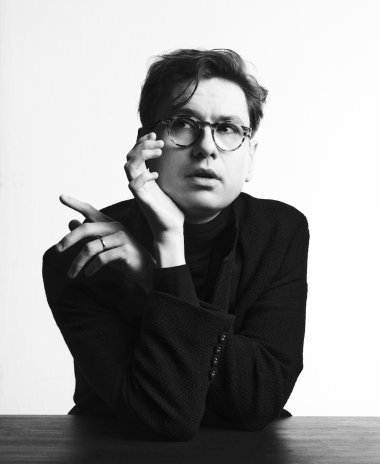
Although I’m working in a print medium, I want to make sure I pronounce your name correctly.
It’s “Vick-ing-ur,” and it’s exactly what you think: I’m a very civilized Viking. When I was in Hungary, the Hungarians told me that when you have an “ur” at the end of your name, in their language, it means someone who’s well-mannered, polite, sophisticated. So you could also call me a soft Viking. I tend to stay away from crime, but I do like parallel fifths and parallel octaves, so maybe I’m not as innocent as I’d like to pretend to be.
You’ve eschewed the straight and narrow path through classical music. I saw a televised collaboration with your compatriot Björk.
And I used to play in a big band when I was a teenager. I still have pictures of myself in the outfit. I listen quite freely to different kinds of music. Last year I was in Germany at the Schloss Elmau, and the evening after me was [jazz pianist] Brad Mehldau, so I hung out with him a bit. We sort of made a deal that maybe he would teach me a few tricks and I would, you know, return the favor in the other direction.
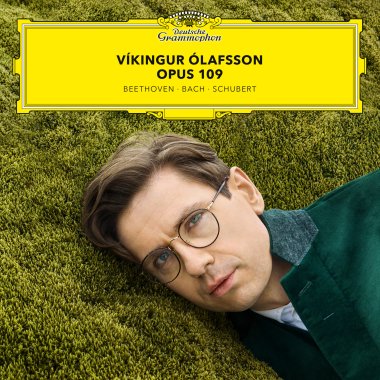
And on last year’s DG recording, Opus 109, which forms the program for this concert at Zellerbach, you explore that piece’s connection to Beethoven’s earlier work, Bach’s abiding influence on Beethoven, and Beethoven’s influence on Schubert.
What draws me to music in the first place, and what I try to find in my programs and albums, is to discover for myself, and hopefully for my audience, unexpected and perhaps new channels. You know, I did a whole album before called Debussy: Rameau [DG, 2020], where I was trying to argue musically that sometimes you can place two composers like that together and completely reverse their roles. I wanted to show Debussy’s deep roots, really, in the French Baroque, and how that sort of fueled his innovation. And how Rameau was sort of an outrageously innovative and forward-looking composer who, in a way, belonged more to the Romantic idea of artists, rather than being a man of the Baroque.
And with the Opus 109 album?
There were like 180 years separating Debussy and Rameau, so this album is much smaller; it’s really about six years in Vienna, framed by three Beethoven sonatas. His Opus 90 was written in 1814, when Schubert was 17 years old, and I think, in its second movement, you hear very much the seed of Schubert, when the piano ceases to be just a piano. It’s not a piano sonata, it’s a piano song, if you wish. And three years later, Schubert writes this incredible sonata that we have completely forgotten about today, the E Minor [D. 566, 1817], which, I think, is an homage to Beethoven. And three years after that, coming out of a five-year silence, Beethoven writes Opus 109.
You’ll be performing Beethoven’s Op. 90 and Op. 109, as well as Schubert’s E Minor Sonata. What has you going back to Bach?
You find threads of Bach running certainly through Beethoven’s late works. So it seemed very logical to put [Bach’s Prelude in E Major, from The Well-Tempered Clavier] into the mix. And it tied the narrative together with my past album of the Goldberg Variations [DG, 2023].
How does performing these works fit with recording them?
I love to have those two worlds. I really want listeners to listen to the albums, but then there’s the blood, sweat, and tears, the victories and disappointments of the concert hall. It’s like the difference between doing a film and stage acting. In the concert hall, everything is up for grabs — the audiences, or what did you have for breakfast — it’s improvisatory. That’s not me trying to replicate the album, it’s challenging myself to find a new perspective on the music, away from the album almost.
And the effect must vary for you day to day on tour.
Yes, with something like the Bach Partita No. 6 [also on the Zellerbach program], I play it drastically differently from performance to performance. You can take something like the opening of the Beethoven Op. 90 and it can have a completely different dramatic result, based on your timing, your proportion, your voicing, your color, the use of the pedal. You’re almost like a theater director: you’re directing the voices under your fingers, and you’re having the voices become different characters with different interactions from night to night.
I like the theatrical comparison, and I’ve seen how that works in your live and filmed performances.
When I go onstage, I like to keep it open and decide in the moment. A musical performer is like an actor with a role. And there are two kinds of actors: those who are acting the role, and those who become the role. I prefer the latter. I mean, a great jazz musician merges with the material, too. You become the material while you’re doing it. And that has the potential to move people.
And perhaps the potential for you to get closer to the composer.
In the late 20th century, there was this very academic tendency to pretend that there’s one right way with the music. But there is no right way. You listen to Maria Callas, [Vladimir] Horowitz, [Sergei] Rachmaninoff, Dinu Lipatti — those greats — they don’t apologize for bringing themselves into the mix. Through their merging with the music, something new is formed, and it’s maybe a meeting with the composer.
Cal Performances presents Víkingur Ólafsson on Wednesday, April 29 at 7:30pm in Zellerbach Hall. Tickets and more information are available at calperformances.org