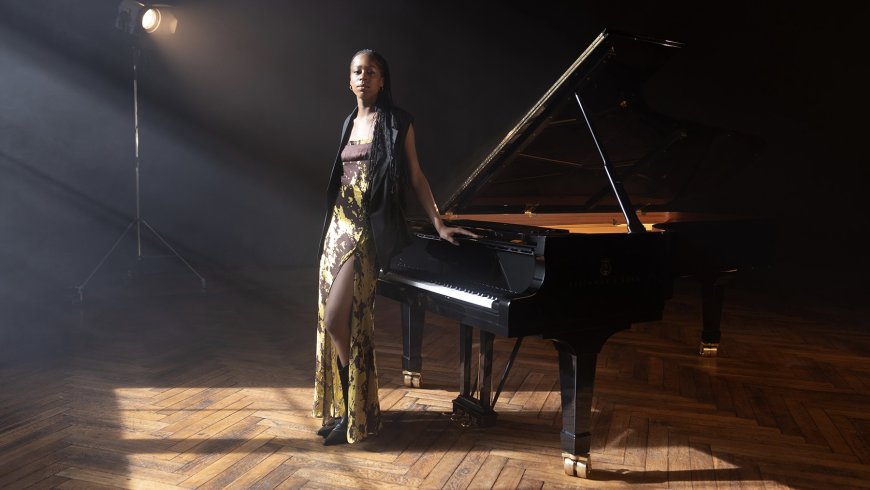
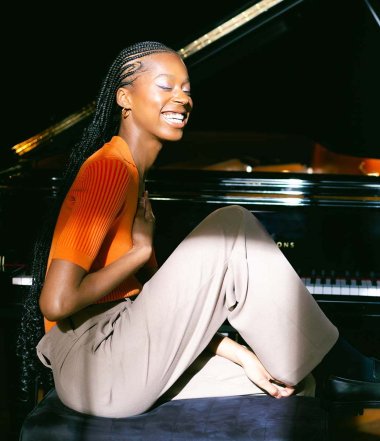
The fifth of seven siblings, pianist Jeneba Kanneh-Mason is a member of one of the world’s great musical dynasties. Indeed, the children of Stuart Mason, a business manager, and Dr. Kadiatu Kanneh-Mason, a former university lecturer, all play either violin, piano, or cello.
Jeneba, who recently turned 24, will make her debut with the Los Angeles Philharmonic at the Hollywood Bowl on Aug. 27, under the baton of Gemma New.
The family first came into mainstream consciousness in 2015, when they reached the semi-finals of “Britain’s Got Talent.” Soon after, cellist Sheku Kanneh-Mason won the 2016 BBC Young Musician award and performed at the 2018 royal wedding.
The Black British phenoms have continued to snag awards, both individually and as a group. They have also been the subject of numerous documentaries, including “CBS Sunday Morning” (2018), and “The Hills Are Alive With the Kanneh-Masons” (2023).
Jeneba, the third of the Kanneh-Mason clan to establish herself as a soloist, bowed on the international scene at the BBC Proms in 2021, when she performed the Florence Price Piano Concerto with the Chineke! Orchestra and was heralded by The Courier’s Garry Fraser as having “maturity in performance and interpretation.”
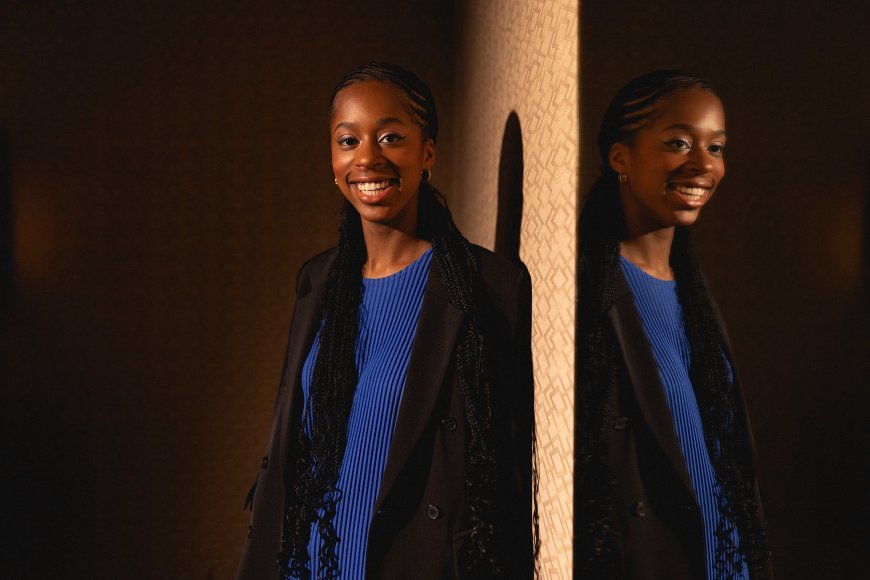
Prior to that, the pianist won the Murs du Son Prize at the Lagny-sur-Marne International Piano Competition (2014) and was the Keyboard Category Finalist for BBC Young Musician (2018).
In the 2025-2026 season, she performed with several orchestras in North America, among them the North Carolina Symphony and San Antonio Philharmonic. As an avid recitalist, the musician also returned to London’s Wigmore Hall and the Bergen International Festival.
SF Classical Voice recently chatted with Jeneba by Zoom from London, where she lives. Topics ranged from her musical family to her debut Bowl concert and status as a role model.
What was it like growing up in a household where music was a shared language? And do your siblings’ artistic habits or philosophies continue to shape your own approach?
I would say that growing up in such a musical environment has meant that all the lessons that I learned have followed me through my life now. And I think that one of the best things is that it's kept me and my siblings so close, because we talk about music so much and we offer advice to each other. It's just a great support network to have around me and to grow up with people who are doing the same thing as me, as well.

How are you able to carve out your own artistic identity within the broader context of your family?
What really helped us growing up was that we were very individual as people. We played together a lot — and we love playing together — but we always supported each other's solo identities, as well. We all had our moments in the spotlight, whether it was our grade exam or a big moment in a competition.
I think my parents really made sure that we each had our own identity. So now, I've adopted that later in life, and as much as I like working with my siblings, we enjoy playing [individually], as well.
Let’s talk about your Hollywood Bowl concert. It’s not only your first time in Los Angeles and debut at the iconic venue. It is also your first time performing with the LA Phil and maestra Gemma New. What are your thoughts on this?
I'm very, very excited about performing at the Hollywood Bowl, and with the LA Phil, an orchestra that I've watched a lot, and also working with Gemma New. I think that the setting of the Hollywood Bowl looks incredible, and the atmosphere of a concert being outside as well, creates a joyful, celebratory atmosphere. I've also heard great things about it from my older siblings.
The program is Rachmaninoff-heavy. You’re not only performing his Piano Concerto No. 2, but the orchestra is also playing the composer’s Symphonic Dances, Op. 45, with John Adams’s “Short Ride in a Fast Machine” as the curtain-raiser. So, why the Rach 2?
It wasn't 100% my decision to do the piece, but it's the concerto that I would have wanted to play if I had a choice, so, I'm glad that it's that one. My attraction is to the scale of the concerto. I think there's so much in it. Even if I've been playing it for such a long time, I discover something new every time I bring it back.
There’s an immense amount of detail in the music, and the melodies are so gorgeous, and the harmonies are so luscious. It’s also a concerto that I've listened to for as long as I can remember, so I think the familiarity, as well, is really enjoyable for me.
The familiarity is something the audience also relishes. What are the most physically demanding aspects of this concerto and how do you prepare for them?
It's definitely a difficult work. Because it's so dense, you have to be thinking about 100 things at once. That's probably the biggest challenge. So the way that I've prepared for it, I guess, it's layering things one at a time.
Then, when it comes to playing it all together, you kind of have all these separate things that you're latching onto, like anchors within the music.
Out of curiosity, when was the first time you played the concerto?
I was 17, and the first time I played it was on a Facebook Live concert. It was during [COVID] lockdown and my siblings had made an orchestra with the five of them. But the time I played it properly with an orchestra was a few months later when I was 18, in Nottingham Royal Concert Hall with the Symphonia Viva Orchestra.
I’m wondering how you adapt your sound and phrasing when performing with different orchestras or conductors. What is your rehearsal schedule at the Bowl?
We have just one rehearsal on the day of the concert, but I guess the orchestra must have played it hundreds of times. And I've done it a lot of times.
[Adapting to an orchestra] is really an in-rehearsal thing, because there are things that you can't predict or control. But playing with great orchestras, I think they’re all listening so well [that] it’s not incredibly challenging. We’re both adjusting as it goes on, and I know that the orchestra is really listening to me.
I know that the Hollywood Bowl is unlike any venue that I played in before, so there will be new things for me to think about. I try and have my ears as open as possible and try and be as adaptable as possible.
How do you feel about playing the piano on major international stages, especially as a young Black British artist?
I think that the piano can be for everyone, and I know that being Black and British and a woman, I represent a certain thing. So, I hope that I can inspire younger people who look like me [and] that my platform allows me to do that.
Is there a lot of expectation because of the family you come from, and do you attend each other’s concerts?
There probably is a lot of expectation, but I tend to shut that kind of thing out. I think what helps is that I'm always so happy to talk about my family and my siblings, so I don't see it as a pressure.
And yes, we attend each other's concerts as often as we can. Certainly, whenever [they’re] in London and if we’re free, we're always there.
Let’s talk about your latest album, Jane Austen’s Piano, which was released last December, coinciding with the 250th anniversary of her birth. What was the genesis of the record? Knowing she was also a pianist in her own right, how did you choose the pieces?
I really enjoyed doing it. It came about because of how much I love her books. I was told there was all this music she had annotated herself [with] her sister, and music that she played. Then I noticed how much music was featured in her books, and I chose the tracks from pieces that she’d written down herself.
I chose pieces by Handel and Haydn that she would have played when she was alive, and I also [recorded] “Dawn,” by Dario Marianelli, from the [2005] Keira Knightley film, “Pride and Prejudice.”
That was such a wonderful film! Finally, Jeneba, what about yourself would surprise most people? I doubt it’s flying an Air France Airbus like the LA Phil’s newly appointed Music Director, Daniel Harding!
I don't do anything remotely as cool as that, [so] I don't think there would be anything that would surprise anyone — but maybe that's the surprising thing! Maybe I’ll do something wild with fashion like Yuja Wang, but not at the moment!
I love food and have about three to four meals that I know how to do, but I’m a really bad cook. Sheku loves to cook; I don’t. The cooking process is the bit that I have to do to get to the enjoyable bit.