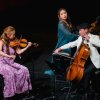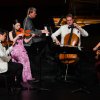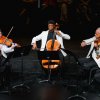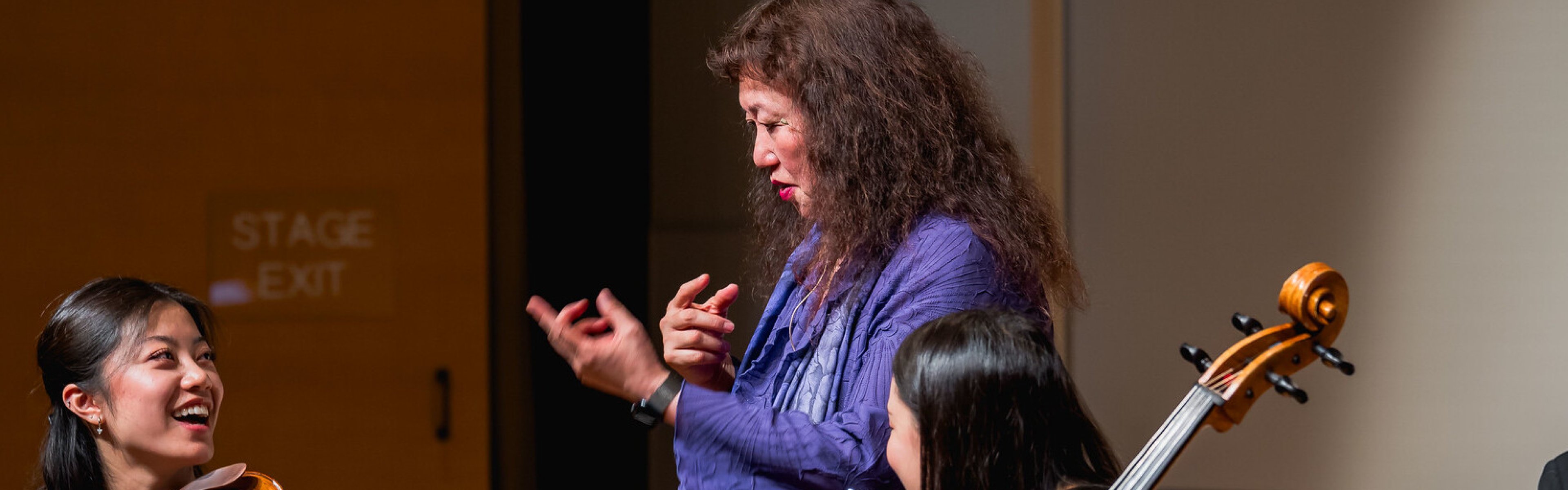
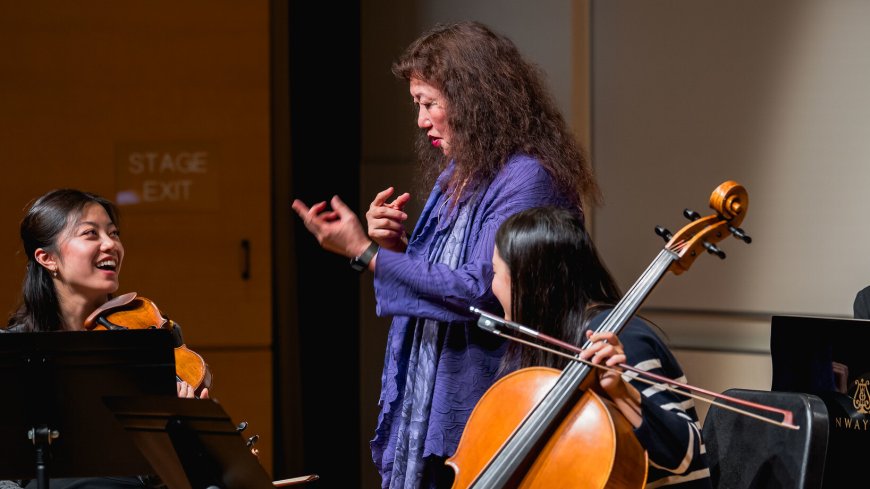
Sometimes things of beauty emerge from terrible loss. Such is the case with Music@Menlo, Silicon Valley’s spectacular chamber music festival and institute, which concluded its 24th season on Aug. 8.
Just under 25 years ago, the terrorist attacks of September 11, 2001, left the world in shock. For many classical musicians, the catastrophe overlapped with a personal crisis brought about by the news that the great violinist Isaac Stern was on his deathbed in a Manhattan hospital. When Stern died 11 days after 9/11, word quickly spread in the New York musical community that a “third tower” — beacon of hope and bedrock of classical music in the United States — had fallen.
For pianist Wu Han and cellist David Finckel — a married couple with deep connections to Stern — September 2001 became a time of reflection and reckoning. What direction did they want their lives to take? The impermanence around them was a call to action.
Stern, who had worked with Finckel and Wu Han in a series of intensive chamber-music encounters in Jerusalem and at Carnegie Hall, provided one inspiration. Vermont’s venerable Marlboro Music Festival, in which both had participated years earlier, provided another. A seemingly offhand comment by the chamber-music “groupie” Paul Brest, then-president of the William and Flora Hewlett Foundation, gave them the courage to think that founding a chamber-music festival of their own might be possible. After scouring the Bay Area, the couple found their location at Menlo School in Atherton, less than three miles from the Hewlett Foundation’s headquarters.
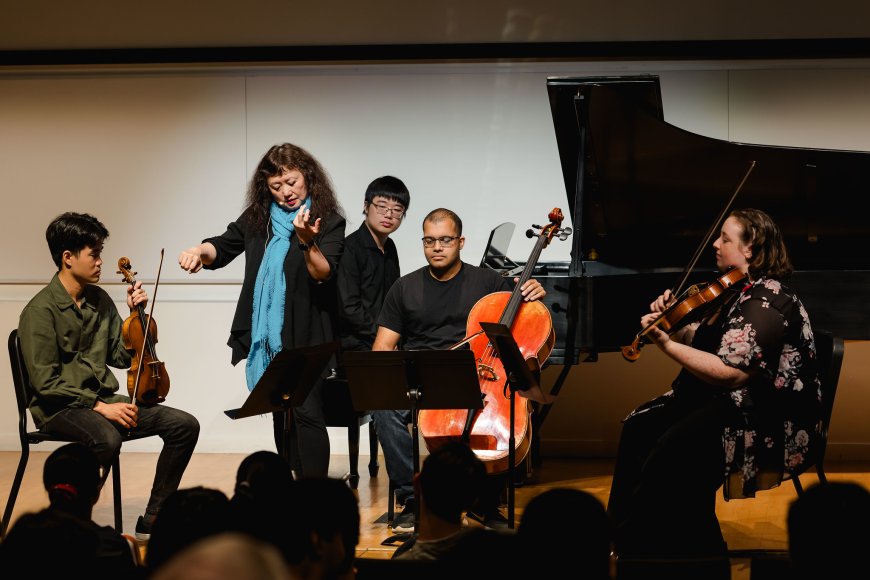
The festival’s public face is a series of professional concerts given by faculty and guest artists — this year seven concerts of chamber music and three concerts of Beethoven piano sonatas (part of a complete cycle of the 32 sonatas that Gilles Vonsattel is surveying at Music@Menlo across the 2026 and 2027 festivals). At its heart is the Chamber Music Institute, which consists of two interrelated educational programs: the Smith Family Young Performers Program for students ages 13 to 19, and an International Program for high-level conservatory students and young professional musicians ages 20 to 30.
The selection process for the two programs is highly rigorous. Applications for the Young Performers Program require video recordings of two contrasting pieces, a video statement explaining why the student wants to participate, and letters of recommendation. Of the approximately 125 applicants, almost 80 percent advance to live auditions and interviews in Boston, New York, Chicago, the Bay Area, Los Angeles, Philadelphia, and Houston (international applicants audition over Zoom).
Achievement is exceptionally high among everyone who reaches the live round, but it is not the only criterion. A student’s ability to benefit from the program and collaborate with others also plays a role. The winner of a major competition may or may not be the best fit. Almost everyone admitted to the program has soloed with an orchestra, but at Music@Menlo everyone spends some time playing “second fiddle,” with the same commitment they would bring to a solo. A crucial element of chamber music is the ability to listen and react to others. The live audition tests this by having applicants rehearse with one of the judges.
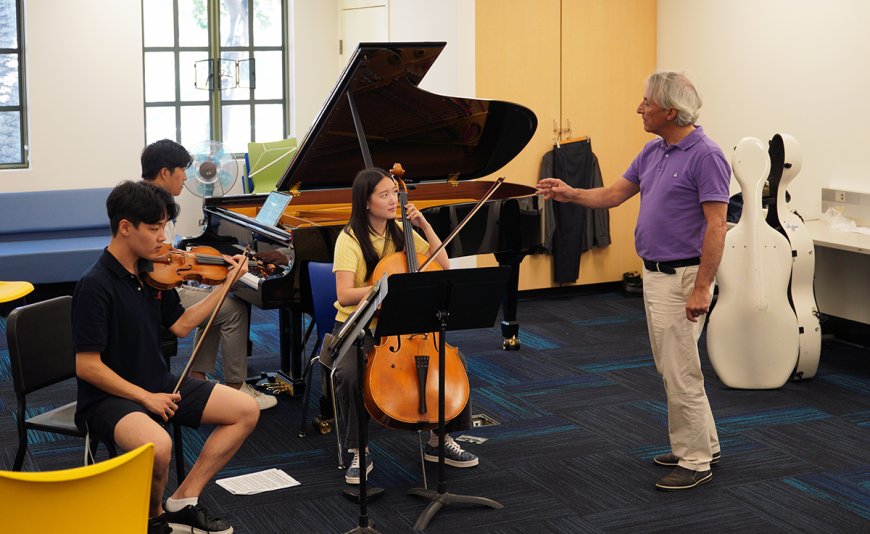
In the first two decades of Music@Menlo, participants in the Young Performers Program had to provide their own housing. The result was that a majority came from the Bay Area. As the program’s reputation spread, its geographical reach expanded — a trend turbo-charged in recent years by the opening of dorms at neighboring Menlo College and a gift that makes participation free for all participants. This summer, four of the 22 Young Performers came from the Bay Area, five from China, two each from greater Boston, greater New York City, Canada (Toronto and Calgary), and New Mexico, and one each from Chicago, Michigan, Singapore, Taiwan, and Texas.
While many of these students go on to careers in musical performance, others have taken Music@Menlo’s lessons of teamwork, creativity, and problem solving into fields such as medicine, finance, and IT. (An alumna of the YP Program recently hired by Google made sure her piano was the first piece of furniture installed in her new apartment.)
The criteria for selecting the International Program’s young professionals are similar to those for the Young Performers, but with only 11 fully funded spots, the competition is even stiffer. (One of the stellar participants this year had auditioned four times previously.)
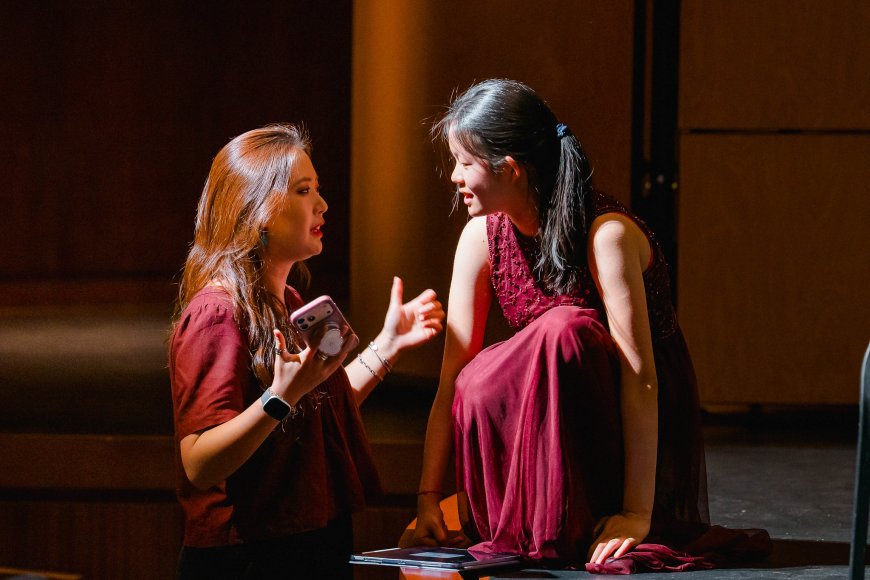
While many summer festivals have programs for advanced conservatory students and young professionals, Music@Menlo is unusual for intentionally exposing them to the rigors and the business of a touring chamber musician’s life. The International Performers are expected to arrive fully in command of their assigned parts in five major works of chamber music. Each of those works they will perform in two different venues, coach with several faculty members, and take into master classes with visiting artists. They are also expected to mentor two or three Young Performers, attend events with donors, establish connections with faculty and visiting artists, and learn about the ins and outs of running a festival — all while rehearsing, being model guests to their local hosts, and attending concerts and lectures. (Sleep during the three-week festival is in short supply.)
Young Performers and International Performers also develop their skills in public speaking by addressing the audience at performances. For the YPs, almost all members of an ensemble speak. The first introduces the players; the others add remarks about the composer, the work at hand, and a personal reflection. There’s nothing quite as humorous as a boyish 16-year-old declaring: “Fun fact, Arensky was drunk all the time, so, yeah, I hope you enjoy his trio!” The sentiment is all the more heartwarming in contrast with the maturity of the playing that followed.
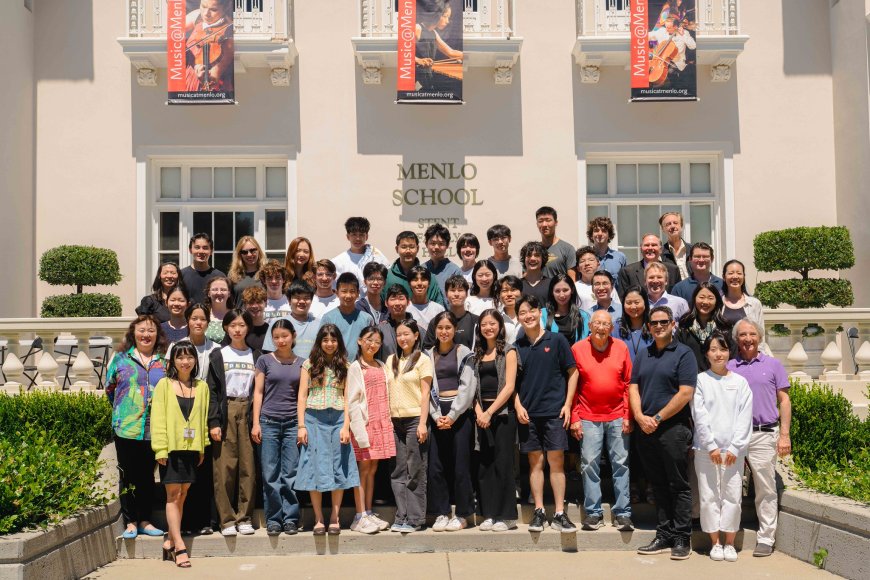
International Performers, appropriately for their station, have just one member of their group speak. In my week of observing the program, those personal comments were the telling ones. A poised violinist introducing Fauré’s Piano Quartet No. 1 told the audience that she loved the work so much that she had been using the opening of its second movement as her smartphone alarm for the last five years.
I found this remark especially revealing. In a world that is ever more dominated by technology, Music@Menlo provides a refuge for the continuation of a pre-digital tradition. Performers rely on the same basic techniques — rosined horsehair and hammers meeting strings — to set a room aglow with harmony as they have for well over two centuries. Yet musicians are also part of the modern world — iPads are now standard for reading scores, and iPhones are filled with recordings. (A 15-year-old Young Performer had listened to a recording by the Beaux Arts Trio over a hundred times.)
Legacy, always at the heart of an artistic tradition, was much on everyone’s mind this summer as Finckel and Wu Han concluded their final season as the festival’s artistic directors, with Dmitri Atapine and Hyeyeon Park set to take the helm. At the emotional conclusion of the festival, my thoughts turned to Isaac Stern, who grew up some 30 miles to the north in San Francisco. Had Music@Menlo been around in the 1930s, it surely would have been a part of his education.
Lucky are those who can experience that legacy through Music@Menlo today.