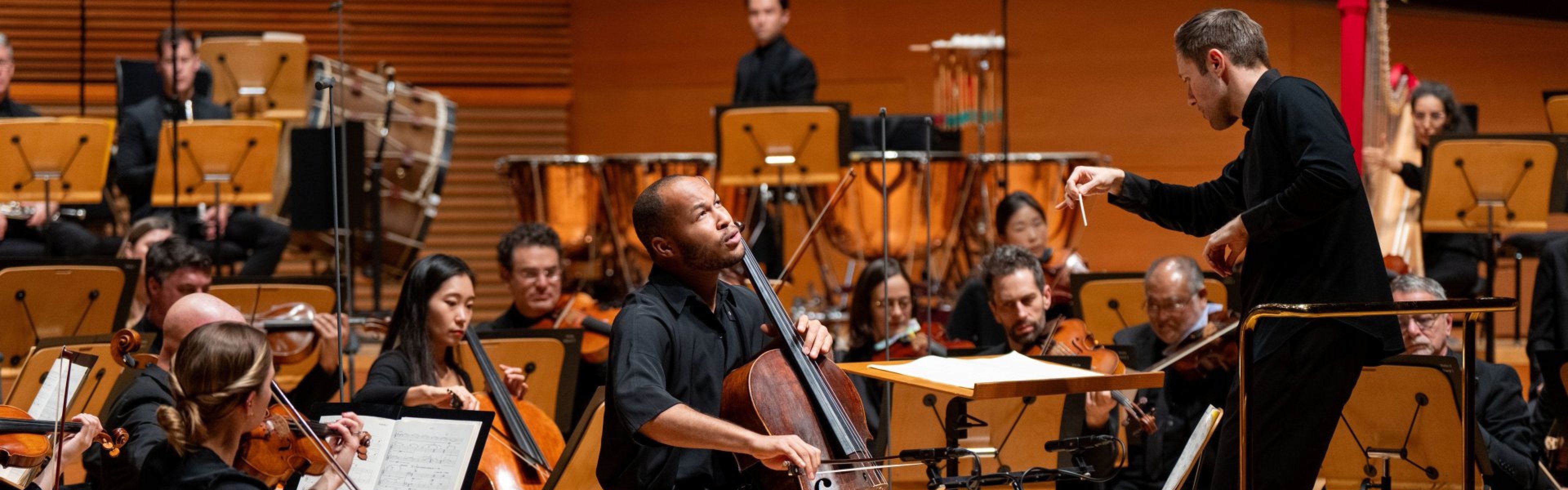
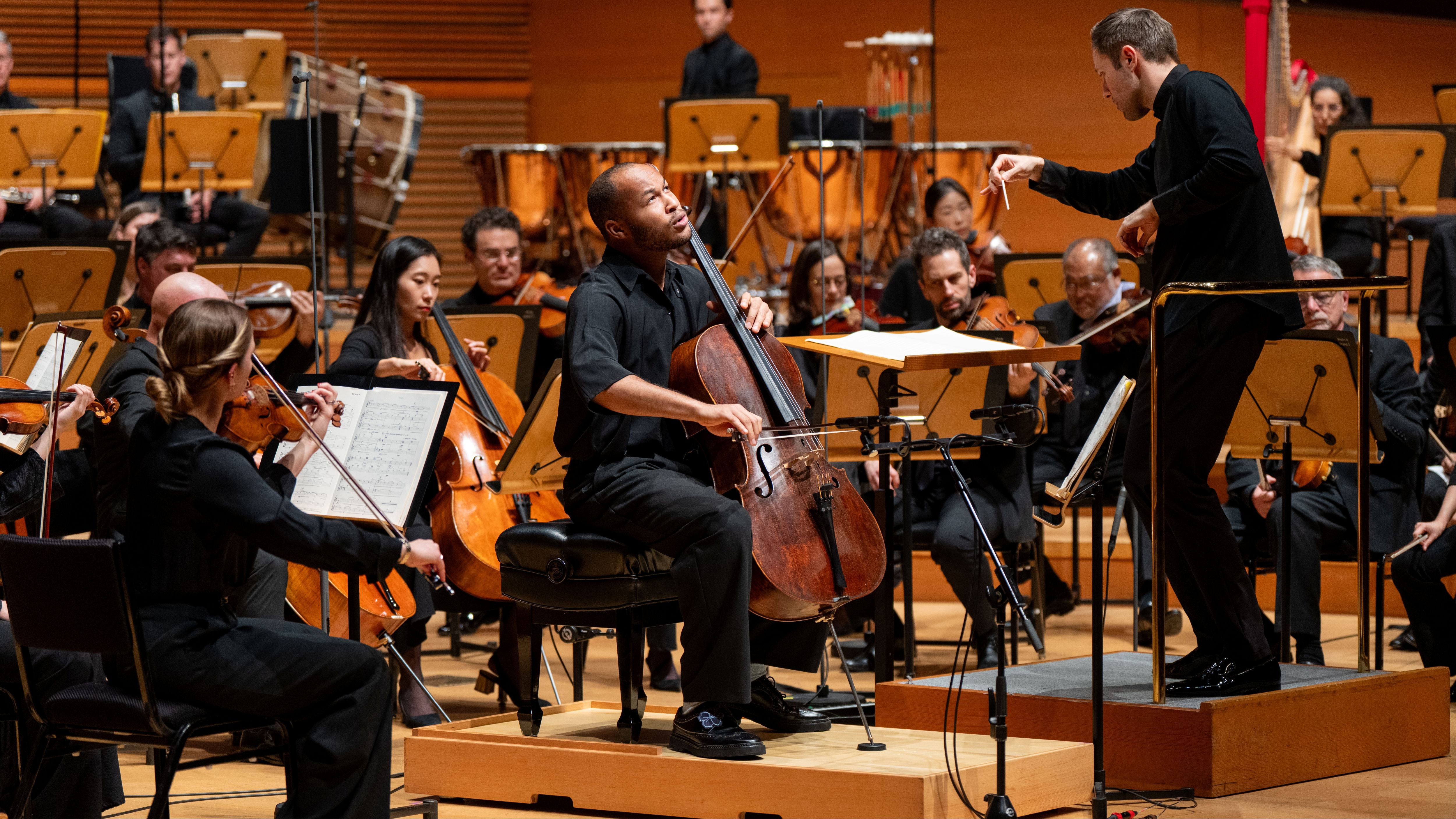
The Los Angeles Philharmonic often plays host to interesting combinations of headliners. This past weekend, it was the celebrated British cellist Sheku Kanneh-Mason and a less well-known Spanish conductor, Roberto González-Monjas.
Their concert, on Friday, Nov. 21, sandwiched the world premiere of a new cello concerto written for Kanneh-Mason by British composer Edmund Finnis between two examples of theme-and-variations by Erich Wolfgang Korngold and Sir Edward Elgar. Not a routine evening at the Phil — which is the way they like it, whenever possible.
Korngold’s Theme and Variations, Op. 42, was the Austrian composer’s last original work, written in Los Angeles in1953. At the time, Korngold was six years past his period of scoring films and was trying to re-establish himself in the classical concert world, and finding the going rough, even heartbreaking. “Old hat,” the critics thought of his style. And indeed, this music is proudly and unapologetically post-Romantic — even cinematic in nature, as if Korngold had never stopped scoring for Warner Bros.
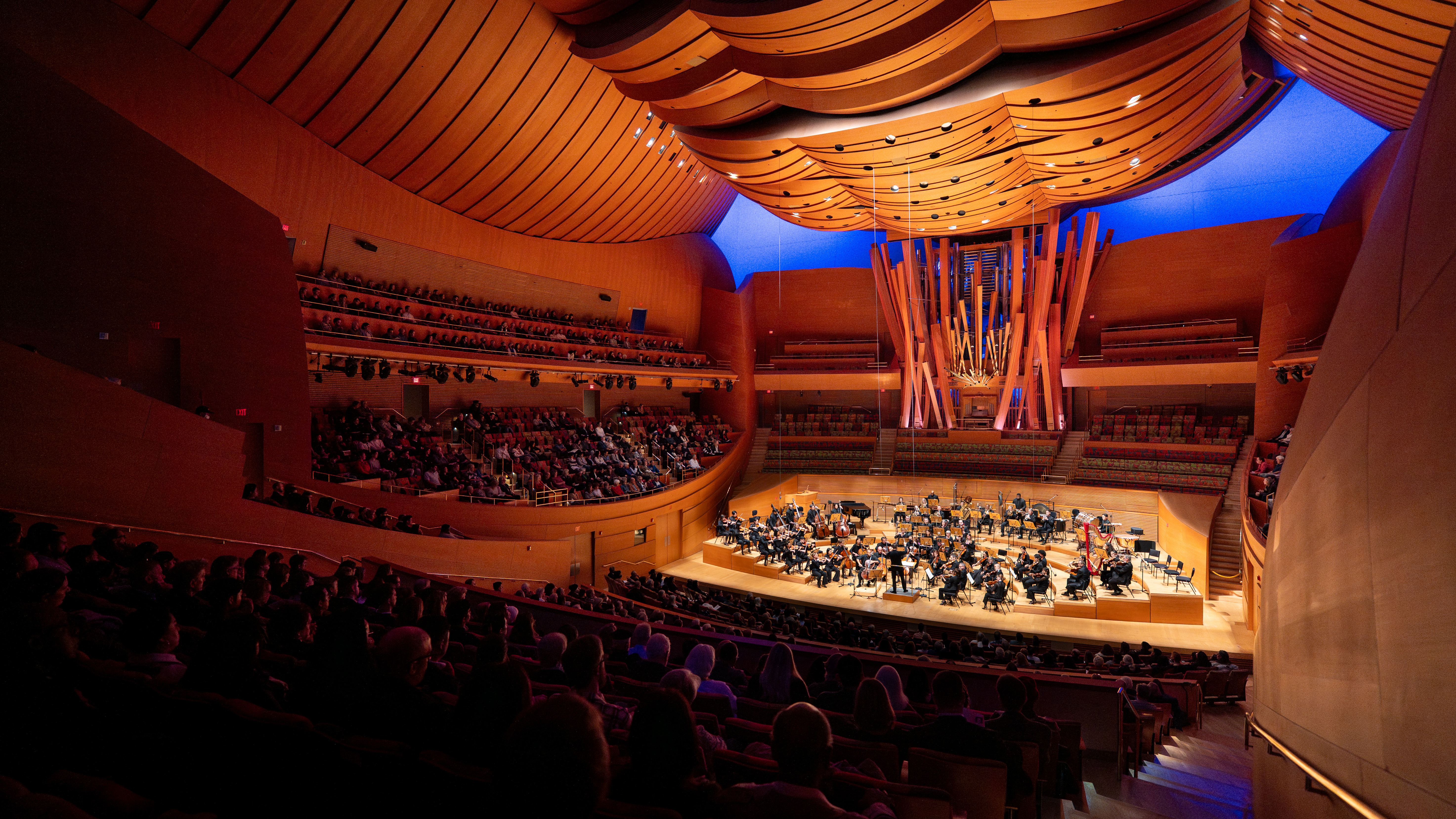
Beginning with a luscious theme that reminds us as much of Frederick Delius as it does the adventures of Hollywood swashbuckler Errol Flynn, Korngold reworks and embroiders the tune with a succinct, skillfully crafted set of variations before concluding with a big, broadly melodic coda that all but screams the Warner Bros. cartoons slogan, “That’s All, Folks!”
All of this happened in just eight-and-a-half minutes, as González-Monjas gave the score a lean, fast, and almost neoclassical treatment. It should have become a very popular curtain-raiser in its time, but this was the LA Phil’s first-ever performance of it.
The Elgar work was, of course, the Enigma Variations (1899) — for my money, his best piece: ever-inspired in invention, ever-rambunctious, ever-touching, and ever-grand in evoking the British Empire at its zenith. It was also a chance for González-Monjas, 37,who worked without a score, to leave a big physical impression — as well as a musical one — with his wide circular conducting motions and impulsive energy.
He made the rambunctious variations snap and pop; the thunderous “Troyte” variation even provoked an audience ovation. He exposed lots of inner detail and gave “Nimrod” its proper supply of pomp. In the concluding variation, “E.D.U.” – said to be an Elgar self-portrait — González-Monjas let loose sudden shifts in tempo, delivered slashing attacks, and leaned excitedly into the flag-waving coda. He’s somebody to watch.
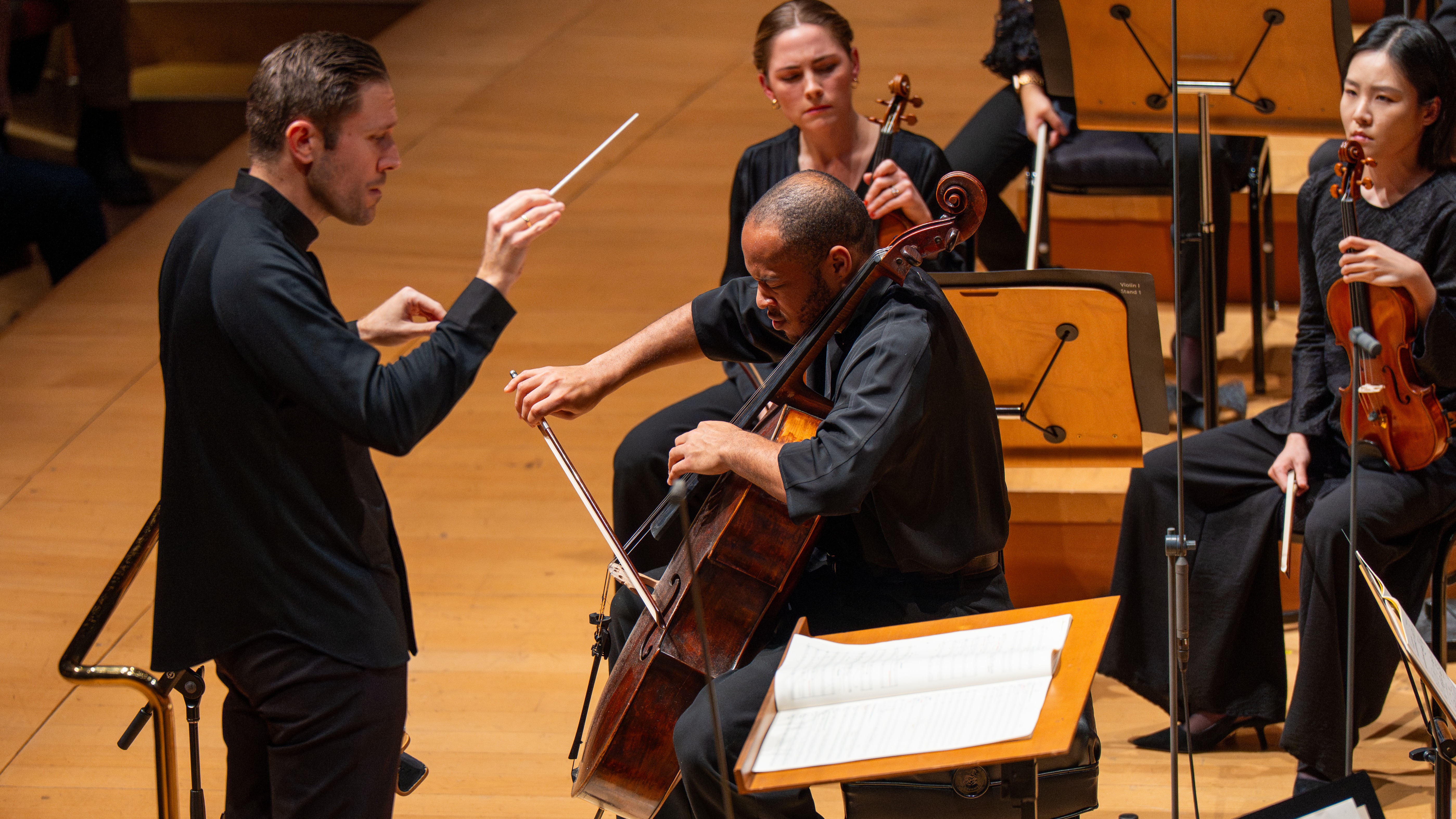
Against the spectacular Enigma Variations, Finnis’s concerto was overmatched. The composer, 41, has an impressive resumé of work in classical and electronic music in England and, interestingly, he served as an amanuensis and scribe for the late avant-garde composer Jonathan Harvey, who was stricken with Lou Gehrig’s disease. He also writes rather evocatively about his music in his program notes – two examples: “Waves of energy accumulate and disperse …” “… a gradual descent through the moonglow of faint string overtones.”
But the proof is in the listening — and on a first hearing, the orchestra seems to serve mostly as musical wallpaper, rarely interacting with the solo cellist.
The strings begin the first movement eerily as the soloist plays sustained multi-stops in the lower register, and then wanders discursively. The piece itself low-key and dark, in a broad tempo, until the orchestra rouses itself to a brief burst of near cacophony before falling back into torpor.
There is barely any difference in the second movement, “Lamentoso,” although here, the cello is permitted to sing as the line meanders. The tempo — and interest — gratefully picks up in the finale as the harmonies grow denser. The soloist gets some indistinctly heard busywork, but the tiny movement was over before you can blink. Kudos to Kanneh-Mason for venturing into new territory, but I doubt whether this new concerto will have staying power.
The encore was the third movement of a suite for solo cello by Natalie Klouda. It was in the same mood as the Finnis concerto — subdued and of moderate interest.