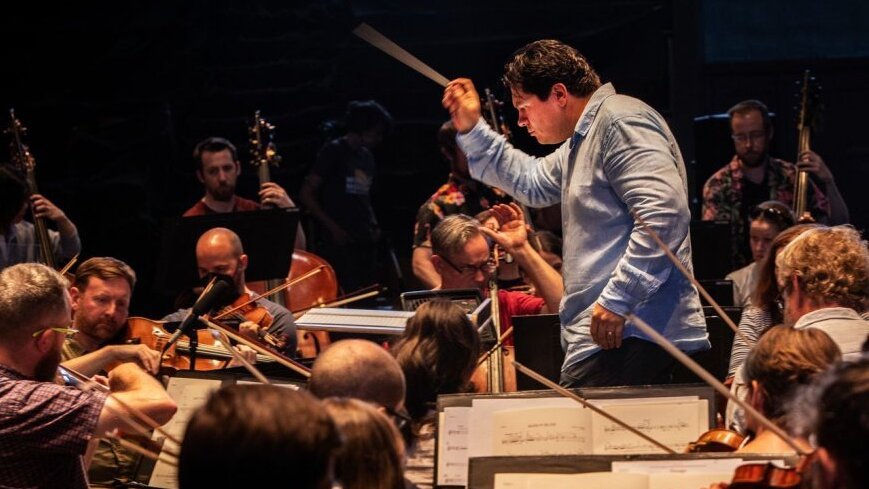
What happens when we give up artistic control? The Cabrillo Festival of Contemporary Music’s Saturday, Aug. 8, program at the Santa Cruz Civic Auditorium — titled Control — explored the question from several angles. The flagship work, and the first on the program, was the hotly anticipated world premiere of Clarice Assad’s Kontrol, a darkly humorous and ingenious work of musical performance art that parodied a tech demo, with the audience, presumably, in the role of venture capitalists.
A short, sleek advertisement described the setup: Kontrol is a neural implant that gives anyone, at any skill level, the ability to play and compose music beyond human capacity. Kontrol is also the app that interfaces with the chip, and Assad demoed it via screen share to “control” the members of the orchestra and violin soloist Philippe Quint. The initial music was excerpts from Vivaldi’s The Four Seasons, which Assad manipulated the orchestra into reshaping in several ways: changing the pitch, then the style, then a “Vivaldi superhuman” setting that saw Quint and the orchestra play the famous Presto at lightning speed, a speed that was, of course, still human. At a certain point, the Vivaldi “glitched out,” and Assad had to recalibrate the app to reassert Kontrol.

Next, Quint expressed a desire to play new material — something magical and beyond imagination. Assad then launched into the second half of the demo, a movement titled “Houdini” — another wink to the audience that this was all a ruse. This material lived up to its name, evoking Bernard Herrmann’s scores for The Twilight Zone, but with a modern, darker intrigue as the piece glitched and thrashed in a wild frenzy. Eventually Assad lost control entirely, the app overriding her and making the musicians play until they, and she, literally dropped. As the music wound to its close, a foreboding interview with Quint and Assad played, screening them for the neural implants with haunting questions like “Do you have a history of resisting authority?”
The audience response was electric, even if the players were not literally electric themselves. The unreality of seeing Assad do her best Elizabeth Holmes impression and be escorted offstage by the real stagehands as Kontrol took over felt like the sublime antics of pro wrestling. The piece seemed to critique three different kinds of real-world authority: that of conductors, of tech oligarchs, and of composers mounting costly, tech-intensive projects at venues like the Park Avenue Armory.
The rest of the program embodied this musician-centric theme, continuing with a movement from Defending Greenwood by Jackson A. Waters, winner of the 2026 Cabrillo Emerging Black Composers Prize. Waters’s piece dramatized the horrific Tulsa Race Massacre, a tragedy that has only in recent years received long-overdue attention. Waters’s music was appropriately macabre, featuring heavy use of percussion, rousing ostinatos, and brief motives that made good use of the orchestra’s sections. Certain sounds overstayed their welcome, and the development and pacing were not always clear. But that was to be expected of a single movement heard apart from the whole, and Waters has the charisma and the talent to give buried histories bright, vivid reanimation.
Next was Hannah Ishizaki’s Spin, a piece the Festival Orchestra’s musicians selected from open score submissions. Spinexperimented with combining the Viennese waltz with elements of electronic dance music. Unfortunately, as is all too common when composers of concert music write pop, the result came across as coy and illegible. The work recalled existing sendups of the waltz by Shostakovich and Ravel far more than the upbeat ecstasy of EDM. The only hint at electronica came in two contrabassoon entrances, both brief, as was the work as a whole — roughly five minutes.
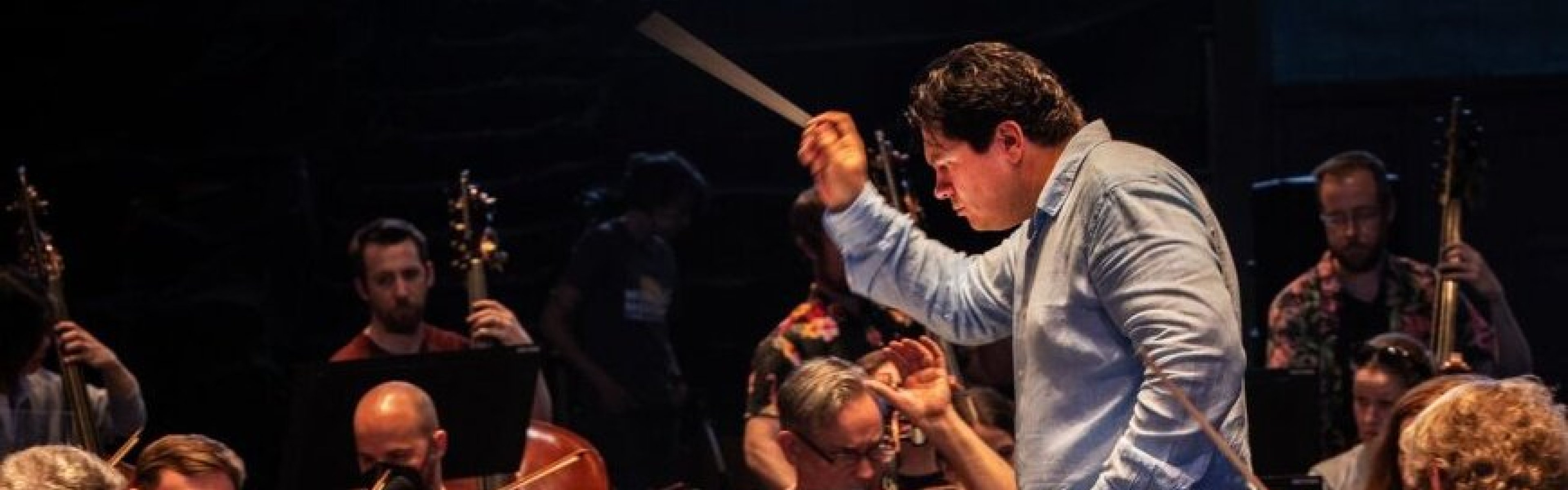
The evening concluded with Romanian composer Dan Dediu’s Concerto for Orchestra, receiving its U.S. premiere. At the urging of Music Director Cristian Măcelaru, Dediu wrote the concerto with a mind for making the orchestra sound not symphonic but operatic, even human. The piece exhibited a lush, varied harmonic language, a wide orchestral palette, and a powerful sense of dramaturgy. It began with a recurring motif, a chaotic, angular 16th-note figure played in unison by the violins, then exploding across the rest of the orchestra. This atonal material wrestled for control with a warm, neo-Romantic theme that showcased Dediu’s cinematic lyricism. Echoes of Bartók’s and Lutosławski’s concertos for orchestra came to mind, but Dediu’s ear for musical drama made his concerto feel more explicitly narrative than either — novel and exhilarating.
Following Kontrol, each piece was a celebration of the many people who make music possible. From an early-career composer’s exciting debut, to a piece chosen not by the conductor but by the orchestra, to a piece written to exalt that orchestra’s abilities, the evening carried a refreshing immediacy and optimism, leaving the audience with a sense of triumph as Dediu’s concerto ended with a crash.