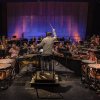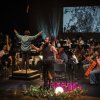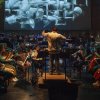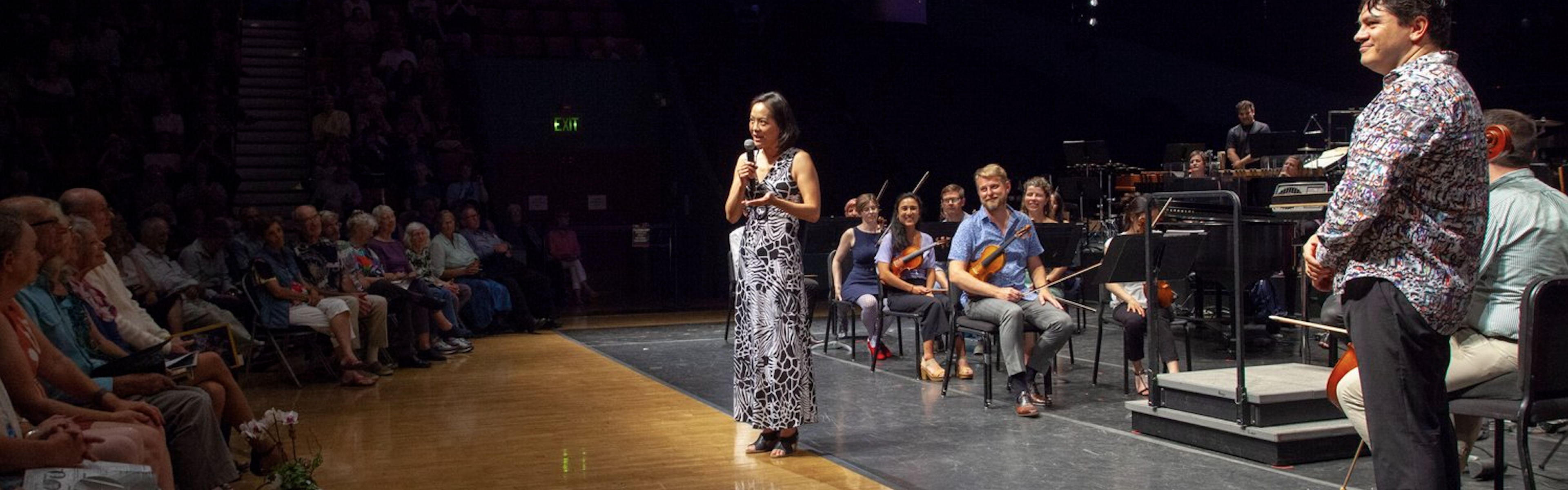
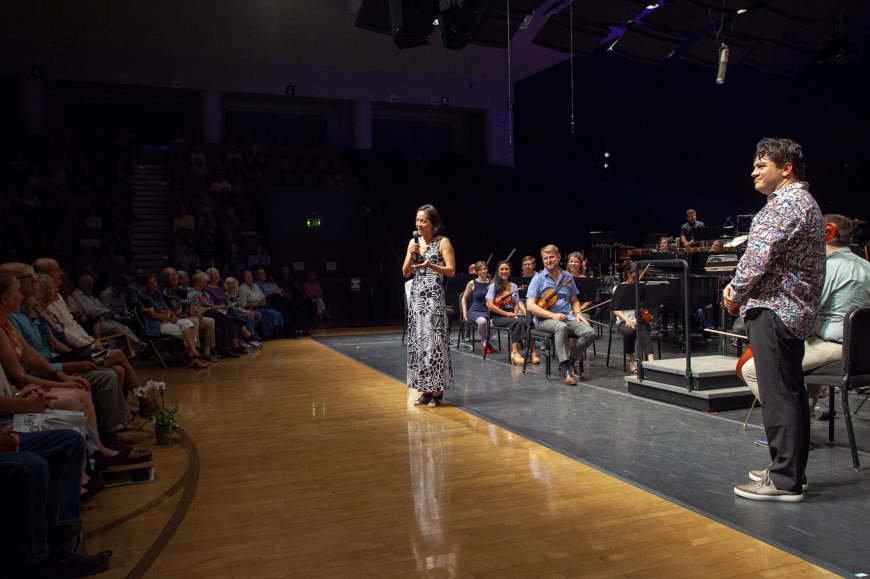
The Cabrillo Festival of Contemporary Music was founded by a bunch of 1960s counterculture types like composer Lou Harrison, who never hid his political leanings. Harrison was a Left Coaster who was strongly pacifist, spent a lifetime learning about Asian musics, was knowledgeable about gay history, and eventually built a straw bale house in the desert town of Joshua Tree.
Harrison lived at a time of excessive formalism and a retreat from “extramusical” meaning — programs, descriptive titles, and the like. His successors — at Cabrillo this year and in new music generally — have no such qualms. They’re communicating messages in their works, both at the behest of the Festival directors and on their own.
The season opened on July 31 with the West Coast premiere of Philip Glass's Symphony No. 15, "Lincoln," and Vivian Fung's America the Beautiful? — a title that ends, pointedly, in a question mark. But composers are talking to audiences throughout the festival, and the trend reaches twin peaks in the closing weekend: Clarice Assad's orchestra-theater piece Kontrol and former U.S. Poet Laureate Rita Dove's closing reflection, in which she recites original poetry honoring the life and legacy of Martin Luther King Jr. alongside Samuel Barber's Adagio for Strings.
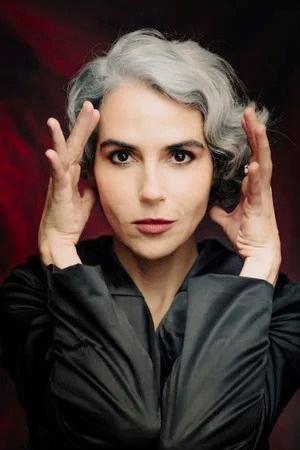
“Cabrillo is the perfect place for this. I always try my most adventurous works there,” said Assad in an SF Classical Voice interview. “Sometimes they go on, sometimes they fail, but it’s a way of knowing.”
Fung — a dual Canadian and American citizen of Chinese descent — meanwhile wrote her five-minute Festival commission for the 250th anniversary of the Declaration of Independence. “When Riley [Nicholson] proposed it, I was like, ‘And you’re choosing me for this? Why?’ But I think, on reflection, it’s a really good choice because they want to show that America is not a one-size-fits-all [idea].”
Her piece, she said, grows out of the urgency of the present moment. “I have the responsibility of portraying the message and storytelling that we need. Other people are not taking the responsibility and that void needs to be filled. It’s an important time to be an artist — I see the necessity of it. And there’s a lot of messages across [my work] — not all of it is meant to be political. It’s a message about humanity and the age we live in. At times it can become political. But it’s up to us to tell these stories.”
As an example, Fung pointed to her song cycle Lamenting Earth, recorded by tenor Nicholas Phan. “The donor that approached us felt that our voices are not being heard on the issue of climate change and he was turning to us, of all people, for help,” she recalled. “And I was, like, ‘what can I do?’ But we have this powerful resource of music to create empathy in the room.”
When asked about the question mark at the end of her title, Fung replied that the piece was indeed political, but in a complicated way, like most of her work.
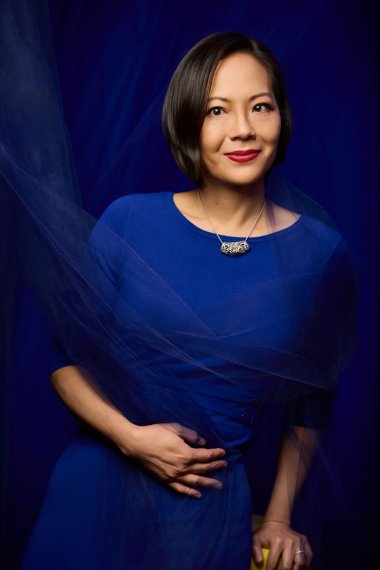
“First and foremost, my relationship with the United States is full of gratitude because I came here to go to school. That experience, the professional experiences I’ve had and the opportunities I’ve had throughout my career in the U.S. — I am very grateful for that.
“At the same time there’s a complex feeling of despair, anger because of what is happening now with ICE and how immigrants are scapegoated for a lot of things. My parents are immigrants, I am an immigrant — so to speak — and there is a level of misunderstanding of what an immigrant is and what they’re capable of. And there’s a lot of injustice involved as well.
“And so this piece has mixed feelings to it. There are quotations of “The Star-Spangled Banner” and the title ends with a question mark because it’s really up to us as a democratic people, to decide what is important to us. The idea of liberty and the pursuit of happiness is ingrained into us but what that means is up to our interpretation.”
Assad’s work is more overtly theatrical and delivers a pointed message about artificial intelligence.
“This piece started with a great concern of mine about surveillance, like how everything we look at or click on online immediately starts to follow us around,” Assad said. “And we’re being tracked more and more, and it could go wrong and get worse. It is also about consent and how far humans are willing to go to become better at what they do and use technology for that.”
Kontrol has a plot: Violinist Philippe Quint, the work’s soloist, applies to be fitted with a microchip that will allow him to play better and faster. But the consequence is that he loses his artistic freedom. From the stage, Assad uses her laptop to control what Quint and the orchestra play. She’s chosen the famous theme from “Autumn” in Vivaldi’s The Four Seasons, and she’s able to “force” the orchestra to play whatever she wants by signaling the musicians’ microchip implants.
But then, as Assad describes it, “what happens in version 2.0 is that AI starts getting control over everything, even overriding my own ability to change things onstage. So that’s really creepy. I’m starting to lose control and we all are lobotomized at the end. It’s not a happy ending.”
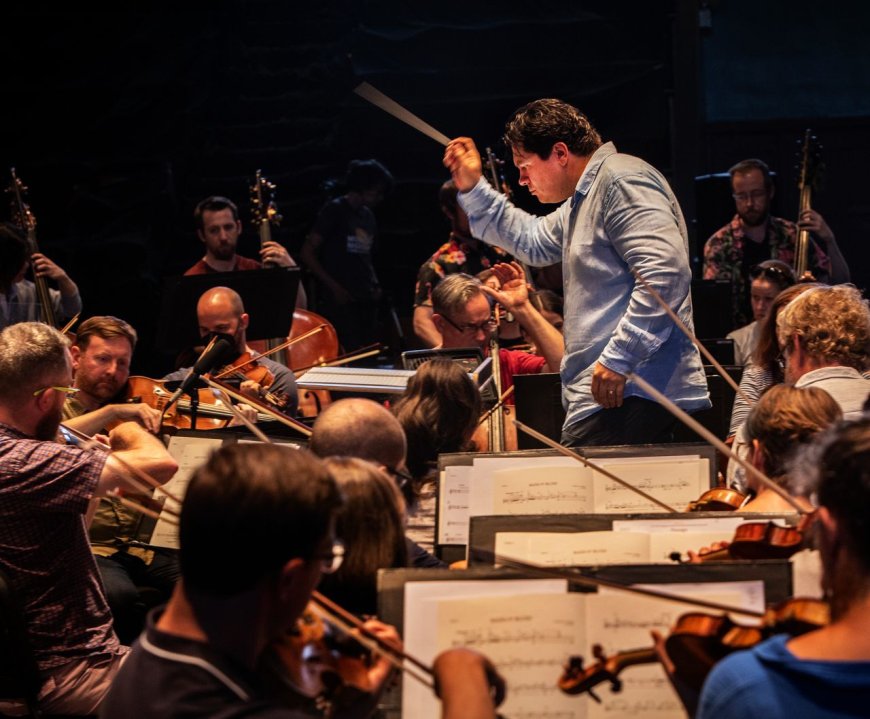
Asked whether the piece could play into musicians’ desire to be perfect, Assad readily agreed. “When he’s asked, Philippe admits that he wants to make no mistakes, he wants to play faster, he wants to cross strings more freely,” she explained. “It’s funny like how he just wants to be a machine. And classical music is very much based on 'we cannot make mistakes.' A wrong note is just a wrong note.
“But I think this is everywhere. Think about it: even pop music, everybody is using autotune; it needs to be perfect and polished. There’s that feeling across everything that we do. The image that you present cannot have any marks on your face, it has to be Photoshopped. It’s very curated. I have no idea how we got to that point but at the end of the day, we are being watched and followed constantly. And we’re being sold things. And that’s what this piece is about. We’re chasing something that is unattainable unless we become machines.”
The differences between Assad and Fung are a microcosm of the variety of American music and musicians that Cabrillo is highlighting this year. Assad is the daughter of famed Brazilian guitarist Sérgio Assad and her aunt is the singer-songwriter Badi Assad. She has said that her home is “The Americas.” She comes out of the Brazilian popular-music tradition.
Fung is the daughter of Chinese immigrants to Canada who made sacrifices to send her to the Juilliard School for composition, where she launched her career. Like Assad's, her work spans an enormous range — neither composer can be pinned to an ethnicity or a performance tradition. Not unlike Harrison.
That's not to say that Brazil and China are undetectable in their works. Fung is writing an opera about her family history and has made several trips to China to study the music of rural minority communities there. Her last trip, to Guizhou, the Chinese province east of Yunnan, was made with violinist Nancy Zhou and the music they experienced there will eventually become part of Fung’s third violin concerto.
The disappearance of those musical traditions carries its own urgency for her. “In Yunnan, there are maybe 50 recognized minority groups and each one is distinctly different,” she said. “And I found that it’s tragic that their cultures are dying out because, first of all, there’s no written language — it’s all orally transmitted. So there is that very real fear of extinction because the kids are boarded in schools that only teach Mandarin. And you can speak the language at home but there’s that idea of modernization and everything is being replaced by more efficient, more cost-effective but also culturally flat products. So houses, even weaving — you know that’s now done by machine, not by hand, so there’s no need for batik.
“So I feel urgency there, too, because there are all these groups whose voices are not being heard and it’s important to acknowledge them and to pay respect to them and the part of their lives that is disappearing.”
Assad, for her part, can weave magic from disparate folk traditions in pieces like Baião 'N' Blues, which premiered in 2023 and appeared at Cabrillo the next year. But Kontrol is, appropriately, very formalistic, with the composer announcing technical transformations like “retrograde” (the theme played backwards), cuing the orchestra and soloist to execute that.
Like the 21st-century music scene as a whole, their styles are assembled from many sources and made personal — which is to say, they sound like the world we live in. As Assad puts it: “The world is changing. People are glued to their phones. Their attention spans are shorter and shorter every year. I feel like sometimes when I’m performing that people are like — poof! — they went away. This is a way for me as a musician to try to see how we can connect. How can we get everybody there, every second? How can we bring everybody together to talk about something relevant, do something outside the box, even in a [orchestra concert] setting that is supposed to be completely void of these things?”
And if that could happen, maybe people would listen to the messages musicians are sending them.