Reviews in this article:
Die Frau ohne Schatten/ Bluebeard's Castle
Last December, I started planning what turned out to be an absurdly long trip to Europe for the summer of 2026, five weeks to attend four music festivals. First up: the matchless Festival d’Aix-en-Provence, currently being run by American director Ted Huffman — a 2010 Merola Fellow — following the unexpected death of Pierre Audi last year. Aix has a distinguished history of presenting important new works and productions, among them Kaija Saariaho’s Innocence and Patrice Chéreau’s Elektra.
Accabadora, July 9
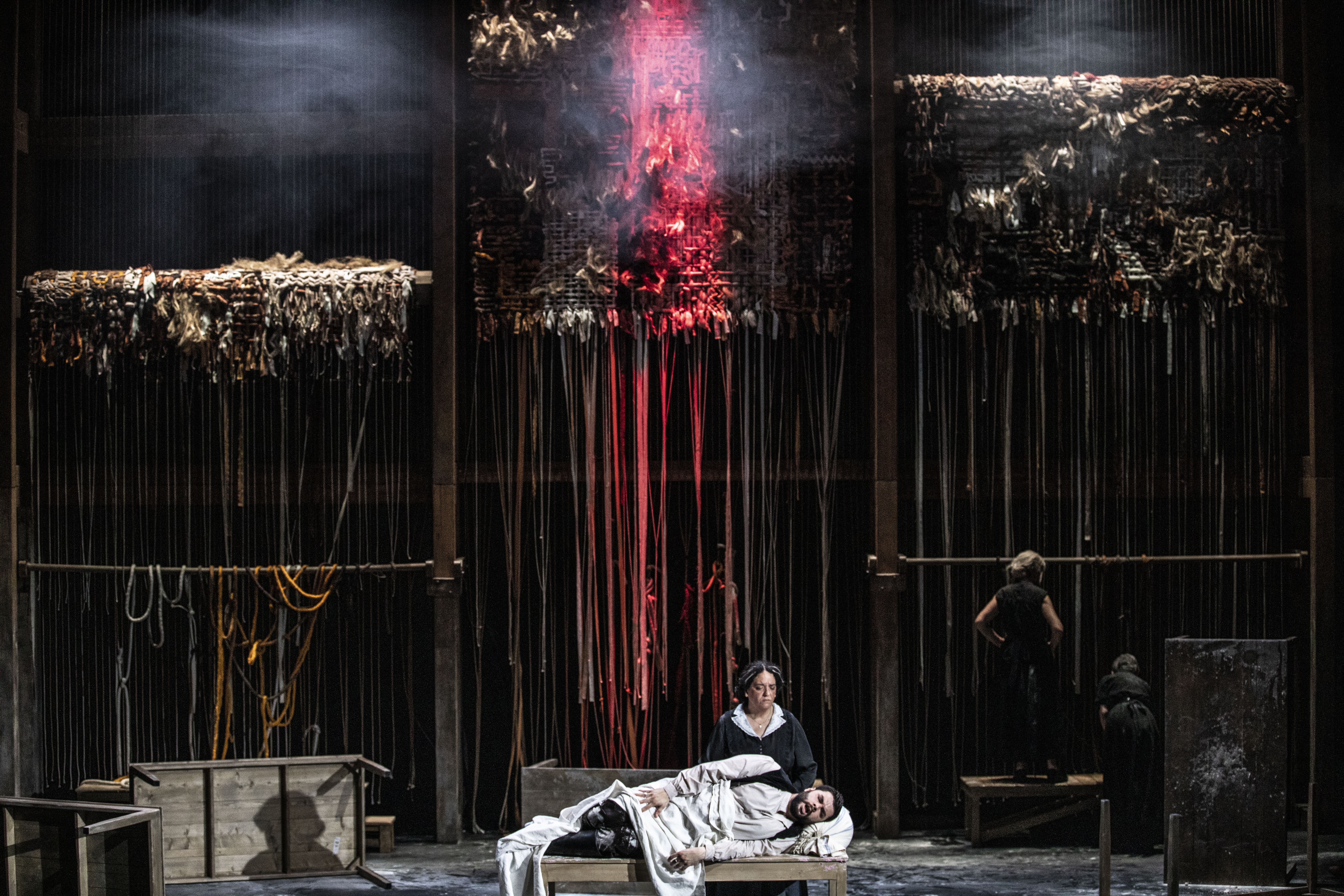
This year’s premiere, on July 7, was the Italian composer Francesco Filidei’s Accabadora , based on the late Michela Murgia’s prize-winning novel of the same name. Set in Sardinia at a time when traditional ways of life were giving way to modernity, Accabadora focuses on the relationship between Tzia (aunt, in the Sardinian language) Bonaria Urrai and Maria, who Bonaria adopted at age 6 from her impoverished mother.
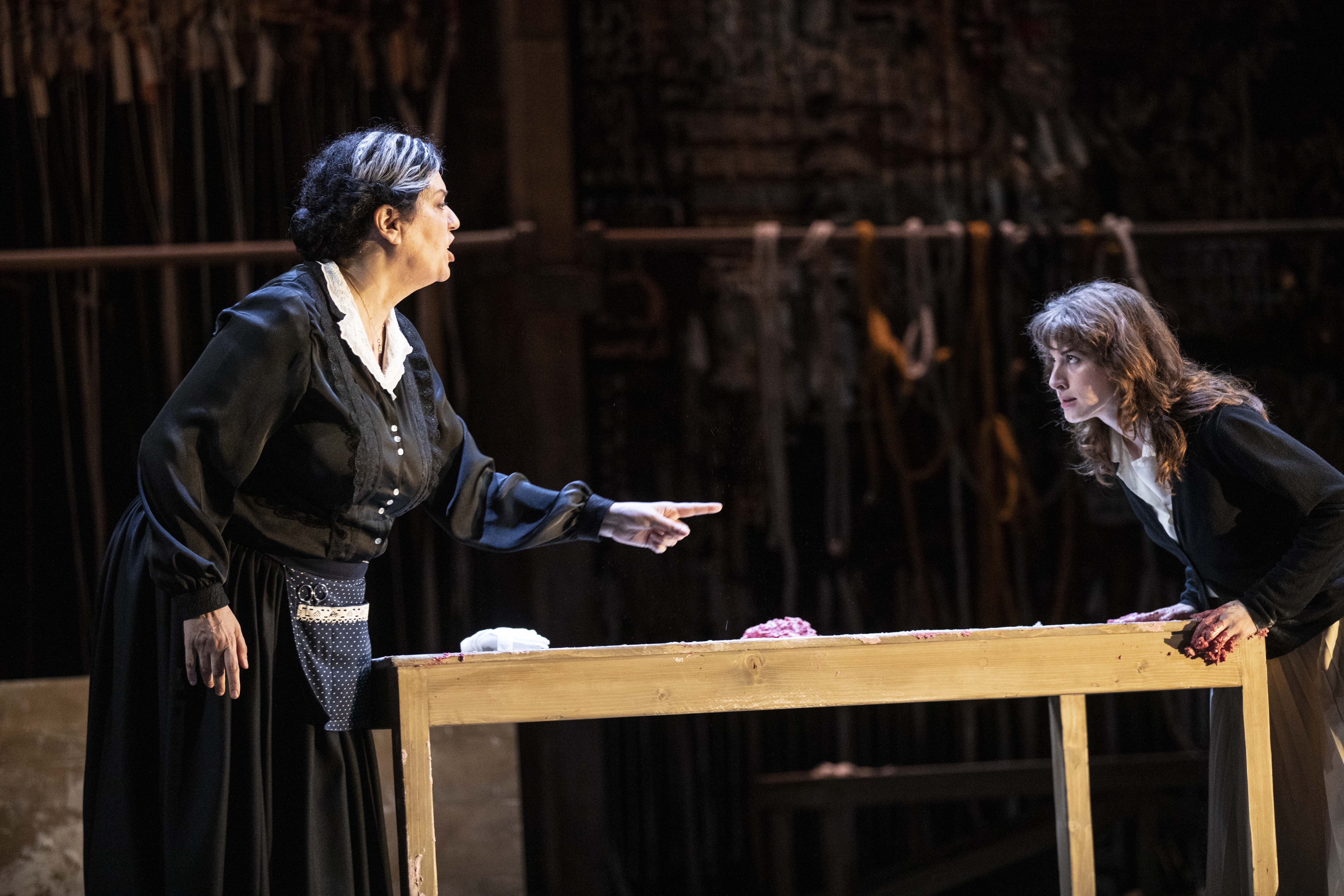
Tzia Bonaria is a skilled seamstress, but also an accabadora, “she who finishes,” a figure in Sardinian folklore who is called in to end the suffering of a person on their deathbed. She is an imposing figure in this opera, sung with immense authority and vocal beauty by the magnificent contralto Noa Frenkel.
Maria — soprano Rachel Masclet, singing with crystalline beauty — observes her occasional nighttime disappearances throughout her childhood and youth without connecting them with the deaths of villagers. The truth finally dawns after her best friend Andria (tenor Hugo Brady) sees Bonaria suffocate his older brother Nicola (baritone Lodovico Filippo Ravizza), who begged for release after losing a leg. Maria temporarily flees Sardinia, returning only after Bonaria suffers a devastating stroke.
Filidei and Murgia became friends during the planning period for this opera. Murgia was to write the libretto, but died of cancer, age 51, before it could be completed. Filidei fashioned his own libretto and did a fine job. I recommend reading the novel, which I found moving.
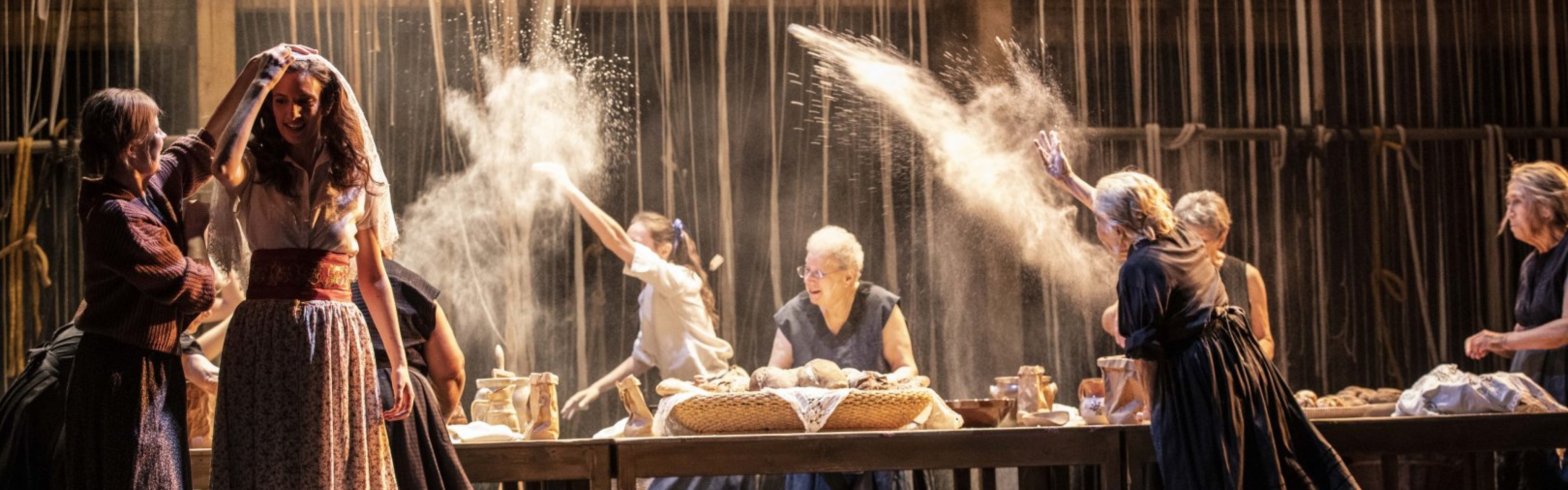
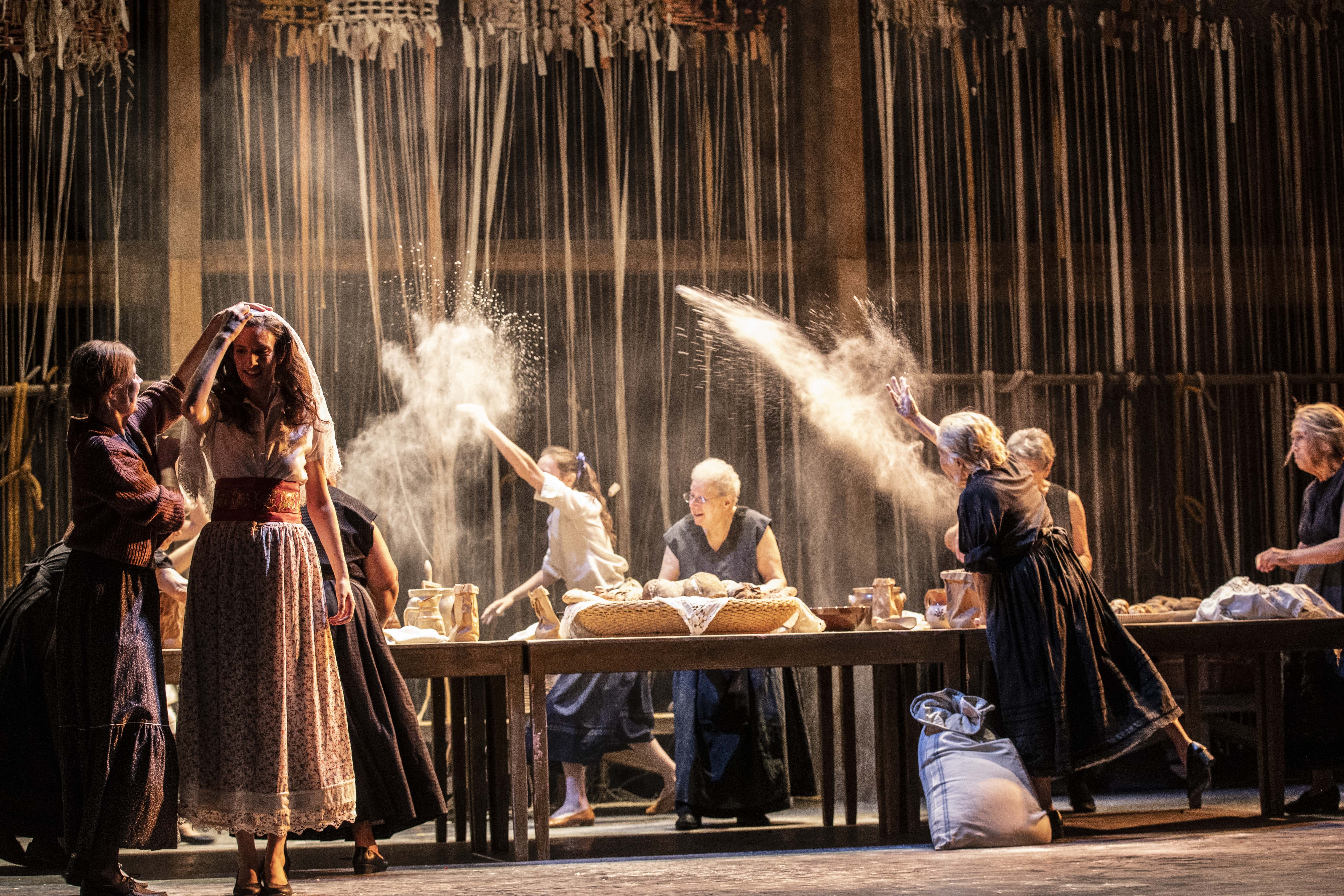
The opera, less than 90 minutes long, opens with several dark-clothed women apparently weaving a giant tapestry at the back of the set, then shifting to the ritual of baking bread. The young Maria enters, and flour pours out of her dress and onto the stage. Baking bread will be a ritual in her life as well. It’s just one of many striking images in the production — another is papers falling from the sky during an exchange of letters between Maria and a beloved teacher — under the excellent direction of Valentina Carrasco.
Filidei’s score is wondrous. The 17-piece orchestra, drawn from the Orchestre de L’Opėra de Lyon, shimmers, rattles, and glides austerely, bursting occasionally into a lyrical passage, water in a dry land. A small chorus comments on the action in a chantlike style. Lucie Laguay conducted sensitively, ever alert to all the colors in the score and the needs of the singers.
The composer’s largely conversational vocal writing is largely conversational lures you into the world of Tzia Bonnaria and Maria. I can’t speak to how well he sets Sardinian, but the story and the music lingered in my ears long after the curtain came down. [Return to top]
El Cimarron, July 17
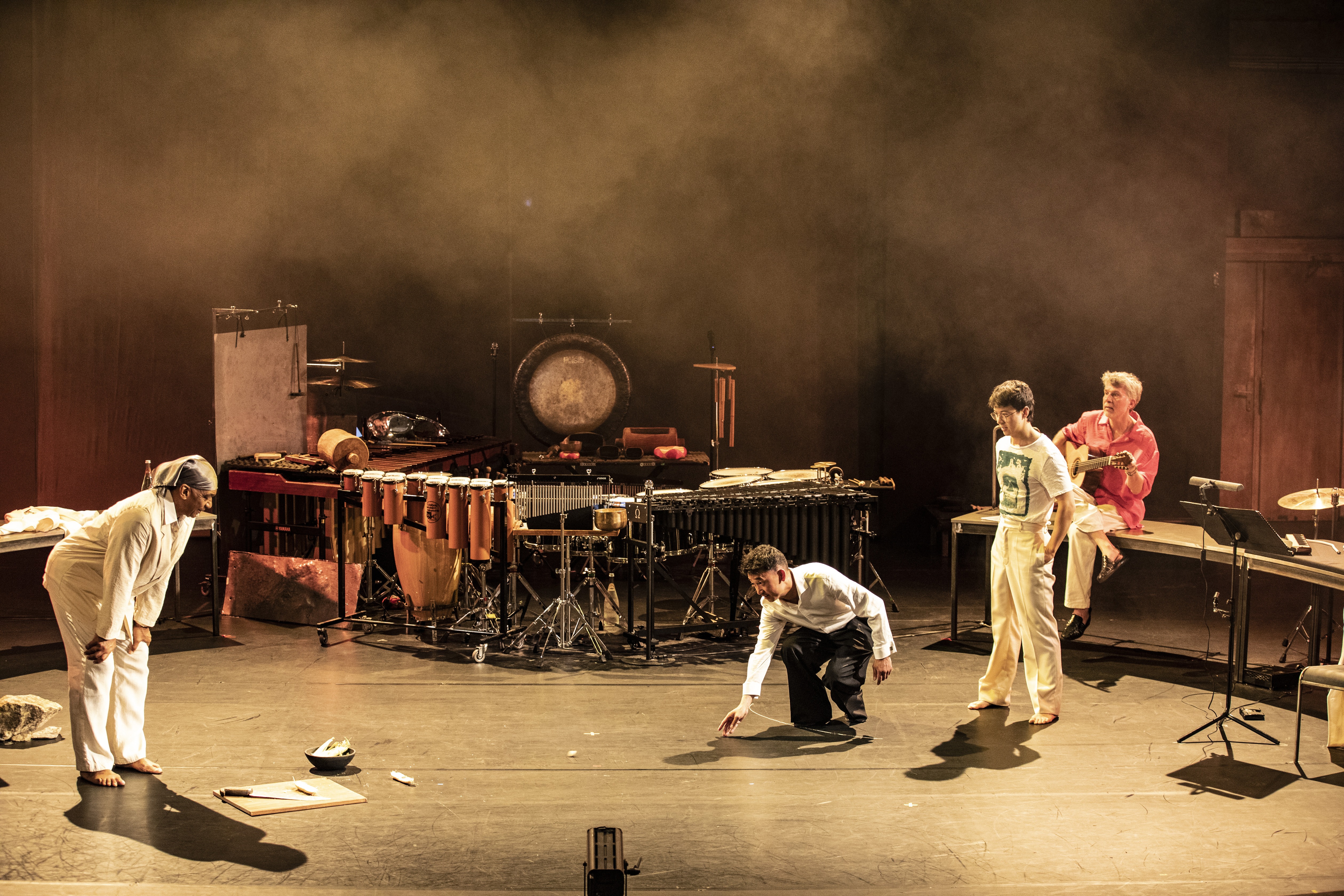
Like Accabadora, the venue for Hans Werner Henze’s El Cimarrón was the 500-seat Théâtre du Jeu de Paume, an 18th-century gem in the Italian style, with an orchestra section and three tiers rising above the floor. Henze’s harrowing monodrama is based on the life and memoir of Esteban Montejo, who was born into slavery in Cuba during the late 19th century. and lived until 1973.
The work was to be performed in English, but the originally scheduled singer withdrew. Instead, the performance was in Spanish with the Venezuelan bass Iván García. Grippingly directed by Elayce Ismail, El Cimarrón was a theatrical tour-de-force for the performer.
Montejo recounts the terrible brutality of slavery, his escape attempts, his life in the woods after a successful attempt, his life after slavery ended in Cuba, his love life, his thoughts about the Church and its priests, a revolt against Spanish conquerors and what happened after U.S. soldiers arrived.
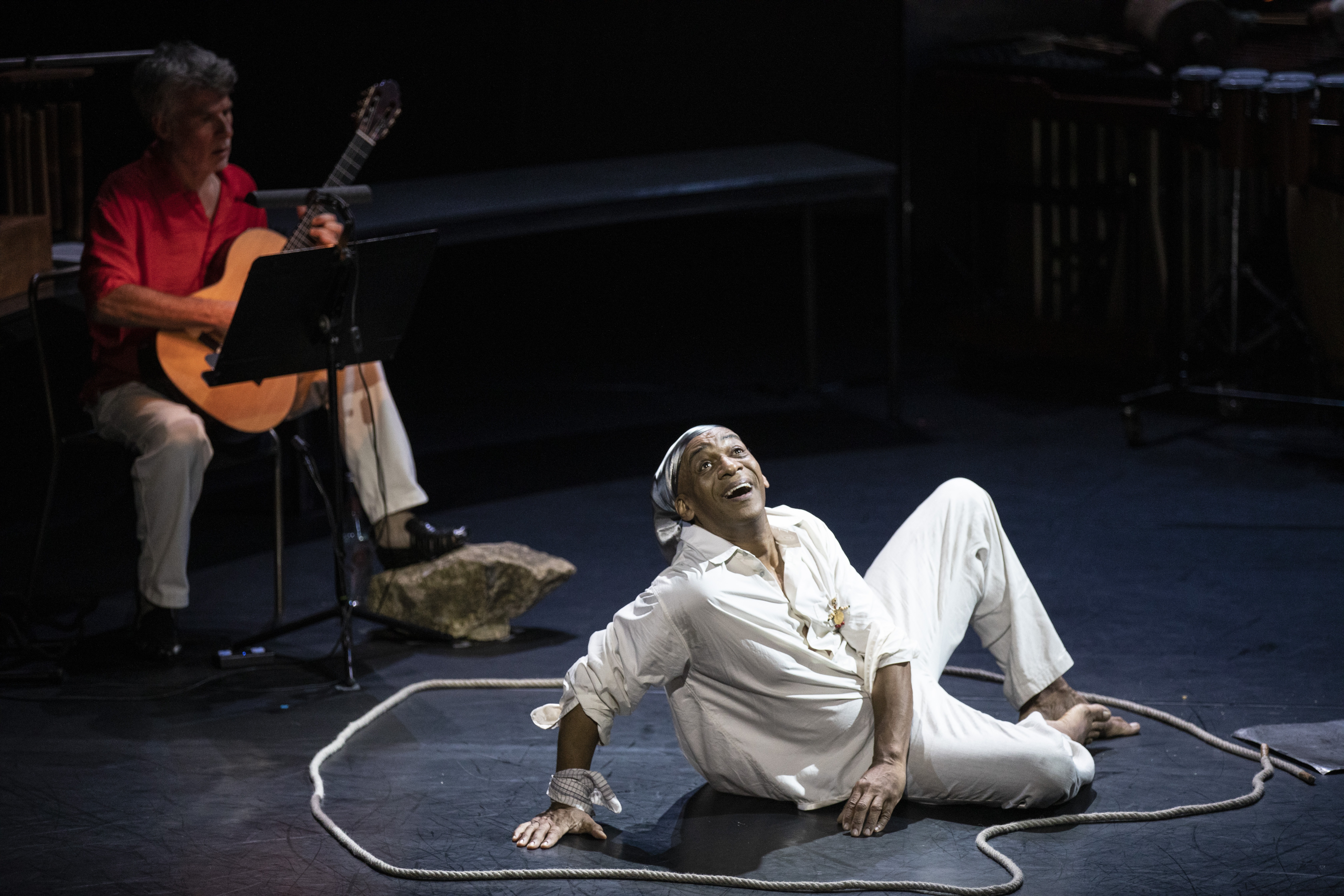
The singer’s part includes recitation, sprechstimme (speech-song), humming, shrieking, and other vocalizations. The accompanying ensemble of three — here, flutist Daniel Shao, guitarist Jean-Marc Zvellenreuther, and percussionist Minh-Tâm Nguyen — ranges broadly, incorporating Cuban music, African music, and various modern styles.
It was magnificently performed by all. García was a charismatic presence, the instrumentalists fluent. The ending, particularly, presented an indelible image: Iván García recounting the battles against the Spanish, advancing toward the audience, a giant machete in hand, saying (in Spanish) “I do not want to die. / I will be here for all the battles that are coming. / I will not go into the trenches. / I will not need a new rifle. / My old machete, my big machete, that’s all I need.” [Return to top]
Die Frau ohne Schatten, July 9/ Bluebeard's Castle, July 11
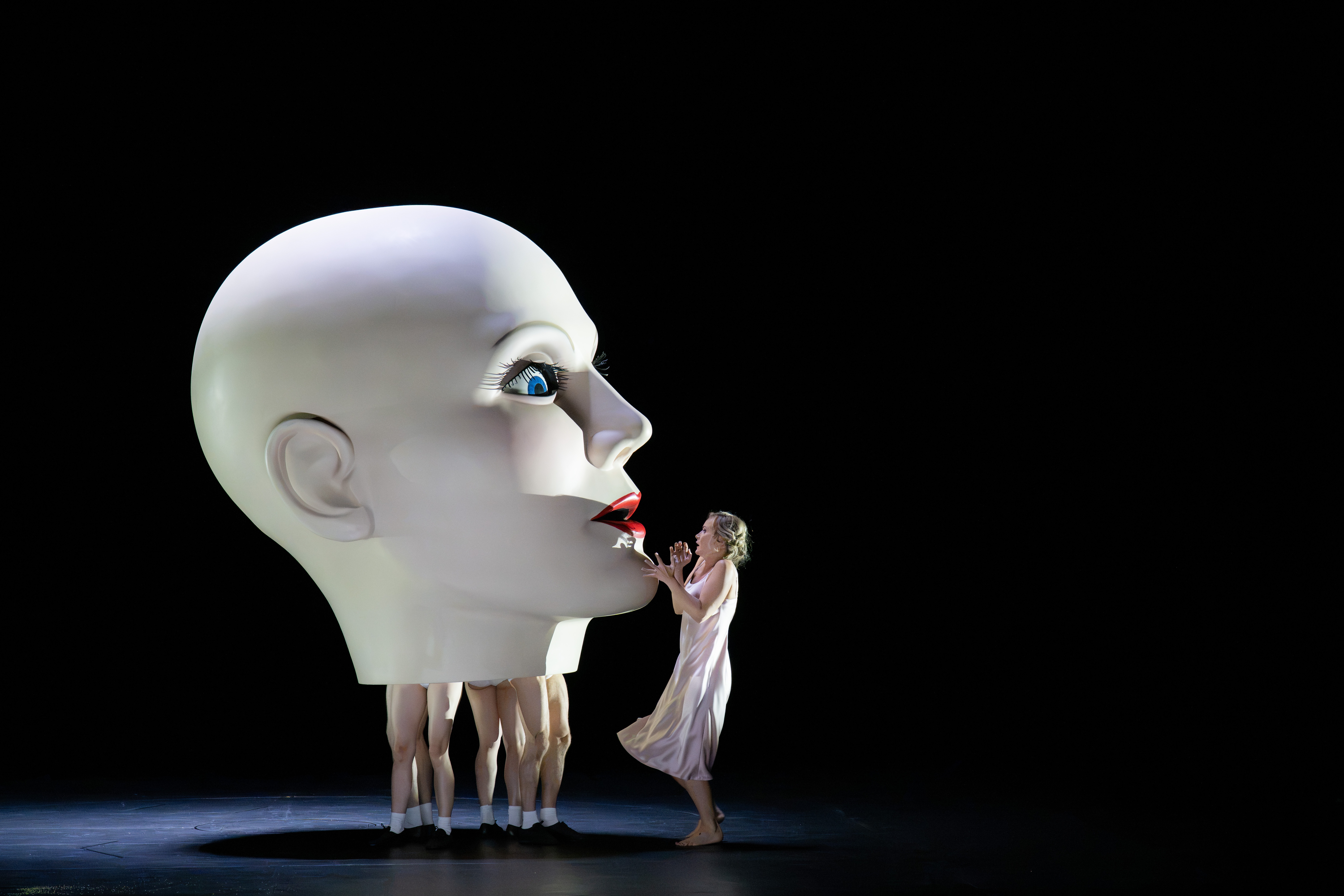
The Festival’s big production this year was a new staging, by the Australian director Barrie Kosky, of Richard Strauss’s Die Frau ohne Schatten, (The Woman without a shadow), with a starry cast conducted by the 30-year-old Klaus Mäkelä, who next year becomes music director of the Chicago Symphony Orchestra and chief conductor of the Royal Concertgebouw Orchestra.
Mäkelä’s only previous operatic experience was a run of Mozart’s Die Zauberflöte — a work Strauss and librettist Hugo von Hofmannsthal drew on for Frau, but on a very different scale. He led a surprisingly intimate performance, emphasizing the chamber-music-like details of the score rather than the giant explosions and musical mass that come with any Strauss opera. The dryish sound of the Grand Théâtre de Provence probably contributed to this effect.
Regardless, his interpretation was quite different from what we’ve heard at San Francisco Opera from Donald Runnicles in Frau and Eun Sun Kim in Elektra. It was equally valid and a great pleasure to hear. And like those conductors, he paced the opera beautifully and with great attention to the drama.
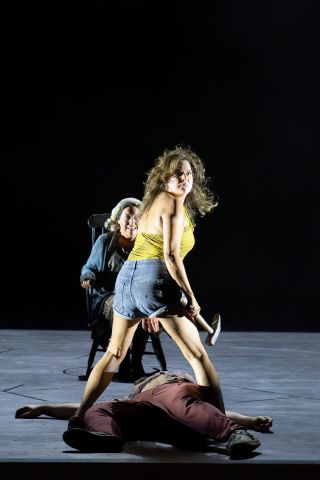
Kosky also took a different approach to Frau and the result was by far the most persuasive interpretation of the several productions I’ve seen. The story, in basic terms, is framed by the plight of an Empress who comes from a spirit realm but is married to the human Emperor. She’s told that she will be parted from her husband if she doesn’t acquire a shadow in three days. She looks to the Dyer’s Wife who is having marital problems with her husband. The Wife agrees to sell her shadow, but the Empress ultimately refuses to go through with the bargain, and her act of selflessness ends up freeing her from her curse.
The libretto is hugely problematic, with its emphasis on the importance of reproduction within a marriage and the clear implication that women aren’t fully human unless they’re mothers.
Between the two troubled couples at the heart of the opera, the singing fishes representing unborn children, and a chorus of the unborn, it’s a challenge to directors to thread their way through the plot and make sense of it for modern audiences, particularly given the current political climate and the rise of racist pro-natalists wanting more white children.
Kosky’s approach was to focus strongly on the relationship between Barak the dyer and his Wife, and the violence in it. At different times, they try to kill each other. At one point, Ambur Braid (Dyer’s Wife), in shorts and a tank top, stands over a fallen Brian Mulligan (Barak) threatening him with a hammer. It’s a disturbing, unforgettable sight.
Kosky’s is an extremely physical production, even in moments you might expect some tranquility, such as in the third-act scene where Barak and his Wife discuss their relationship and become reconciled. Here Kosky had the characters unable to see each other, sometimes desperately running back and forth onstage, a powerful visual metaphor for their psychological search for one another.
The director also eliminates anything resembling a crowd scene, emphasizing the intimacy of the relationships you see onstage. The Spirit Messenger (Jean-Sébastien Bou, who sang additional small roles) is unseen, singing from somewhere in the auditorium. The chorus always sings from offstage; there are none of the grandiose effects that the libretto calls for.
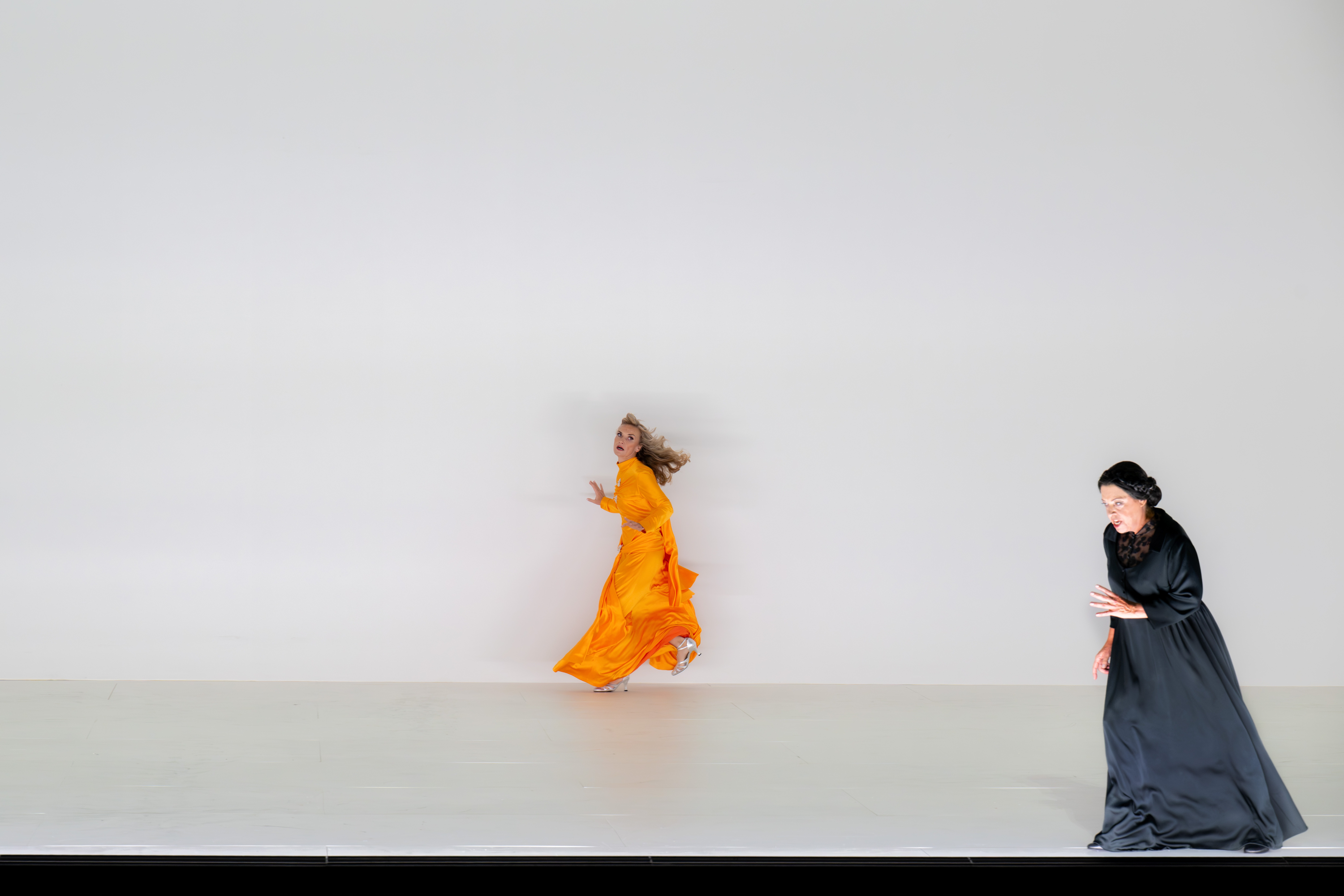
The spirit world is nearly blank; the Nurse (Nina Stemme, a veteran performer in this show), Emperor (Michael Spyres), and Empress (Vida Miknevičiūtė) make their initial entrances from within a black rectangle that rises to reveal them. The Nurse and Empress rock ceaselessly in a rocking chair, the Emperor on a giant rocking horse. Barak’s hut is a steaming tower bedecked with fabric.
In the third act, Kosky deviated from the libretto in ways I found insightful and psychologically acute. I can’t really explain the headless, glittering dancers — and the return of the Young Man? — who stab the Nurse to death, but the scene was shocking and powerful.
The Empress, too, rushes about the stage. During a long scene, she encounters an old man — he emerges from a giant head that produces the water of life — who can only be her father, Keikobad, who is referenced but never seen in the libretto. She beats on his chest, then falls to the floor. Then she begins her (greatly cut) speech that leads to her act of renunciation, “Ich will nicht!.”
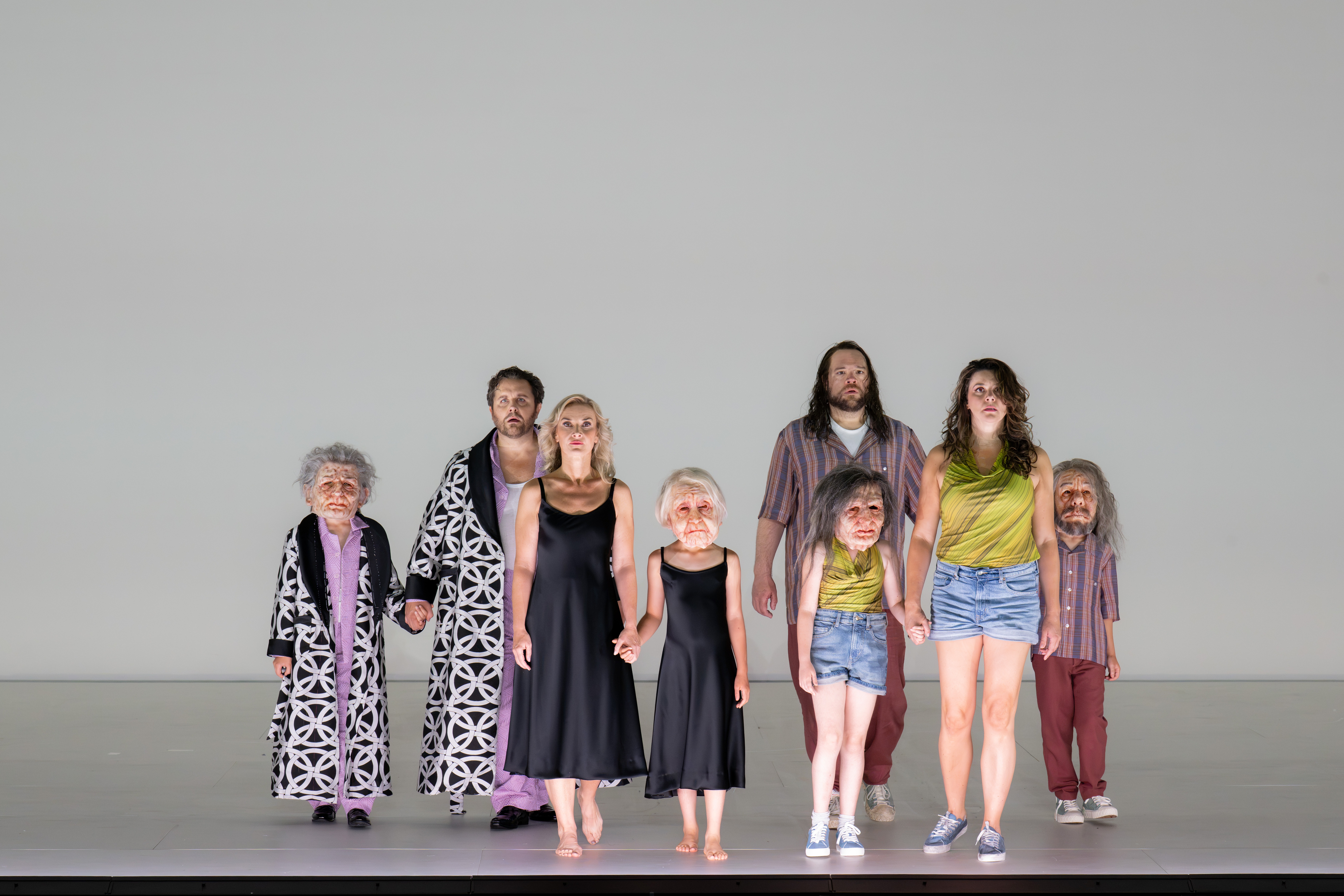
The closing scene is also a giant deviation from the libretto. The two couples are touchingly united with their mates at last. The Nurse reappears, and then they’re confronted with, and initially terrified by, four children dressed in clothing identical to theirs, but with vastly aged faces: perhaps a caution that the longed-for children and parenthood might not be quite what they’re hoping for.
The five principals’ singing and acting could hardly have been better, with spectacular showings from Braid (a former coloratura now matured into a dramatic soprano) and Miknevičiūtė. I’d prefer a mezzo for the Nurse, but Stemme brought immense dramatic strength and experience to the role. Mulligan sang with great warmth and beauty, while Spyres somehow made the Emperor’s music sound easy. The Orchestre de Paris and its chorus, both shone brightly.
Given Mäkelä’s outstanding Frau, his conducting of Béla Bartók’s Bluebeard’s Castle in concert on July 11, was an enormous shock and disappointment: It was among the dullest and least satisfying opera performances I have ever seen.
Bluebeard bursts with color, and certainly there were many pretty sounds onstage. But the performance was inert, lacking in pulse and rhythmic drive. Those pretty sounds were disconnected from and often did not support the drama. The mighty Fifth Door was loud but lacked grandeur. Bluebeard’s warning to “beware my castle” didn’t sound like the sinister threat that it is.
All of this left the two singers, bass-baritone Gerald Finley (an experienced Bluebeard) and mezzo-soprano Irene Roberts (making her role debut as Judith) somewhat at sea, reading from the score and hardly interacting. [Return to top]
Les vêpres siciliennes, July 16
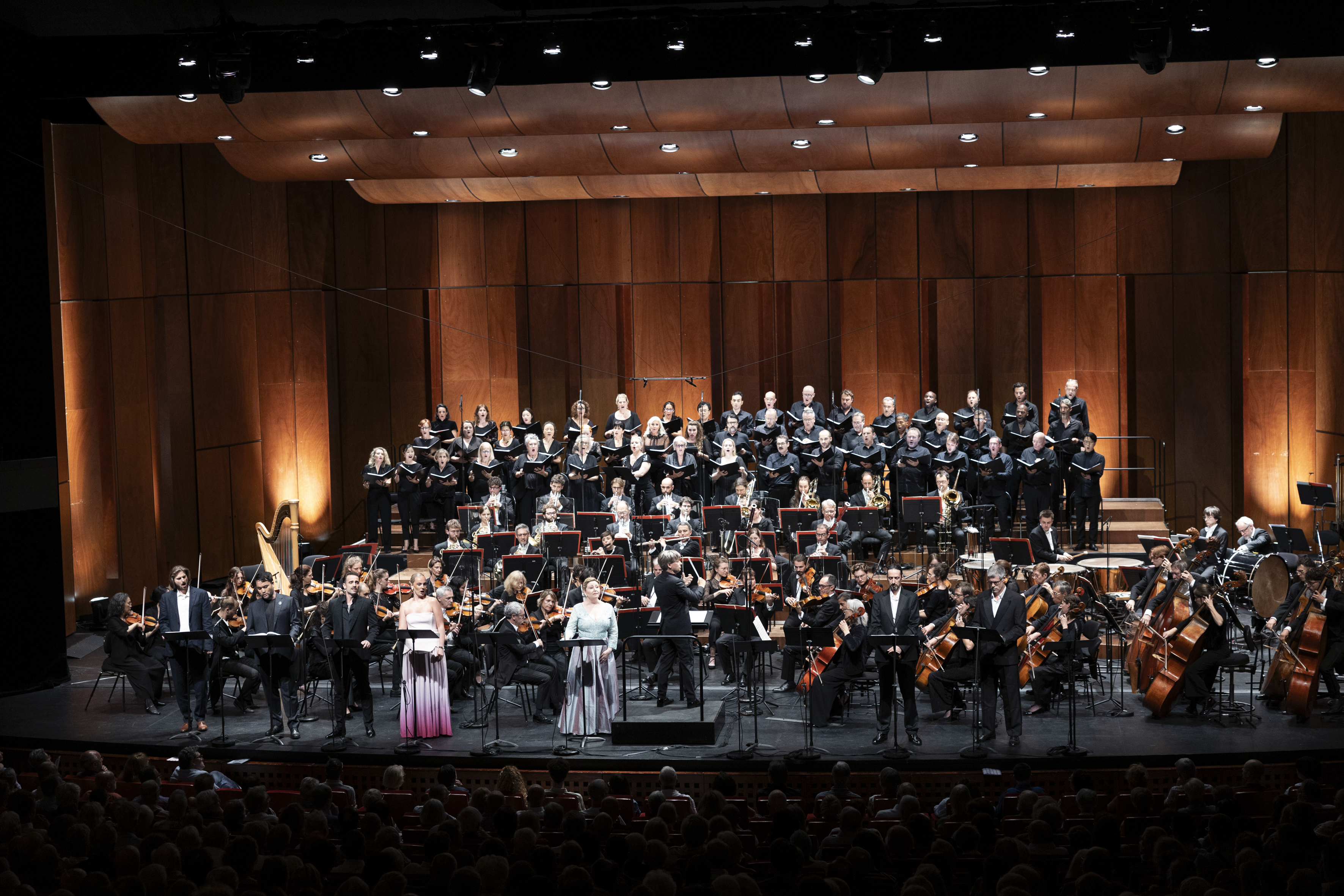
The other opera given in concert at this year’s Festival was Verdi’s Les Vêpres siciliennes (The Sicilian vespers, 1855), a rarity, at least in the United States. The combination of a murky plot, length, a half-hour of often-cut ballet music, and an exceptionally difficult tenor part are surely reasons for its infrequency.
But there’s plenty of terrific music in the work and with Daniele Rustioni, the orchestra and chorus of the Opéra de Lyon, and a bravura band of singers, the opera got just what it needed. Like Frau, this was a triumph and one of the best Verdi performances I have ever heard.
Rustioni, principal guest conductor of the Metropolitan Opera and the Tokyo Metropolitan Symphony Orchestra, was previously music director of the Opéra de Lyon and clearly there’s a close bond between him and the orchestra. He conducted with verve and finely judged tempos, bringing out the particular colors of the score, from the brightest to the darkest.
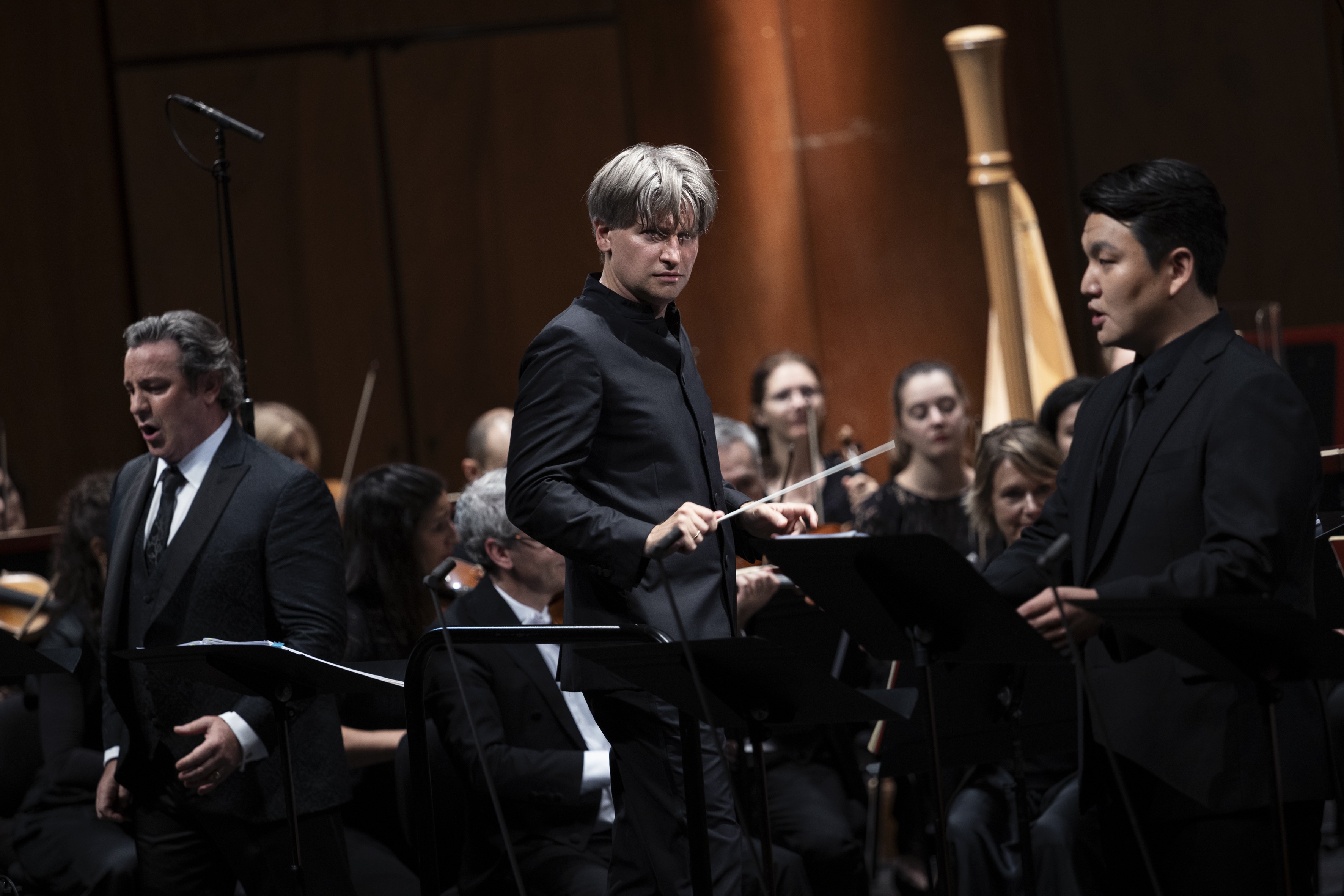
He had an ideal cast for the opera. American tenor John Osborn has long specialized in the impossible high dramatic tenor roles of the early 19th century and has everything those roles require: range, flexibility, power, command of the style, and a fine legato.
Osborn played the nominal hero of the opera, Henri, the unknown illegitimate son, conceived in rape, of Guy de Monfort the French governor of Sicily. Henri was raised to hate de Monfort, sung in this performance by Korean baritone Insik Choi.
Choi, a member of the Cologne Opera ensemble, is a real find. He has a glorious and commanding voice that’s perfect for the big Verdi baritone roles.
De Monfort is holding Duchess Hélène prisoner; she is the sister of Duke Frédéric, whom the French executed a year earlier. The French mezzo-soprano Karine Deshayes sang this soprano role, showing no strain at all in her upper register. If anything, the power in her voice has shifted upward, with the lowest notes not projecting as they typically would for a mezzo. She handled every difficulty in the score with spectacular aplomb, including the last-movement bolero, a showpiece replete with trills and fioriture (rapid scale runs and ornamentation).
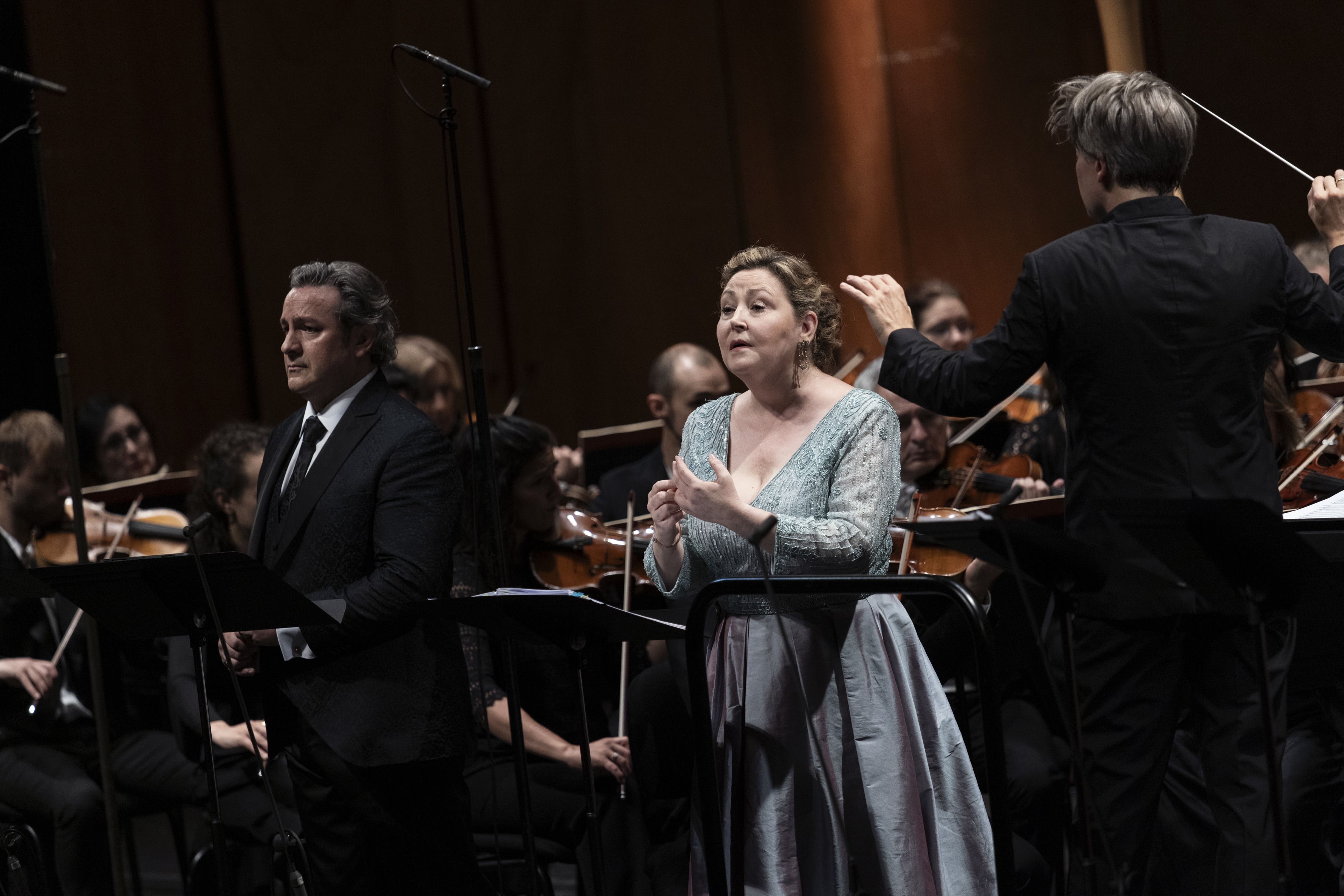
Henri and Hélène are in love and determined to oust the French invaders. The leader of the Sicilian resistance is Jean Procida, returning from a period of exile. The Italian bass Michele Pertusi sang Procida with gravity and true Italian style.
Many plot complications ensue, including Henri learning of his parentage, the threatened executions of Henri and Hélène, a marriage that’s on, off, and on again, and, concluding the opera, the slaughter of the French by Sicilian patriots. Without a staging, none of this was visible, but the musical riches are such that Les vêpres siciliennes ought to be staged much more often than it is. [Return to top]
Michael Spyres in recital, July 13
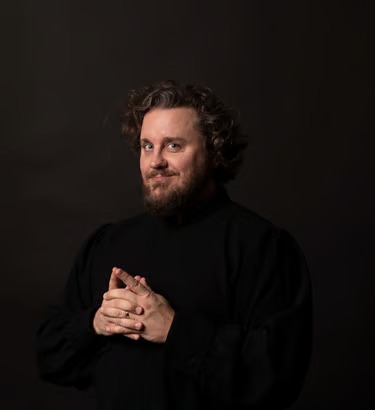
The tenor Michael Spyres has, for some years, referred to himself as a baritenor. He has perhaps the most idiosyncratic repertory of any current or past tenor: it includes roles as light as Nemorino in L’elisir d’amore, as florid as Idomeneo, and as heavy as Richard Wagner’s Tristan and the Emperor in Die Frau ohne Schatten.
His recital with pianist Mathieu Pordoyin the handsome recital hall of the Conservatoire Darius Milhaud was similarly idiosyncratic. He led off with Wagner’s Fünf Gedichte für eine Frauenstimme (Five poems for a woman’s voice), commonly known as the Wesendonck Lieder, after Mathilde Wesendonck, whose poems they set, continuing through Gustav Mahler’s Lieder eines fahrenden Gesellen (Songs of a Wayfarer), Richard Strauss’s Four Songs, Op. 27, and Wolfgang Erich Korngold’s song cycle Unvergänglichkeit (Immortality), Op. 27.
Spyres is an unfailingly musical and intelligent singer and brought all of that to bear on these songs. Many listeners, including myself, associate most of these songs with women’s voices, and it was definitely a change to hear them in so masculine a voice. They didn’t always seem a comfortable fit, both in terms of range and in achieving the kind of intimacy they might require: his is a voice for the opera house and one that doesn’t scale down easily for Lieder.
Still, his unerring attack at any dynamic level and the expansive heroism he brought to the more vigorous songs were impressive. He sang “Im Treibhaus” (In the greenhouse) from the Wesendonck songs with particularly fine attention to details, particularly in dynamic variation. “Träume” (Dreams) was similarly beautiful. Wagner called both songs “studies for Tristan und Isolde,” and Spyres recently made his role debut as Tristan; it is not surprising that he would bring special insights to those songs.
The Strauss songs were also richly detailed, with a particularly lovely “Ruhe meine Seele!” (Rest, my soul) and exquisite soft singing in “Morgen” (Morning).
For encores, he sang Hector Berlioz’s “Le spectre de la rose” (The ghost of the rose) from Les Nuits d'été (Summer nights) and Franz Schubert’s “An die Musik” (To music). The first and last verses of “Spectre” were marvelously intimate, the middle overblown. Schubert’s song was direct and a fine close to the recital. [Return to top]
Sonya Yoncheva and Cappella Mediterranea, July 14
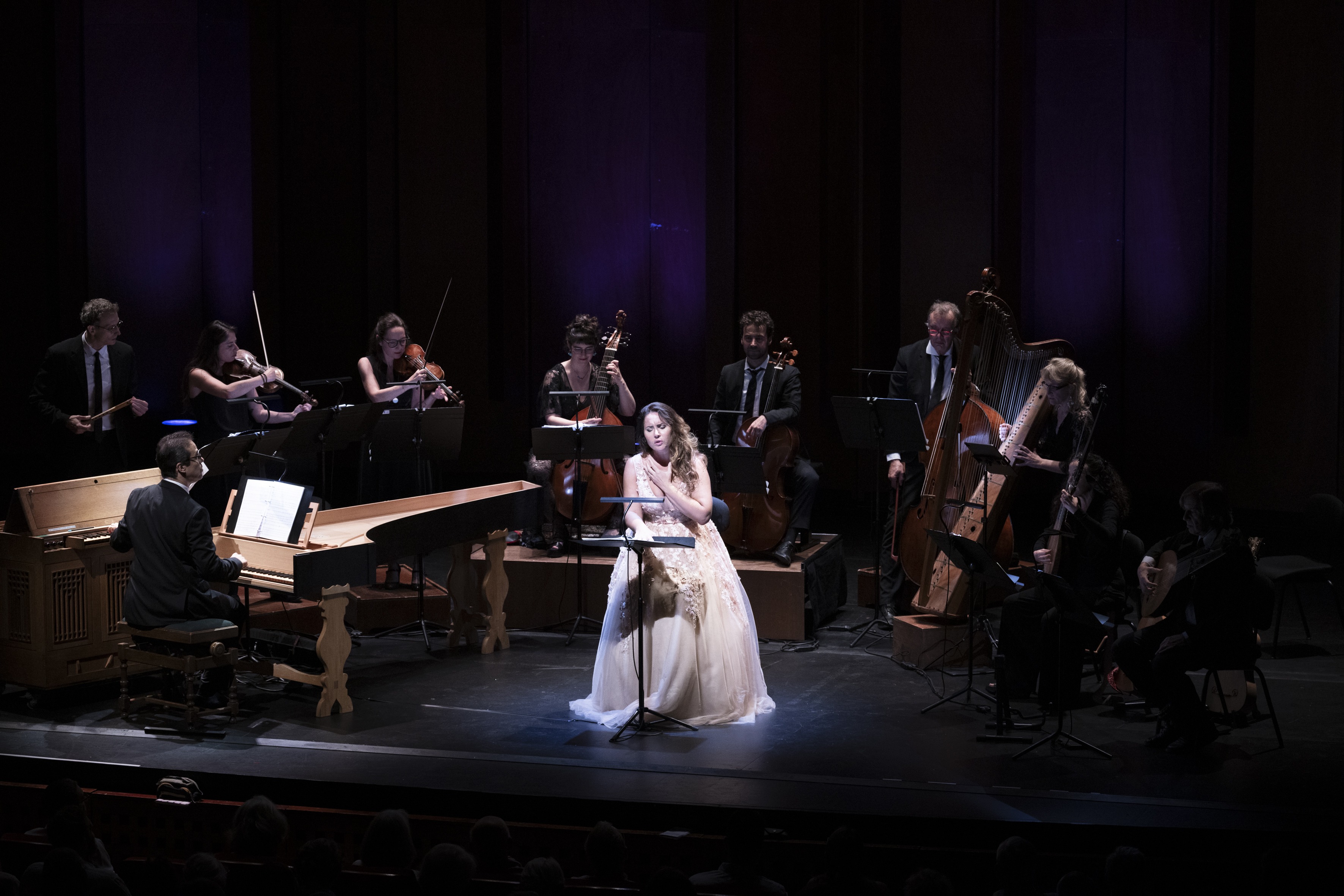
Sonya Yoncheva is well known for roles in 19th-century opera, but the soprano got her start as a singer in early music specialist William Christie’s young singer program, and she kept a hand in that world as her career grew.
Her recital with Cappella Mediterranea and its music director Leonardo García-Alarcón was a pure delight, full of charm and joy. Everyone onstage seemed to be having a wonderful time — there were many smiles from the performers and appreciation for each other. By the end of the concert, Yoncheva had taken off her silver heels to relax with bare feet
The instrumental and vocal repertory for the concert ranged from the late 1500s. to the early 1700s and included works by such luminaries as John Dowland, Claudio Monteverdi, Henry Purcell, Orlando Gibbons, and Francesco Cavalli, as well as Spanish composers such as Lucas Ruiz de Ribayaz and Josė Marín.
García-Alarcón led brilliantly from the keyboards. The excellent Cappella Mediterranea ensemble (two violins, a viola da gamba, a cello, a contrabass, flute/cornet, harp, archlute/guitar, and theorbo/guitar) provided more than sufficient timbral variety. Every number was lively and shapely and played with virtuosic confidence.
Yoncheva’s a wonderful communicator, coloring her voice for the mood of each song. Her diction was startlingly clear in the English works, good enough that most of the words came through in those songs I was familiar with. And she’s also thoroughly charming.
The recital was held with the hall fully darkened; the only improvement one could possibly have made to this lovely event would have been to either project the song texts or have the lights up enough that we could read them in the programs. Otherwise, I would have been perfectly happy if this 90-minute performance had been twice as long. [Return to top]