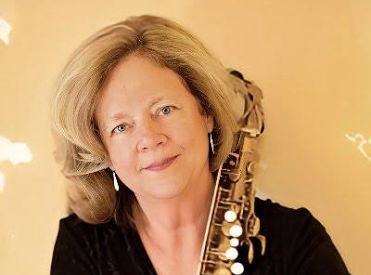
At the age of 20, Mary Fettig shattered the glass ceiling of one of jazz’s most conspicuous edifices when she left UCLA her junior year to become the first female instrumentalist in the Stan Kenton Orchestra. With the women’s movement seizing media attention across the West in that year, 1973, the story of the young alto saxophonist and flutist holding down a key chair in a testosterone-soaked institution with a quarter-century track record of boosting brilliant musicians proved irresistible.
Concord-raised Fettig quickly realized she needed a strategy for dealing with the press. “I was thrown to wolves joining Kenton,” she recalled. “The first radio interview right away was a national broadcast. What I found is that they often had no idea about anything when it comes to jazz, and I learned after a while to run the interview.”
As Fettig learned to manage the press, she mastered the demands of Kenton’s book, including a featured flute solo on Pete Rugolo’s oft-played, percussion-powered arrangement of “The Peanut Vender” by Cuban composer Bola de Nieve. Every show was a thrill ride “to be on stage, making a part of that sound with that powerful group,” she said.
What Kenton heard in Fettig soon became evident to the Bay Area music scene, where she’s been a ubiquitous force ever since. From the pit bands of touring Broadway shows (including a five-year run in The Phantom of the Opera at the Curran Theatre) to jazz, Brazilian, and orchestral gigs at clubs and theaters around the region, she’s been a first-call player across a wide array of scenes and settings.
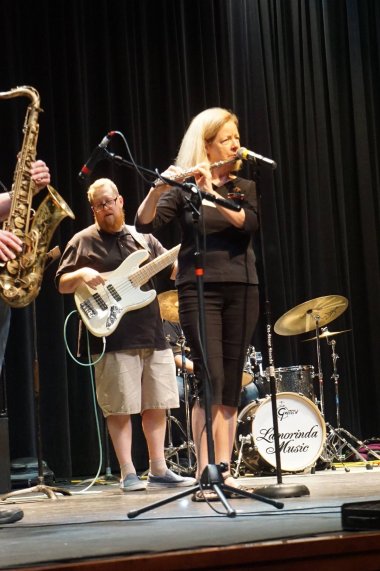
Last month, Fettig performed on flutes at SFJAZZ’s reimagining of the orchestral music of Miles Davis and Gil Evans, arranged by Gil Goldstein. “[Goldstein] found out I play bass flute and worked it into the charts,” she said.
Fettig’s work on the bass flute has figured prominently over the years in Luca & Lucca Orchestra concerts devoted to the music of Henry Mancini, “who loved the low flutes,” Fettig noted. She’ll be in the flute chair again at the Jazzschool in Berkeley on April 17 when Daniel Parenti directs the Luca & Lucca Orchestra’s latest tribute to Mancini.
Fettig also performs with trombonist/arranger Dave Eshelman’s JazzGarden Big Band on May 8 at Diablo Valley College and May 26 at the Freight.
When she’s not in shows like Broadway San Jose’s July production of The Sound of Music, she can often be found collaborating with the region’s finest jazz artists. Trumpeter, composer and arranger Erik Jekabson, who directs and contributes charts for the Electric Squeezebox Orchestra while also writing ambitious works for his own chamber jazz ensembles, has often depended upon Fettig’s consummate reading skills to tackle difficult charts with minimal preparation.
“Having Mary play your music on any of her many instruments means that it will be played at the highest level: in tune, with great sound and feeling,” Jekabson wrote in an email. “When giving her space to improvise, it's the same: great sound, feeling, and time. She's also very helpful in bringing the ensemble together, a result of her having played with so many world-class musicians over the years.”
Her facility with the flute family — she’s partial to the alto flute — has been her calling card, but if she had to choose an instrument to define her voice, it would be the alto sax. “After a while, flute is pretty, prettier, and prettiest,” she said. “I need more emotional range than you get on flute. I need some saxophone.”
In some circles, Fettig is associated most prominently with the Bay Area’s vibrant Brazilian jazz scene. A connection sparked when her colleague, reed expert Charlie McCarthy, dropped her name to Marcos Silva when he was launching his band, Intersection, in 1984. The Rio-born pianist, arranger, and educator has introduced generations of Bay Area musicians to the intricacies of Brazilian music — when Fettig met Silva, she was ready for a new challenge.
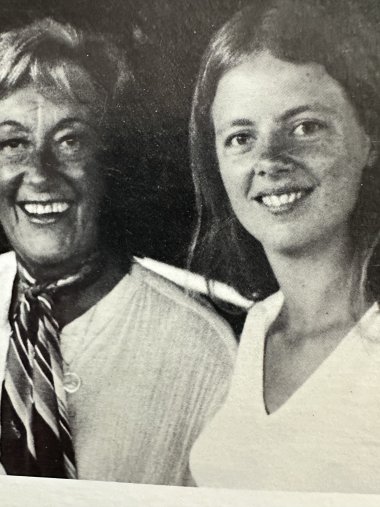
“I was doing a whole lot of playing standards. Jumping into Marcos’s work was a kick in the pants at the perfect time,” said Fettig, who was in her first trimester of the pregnancy when she started working with Silva. Her first-born child, Scott Thompson, is now a highly regarded bassist employed by many prominent Brazilian musicians.
For Fettig, the early Intersection rehearsals were both exhilarating and plagued by morning sickness. “I’m going, this is the most awesome thing I’ve ever done,” she recalled. “And I want to go home and throw up.”
The band started working internationally when Flora Purim and Airto Moreira, the celebrated Brazilian wife-and-husband team of vocalist Purim and percussionist Moreira, hired Silva as music director and adopted his band. She went on to work with Toninho Horta, the Brazilian guitarist and composer widely revered by peers like jazz guitar great Pat Metheny.
She remembers a week-long run at Kimball’s, the San Francisco jazz club, as a career high point. “The place was jam packed by musicians every night,” Fettig said. “The first few nights it was, stay in your lane, just making sense of his changes. But by the third night, you get past that and make music out of those changes. I like getting my butt kicked. That’s what keeps us going.”
Her son Scott Thompson, who was a toddler during that mid-1980s engagement, was working with Horta last summer around the Bay Area and when he mentioned his mom planned on coming to one of the gigs. Horta invited her to sit in with the band. She printed out the charts and ended up playing the entire Yerba Buena Gardens Festival show without a rehearsal. It was her first performance with Horta in decades.
“I haven’t been stagnant,” she said. “It was incredibly fun and challenging.”
Fettig has also passed on her musical values to students. She’s nurtured generations of musicians at her home studio in Pleasant Hill, though she’s shutting down her teaching practice in May to spend more time with her grandchildren. While growing up, teaching was Fettig’s first career ambition — the path she ultimately navigated wasn’t really on the map for women at the time.
“I knew I wanted to teach in first grade, since I loved my teacher,” said Fettig, who grew up in Concord. “I was very involved in music and I thought, ‘I’ll be a music teacher,’ because what my career is, girls didn’t do that. Now, with taking care of my grandchildren every week, it’s hard to get practice time. Teaching is going to be hard to give up. I love the relationships you develop with budding musicians.”
Though always looking forward to the next challenge, Fettig can also take a few minutes to reflect on bright moments of her career, like when she played in ensembles backing stars like Stevie Wonder, Natalie Cole, and Ray Charles. She played a week at Yoshi’s with tenor sax titan Joe Henderson’s big band in 1997, followed by a Hollywood Bowl set at the Playboy Jazz Festival. When saxophone great Chris Potter premiered his orchestral song cycle Sing to Me at the SFJAZZ Center in 2022, Fettig was in the band.
“I always look at it like I’m being paid to go to school,” she said. “I feel grateful all the time.”