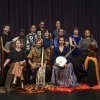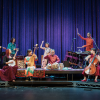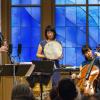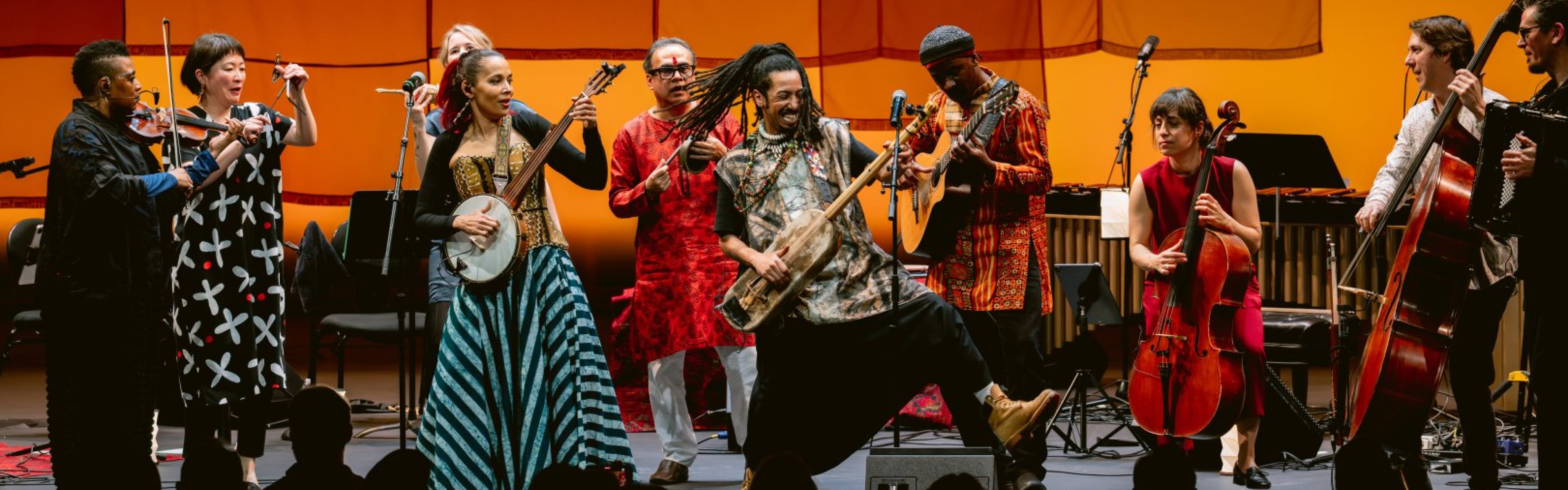
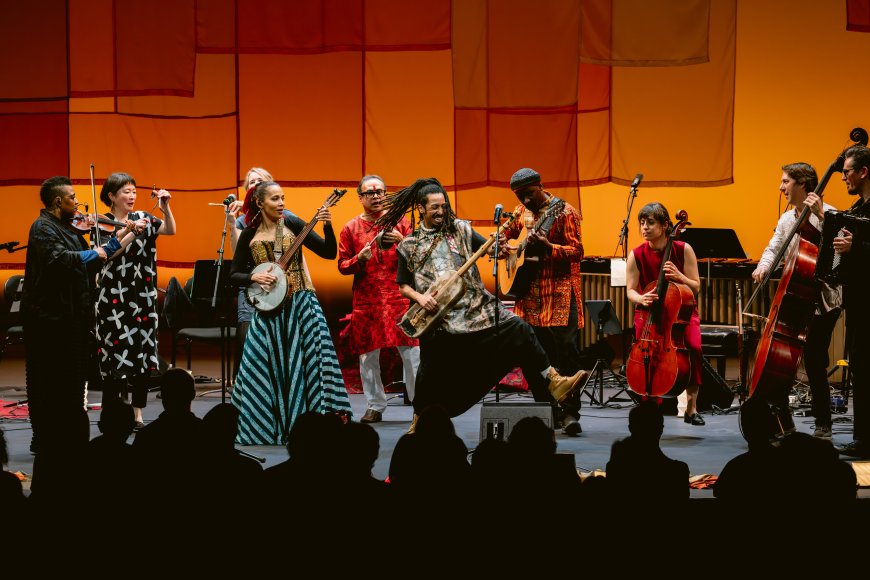
The lights in the University of California, Berkeley’s Zellerbach Hall were half illuminated, and the packed theater was still buzzing with pre-concert chatter when the Silkroad Ensemble started performing without an introduction. Entering from the back of the venue, the 12 musicians promenaded slowly down the aisles, chanting all the way until they reached the stage, where Rhiannon Giddens conducted the audience in a wordless call-and-response and introduced the evening’s overarching theme, singing “How can we build a community?”
It was effective theater, promising an evening of striking music and intriguing hybridity given the polyglot diversity of the ensemble. If the March 19 concert, the first of two Cal Performances shows for the Silkroad Ensemble, didn’t quite live up to that promise, it wasn’t for a lack of talent.
Giddens, the Grammy Award-winning multi-instrumentalist, vocalist, and composer, took over the direction of the Silkroad Ensemble in 2020, and it has evolved considerably under her watch. Yo-Yo Ma founded the organization in 1998 with a concept closely tracking the path of the Silk Road trade routes that connected East Asia to the Mediterranean for some 17 centuries, until the fall of Constantinople in 1453 CE. Central Asian and Near Eastern musicians figured prominently in the group.
The new program, “Sanctuary: The Power of Resonance and Ritual,” is less explicitly about an East-meets-West thematic focus and more about these particular musicians interacting on a program of folk themes and traditional grooves transformed and expanded by nontraditional orchestration and interaction. The tunes lean into incantatory songs, call-and-response refrains, and delicate balladry.
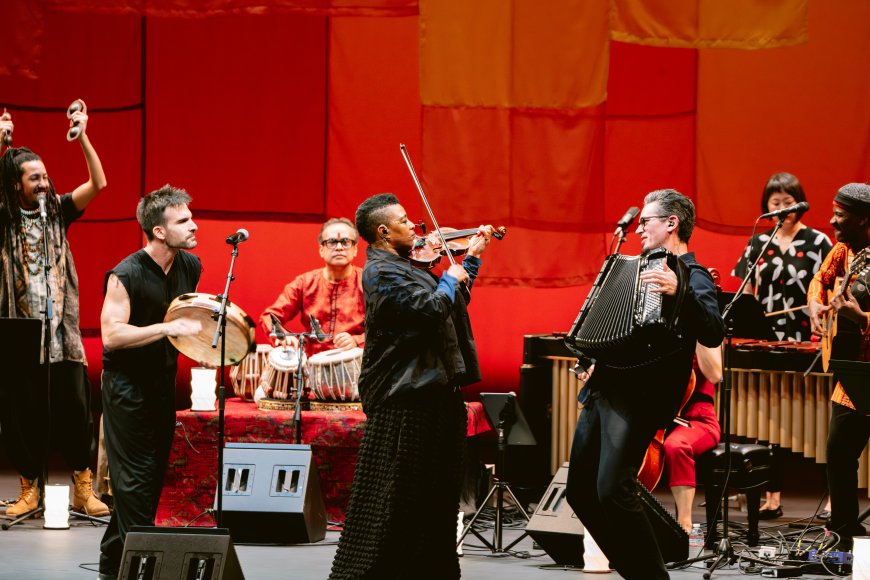
What sets the music’s parameters is that Giddens’s Silkroad is essentially a strings and percussion ensemble, with Japanese bamboo flutist (and percussionist) Kaoru Watanabe and Sicilian accordionist Francesco Turrisi providing a good deal of timbral texture to the program’s ever-shifting instrumentation. Turrisi’s accordion often doubled Canadian-Armenian cellist Karen Ouzounian’s lines, or provided a grounding drone in concert with American bassist Shawn Conley’s thrumming bow work.
With no sheet music on stage, the musicians took turns directing the flow, presumably leading the pieces they brought into the group, though there were no announcements from the stage crediting composers, arrangers, or musical origins. American violinist-vocalist Mazz Swift made the improvisational ethos most conspicuous, cueing various players in and out while scatting, responding, and leading the quick-shifting melodic line.
One of the primary challenges facing Silkroad is distributing the spotlight in a group brimming with virtuosity. Scottish harpist Maeve Gilchrist seemed underutilized, but I wouldn’t have wanted to hear any less from Congolese guitarist Niwel Tsumbu. Special guest Mehdi Nassouli, a Moroccan master of the bass-guitar-like guembri, provided a 1,000-watt jolt whenever he moved to center stage, and his absence was felt when he left.
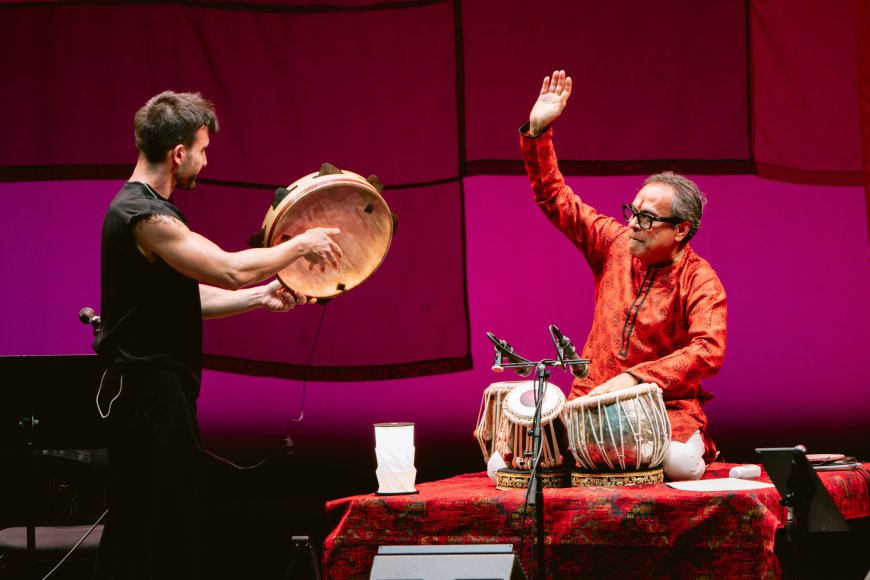
Tabla master Sandeep Das, an original member of Ma’s Silk Road, performed from a platform at center stage, and the energy sometimes flagged during long periods of him sitting out, which only became apparent when he rejoined the fray. Similarly, Giddens is such a forceful presence that she changed the chemistry whenever her voice moved to the foreground (she also demonstrated some expert dance moves, including footwork she may have acquired during her long residence in Ireland).
Giddens’s string-centric version of Hazel Dickens’s “Pretty Bird,” a song she recorded with the Carolina Chocolate Drops, was one of the program’s centerpieces, unleashing her full, glorious vocal prowess. While the string players created passages of intense beauty, the program runs on the power of percussion.
One piece that struck an ideal balance was Albany percussionist Haruka Fujii’s arrangement of the traditional salt-worker song “Sunatori-Bushi.” Her delicate, levitating marimba, buoyed by Gilchrist’s harp and Mauro Durante’s tamburello, started with a quiet intensity and soon gathered momentum, with Giddens singing the Japanese lyric (eventually joined by the entire ensemble). It was a communal creation that honored its origins and fueled a surprising journey, a mission that defines Silkroad Ensemble at its best.