
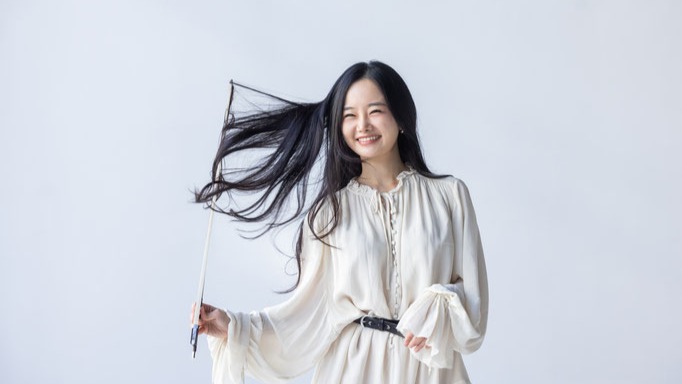
Only a few instruments can balance intimacy and drama as effortlessly as the violin, and Bomsori Kim is ready to embrace this duality at Stanford Live.
The violinist has quickly become one of the most celebrated musicians in the world, after winning top prizes in the Sibelius, Tchaikovsky, Queen Elisabeth, and Wieniawski International violin competitions. In 2021, she became the first Korean female violinist to sign an exclusive contract with Deutsche Grammophon, marking a major milestone in her career.
While on a European tour this year, Kim will make a quick stop at Bing Concert Hall before heading to Spain. Her recital this Wednesday, Apr. 1, will explore works by Maurice Ravel, Claude Debussy, Jules Massenet, Karol Szymanowski, and Henryk Wieniawski with pianist Changyong Shin. On Apr. 2, Kim will also lead a masterclass with Stanford music students that’s free and open to the public.
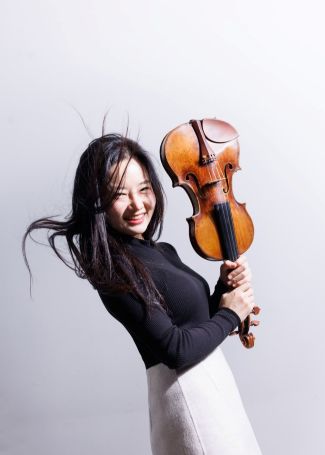
Kim described her recital repertoire as an intuitive journey. “Looking back, I feel the program traces a journey through different shades of intimacy,” she said. “[It moves from] something inward and introspective toward something more extroverted and freer, like opening a window gradually.”
Her recital spotlights: Ravel’s Violin Sonata No. 2 and Debussy’s Violin Sonata in G Minor. Although sometimes grouped together stylistically, they actually have strikingly different personalities and aesthetics. “Both sonatas belong to the same cultural and musical world, but they speak completely different languages,” Kim added.
While Debussy’s sonata feels “fleeting and poetic, almost like a memory that appears and disappears,” Kim approaches it with a sense of release, allowing the sound to breathe and dissolve. Ravel, by contrast, is “much more structured,” marked by clarity, wit, and even irony, which Kim reflects through a more articulated, rhythmic, and playful approach.
In Ravel’s sonata, the theme of incompatibility is emphasized by contrasting a dry piano part with the jazz and blues-infused violin melody. Rather than forcing unity, Kim embraces the tension to inspire a “conversational energy.”
“The violin and piano don’t always try to blend; they coexist while maintaining their individuality,” she explained. In the jazz-inspired movement, Kim focuses on flexibility of rhythm and looseness, “almost stepping out of classical restraint.”
On the other hand, Debussy’s final chamber work is intimate and introspective, exploring themes of emotional volatility and fluidity. “It’s almost like a private confession, and there’s something fragile and unfinished about it — not in a negative sense, but in a way that feels human,” Kim added. “When I play it, I try to create a space where the audience can lean in, rather than be overwhelmed.”
The violin is often compared to the human voice for its intrinsic similarity in phrasing, techniques, and range, making it a natural fit for music rooted in opera. That quality takes center stage in Massenet’s “Méditation” from Thaïs, a serene five-minute violin intermezzo drawn from the composer’s opera. For Kim, its power comes from its simplicity and sincerity.
“The melody is so direct, and there’s no need to exaggerate,” she explained. “In fact, the more honest and restrained the expression is, the more it reaches people.”
Less frequently heard but equally as striking is Szymanowski’s Nocturne and Tarantella, a piece that moves from long, Spanish-inspired melodic lines to a faster, more impressionistic section with Middle Eastern influences, like many of his other compositions. Kim is drawn to the composer’s distinctive voice.
“It’s sensual, colorful, and mysterious,” she said. By emphasizing the work’s dramatic contrasts, Kim hopes the audience will be pleasantly surprised by “how modern and vivid it feels.”
Her program culminates with Wieniawski’s Fantasie brillante, on themes from Charles Gounod’s opera Faust — an exciting whirlwind of virtuosic fireworks guaranteed to thrill the ear. Alternating between technically demanding runs, romantic phrasing, and dramatic flair, this showpiece is both audience-friendly and a testament to the performer’s true mastery of the instrument.
“There’s a kind of theatrical joy in playing it. It’s about sharing that excitement and story in the music with the audience,” Kim said. “Compared to sonatas, I allow myself more freedom here: more gesture, more contrast, and a stronger sense of communication outward.”
For Kim, the ultimate goal of her recital is to create space for personal interpretation and connection, whether for seasoned concertgoers or first-time listeners. With a program that moves from soaring melodic lines to sheer virtuosity, she hopes to showcase the violin’s versatility.
“I hope [the audience] leaves with a feeling rather than a specific thought,” she said. “If they walk out with even one little moment that stays in their memory, that would mean a lot to me.”