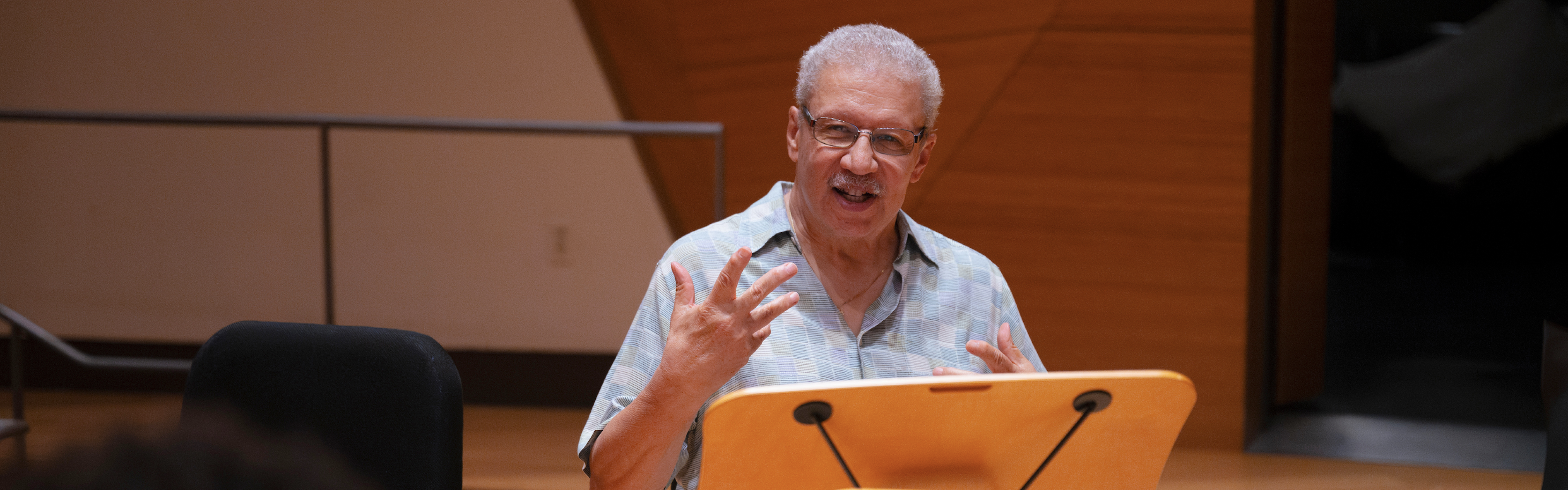
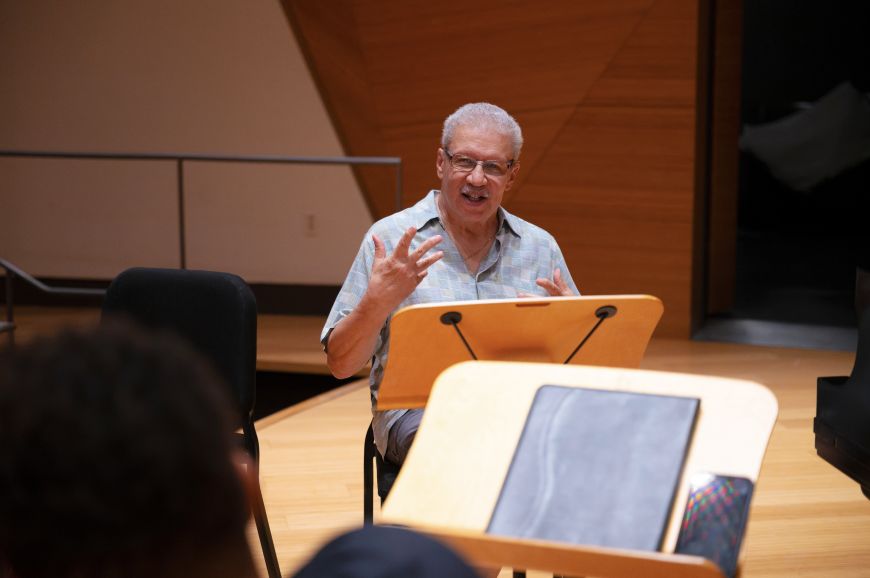
California is graced with its share of globally admired composers — John Adams, Thomas Adès, John Williams, Esa-Pekka Salonen, Danny Elfman, and hardly least, San Diego’s Anthony Davis.
Best known for X: The Life and Times of Malcolm X (1986) and the Pulitzer Prize-winning The Central Park Five, Davis has composed nine operas, often with political themes. The latest, Pancho Rabbit and the Coyote, will premiere in San Diego on Jan. 17 and 18, and in Tijuana on Jan. 31. The work breaks new ground for the composer: an opera for both children and adults, focused on immigration, and set in San Diego’s border-culture crucible.
Davis credits San Diego’s Bodhi Tree Concerts, the project’s commissioner, for suggesting he write an opera children could embrace. “I was curious. I'd never done anything like that.”
A longtime admirer of children’s musical parables such as Igor Stravinsky’s Rossignol (Nightingale) and Sergei Prokofiev’s Peter and the Wolf, Davis took a hint from painter Margo Sharpe and read “Pancho Rabbit and the Coyote: A Migrant’s Tale” (2013) by Duncan Tonatiuh, which tells the allegorical story of a young rabbit’s cross-border search for his father, for which he enlists a coyote guide.
“I said, ‘Well, this is perfect.’ It touched every base for me. It's a children's book with a political aspect,” Davis said. “As a picture book, it's almost giving you the structure of an opera right away. So often in operas, the most problematic thing is the storytelling and the dramaturgy.”
Though Tonatiuh gave Davis and librettist Allan Havis permission to take liberties with the source material, the composer insisted on preserving the book’s children’s-story roots: “the directness of the way the story unfolds, [its] guilelessness,” as he characterized it. “You don't want to make it too ironic, because then there’s too much distance from the story. But also, you don't want to just tell the story like the book does: as a third-person narrative.”
Davis and Havis have chosen to dramatize the opera’s cross-border odyssey in real time by deepening the characters’ perspectives, especially that of the Coyote. “Otherwise, [he] could be Wile E. Coyote or the Big Bad Wolf,” Davis explained. “That threat is still there in the opera, but also he has charm; there's a reason that Pancho trusts him. You have to think about how their relationship builds through all these adventures and then the ultimate disappointment that Pancho feels. ‘Why after all this, would you want to eat me?’”
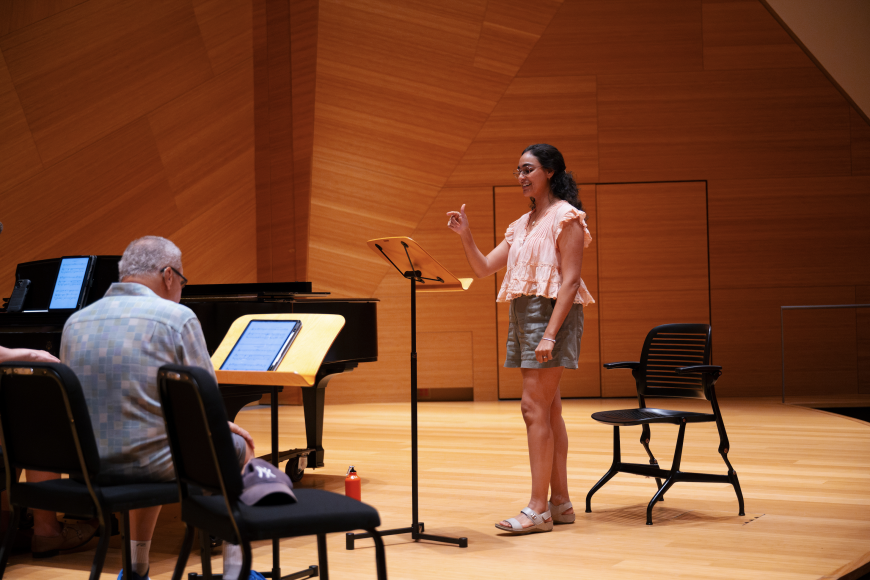
Davis’s music helps preserve the opera’s tone. “Doing a piece for children allowed me to really make something that’s exciting and terrifying at times,” Davis explained. “But also something where there's a direct sense of melody in the music. That was so fun for me to come back to — this very direct musical world.”
Pancho Rabbit’s music draws heavily from the tale’s Mexican context which, as a San Diego resident and UC San Diego professor, Davis had some familiarity with. “But it's new to me,” the composer admitted. “I was much more familiar with Cuban music, because of my previous piece about the Cuban Revolution [Revolution of Forms].
I didn't want to try to ‘imitate’ Mexican music — I'm not a Mexican American.. To incorporate a flavor of it I adapted [it] to my own musical language.” The bilingual opera’s native Spanish speakers (singing additional Spanish text by Laura Fuentes) stood by to ensure Davis’s setting of the language was idiomatic.
Improvisation has featured in all the operas by this original jazzman. It also figures in Pancho, though to a lesser extent. “There's a certain lift and sense of release that comes with improvisation,” Davis notes. “Even when playing the notated music, it’s what [the musicians] bring to the rhythmic language.” In the Bodhi Tree Concerts premiere, the improvisers are longtime Davis collaborator and bassist Mark Dresser, violinist David Boroff, trombonist Michael Dessen, and drummer Mike Holguin.
In January 2025, as the opera neared completion, the Trump administration rescinded Bodhi Tree’s NEA grant for production and outreach. Pancho’s theme suddenly gained fearful urgency — and two new scenes.
“The [ICE] crackdown, the deportations, and all the brutality fueled my fire in terms of what I was doing in the opera,” Davis admitted. “In one [new] scene, there's an Orange Snapping Turtle [Sharmay Musacchio] building a wall. There's an aria for why walls are necessary, not just physically to block migrants but also walls that are in your mind, that you create. And then [in another new scene] I actually have a child [played by Jessie Neuffer] in a cage. That’s part of Pancho’s dream. The Monarch Butterflies, a children's chorus, then actually free the child from the cage.”
Could major producers of Davis’s previous operas, like New York’s Metropolitan Opera or Chicago’s Lyric Opera, have premiered Pancho Rabbit? Davis is pragmatic: “There are times when you have to look at smaller organizations like Bodhi Tree Concerts to do projects in this political period where there'll be retribution, and that certainly has happened. It's important for artists to push the envelope.”