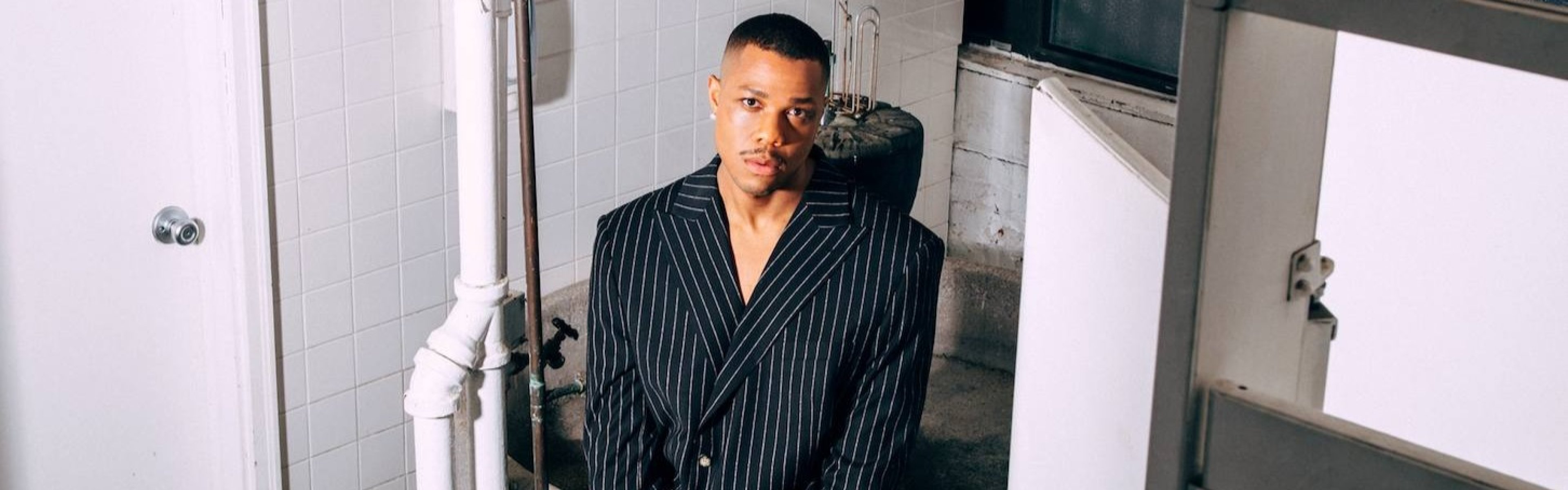
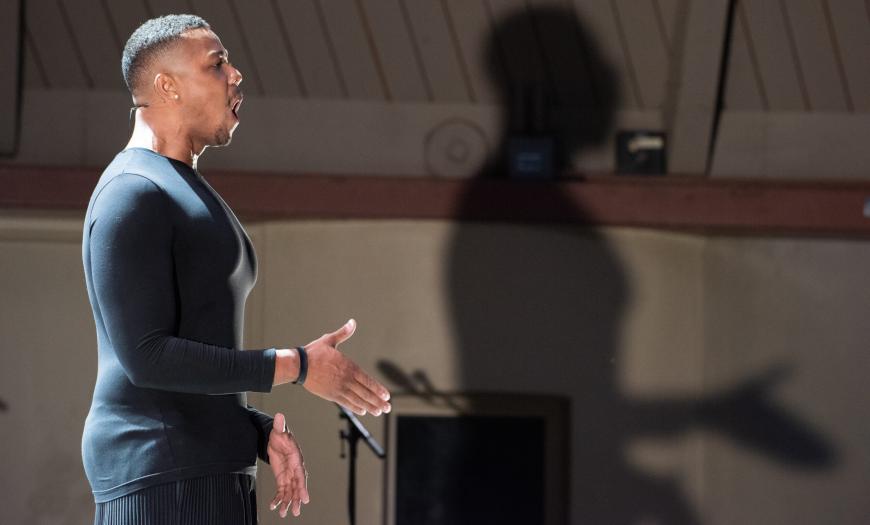
When we first interviewed bass-baritone Davóne Tines in 2017, he was about to debut with San Francisco Opera as Ned Peters, the stagecoach driver in John Adams’s Girls of the Golden West. At the time, fellow cast member and bass-baritone Ryan McKinny commented, “Davóne has a big heart, and he’s always interested in how we, as artists, can make a social impact.”
Since then, that motivation has had Tines reimagining, in recording and performance, the musical and activist legend of another bass-baritone in ROBESON; Tines’s Recital No. 1: MASS, a mashup of Bach, spirituals, and contemporary works, in an examination of spirituality, identity, and social justice; and two concertos for voice and orchestra, SERMON, incorporating poems by Black activists, and ANTHEM, a perspective on collective visions of America.
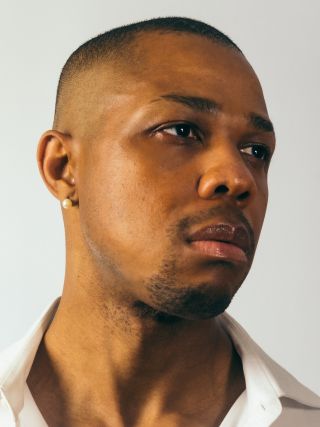
Extending the latter theme, Tines is now touring through San Francisco and nine other cities with What Is Your Hand in This? in the company of Ruckus, previously applauded in SFCV as “the world’s only period-instrument rock band.” In collaboration with San Francisco Performances, he will bring the program to Herbst Theatre on Feb. 7.
Tines self-describes as “curious since childhood,” when he was recruited early for the choir of his family’s Baptist church in Virginia. He went on to study sociology at Harvard as an undergraduate and then worked in arts administration, but turned to an advanced degree in music at The Juilliard School. Tines quickly scored international operatic bookings after graduating in 2013 and went on to residencies and partnerships on both coasts and in Detroit. SFCV spoke with him again earlier this month when he was visiting old friends in Boston.
How does the new show, What Is Your Hand in This?, figure in your canon of creative social consciousness?
A huge theme of this show’s program is looking at music that has questioned structures of leadership and the status quo. One songwriter who’s in the program in different ways is Stephen Foster. The evening actually opens with his well-known and quite beautiful “Beautiful Dreamer.” But as a complicated contradiction within Foster’s work, he also wrote a lot of minstrel tunes, meant for a theatrical practice that could [now] seem presumptive or enacting oppression. He wrote a minstrel tune [“Massa’s in the Cold, Cold Ground” (1852)] to which a formerly enslaved person, Joshua McCarter Simpson, wrote new words to [“To the White People of America” (1854), an abolitionist anthem]. In the program, they’re subtly contrasted. I think it’s really important that we continue to question America’s hypocrisy as a land of seemingly Christian ideals, which continues to hold to enslavement.
The press release describes the program as “time-traveling through four centuries of reimagined songs, hymns, and ballads, including newly commissioned works and arrangements” by you and bassist-composer-poet Douglas Adam August Balliett, a member of Ruckus. What’s your role in the mission of the show, aside from your composition and vocalization?
It’s a unique way for people to look at a slice of American history, and I work as both the singer and something of a narrator. So I’m giving information as we go along as to why we’re listening to certain pieces, and what to consider before and after listening to them. It all builds to a particular song called “What Is My Hand in This?” [by Tines], and that will involve a bit of invited audience participation ... a gentle invitation on my part to thinking about how each individual, of their own volition, can be connected to a greater idea of this messy American project.
There’s quite a gumbo of genres in the concert program, from 18th-century composers George Frideric Handel and William Billings on to Foster and Simpson to the compositions and arrangements by you and Balliett.
A lot of the work I like to do pulls in musical ideas, materials, aesthetics, and practices from a number of different places, to show how all of these different histories and cultures can be in conversation with one another, in order to deliver a narrative whole. There’s an interesting paradigm that happens with songs which apparently speak to a specific moment but continue to have prescience well past that moment, even when the initial impetus has passed.
What has this journeying through time and genre done for your voice?
A big part of the more recent change in my voice came when I started my exploration of my own connection to Paul Robeson, as a Black bass-baritone. I found he had an ideal balance of elements … natural, grounded breath support, an open throat, and frontal resonance, with a balance of ping and backspace. I found my normal singing voice. Without putting genre on it, you can utilize the breath as a full-on support system, like in opera, soften it to get more within the art song realm, or open into jazz, R&B, and gospel. I found that all these things are actually very closely related, with just very minute changes, and it just kind of broadened the color palette of what I’m able to explore with. And I’m still mixing colors and finding new ways to do old things. It’s exciting!
Where will you be journeying later this year? Any return to opera?
Let’s see — I’ll be premiering a new piece [the wealth of nations] by David Lang with the New York Phil and Gustavo Dudamel [in March]. I’m going to be at the Paris Opera starting in March and continuing in April and May, doing Philip Glass’s Satyagraha. And that’s in a new [production with] countertenor Anthony Roth Costanzo playing Gandhi, rather than a tenor. I’ve co-created a musical called The Black Clown [a multi-genre setting of Langston Hughes’s verse] which was first shown at the American Repertory Theater and Lincoln Center in 2018 and 2019; it will be at Opera Philadelphia in late May.
A year ago, you brought a project called Queering the Mass to the Chan National Queer Arts Center here; I’d like you to talk a bit about that.
It was actually a piece called Recital No. 1: Mass, about which a New Yorker interviewer had made the assertion that I was essentially “queering the mass,” in that I’d bent it to my own understanding. People then went to the aspect of sexuality, which, yes, is a part of my own story, but just a facet of who I am, not necessarily what was being fronted. And it’s only natural that I would do work in spaces like the Chan National Queer Arts Center [on Valencia Street], which uplift different parts of myself. It’s connected with broader ideals of gender and sexuality, and most institutions don’t lead with the idea of curiosity toward growth as they do.
Would you summon other classically trained musicians to activate their social consciousness?
I don’t think that vocalists and classical instrumentalists have been curious enough, though the blame is not necessarily on them — there has to be an invitation to it, and it has to be fostered and supported. Generally, curiosity is not encouraged, and I think that can lead us to a lot of bad places. And it’s important that opera be coming from an ever-broadening array of voices, and that rests on opera actually self-evaluating its strengths and connections to the communities in which it exists. At one time, opera served a certain purpose as the central place of musical and theatrical engagement, and now those attentions have been taken over by other forms of media, so we have to evaluate opera’s actual practices: How can you create things that capture the emotion, attention, and curiosity of a broader public that’s pulled in many directions?