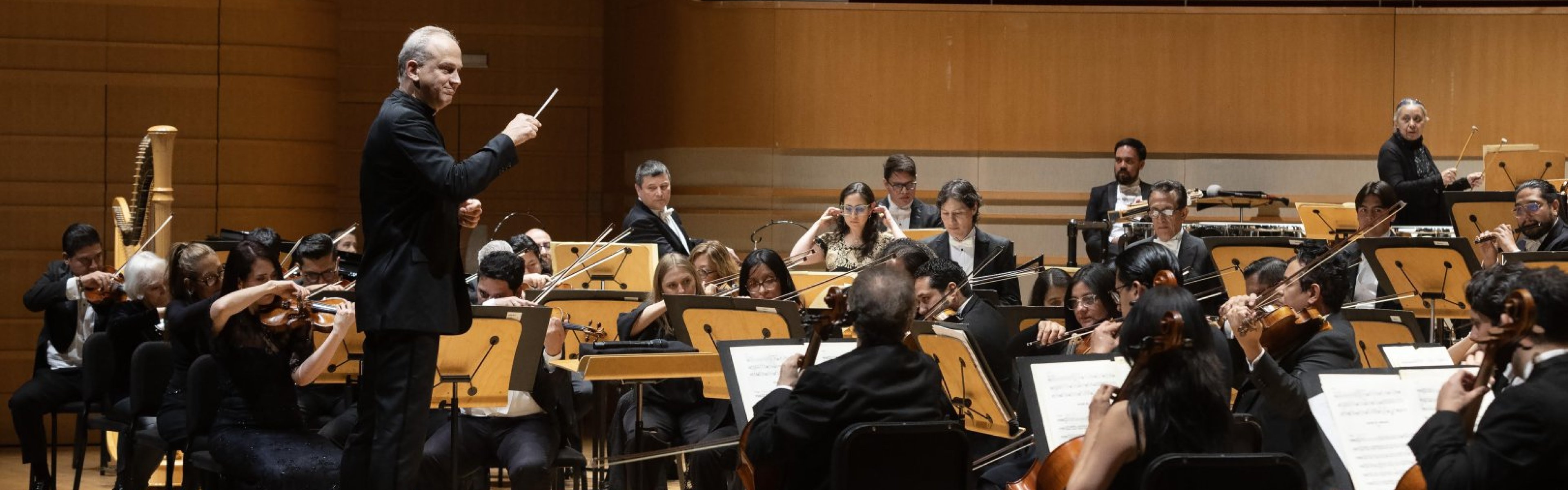
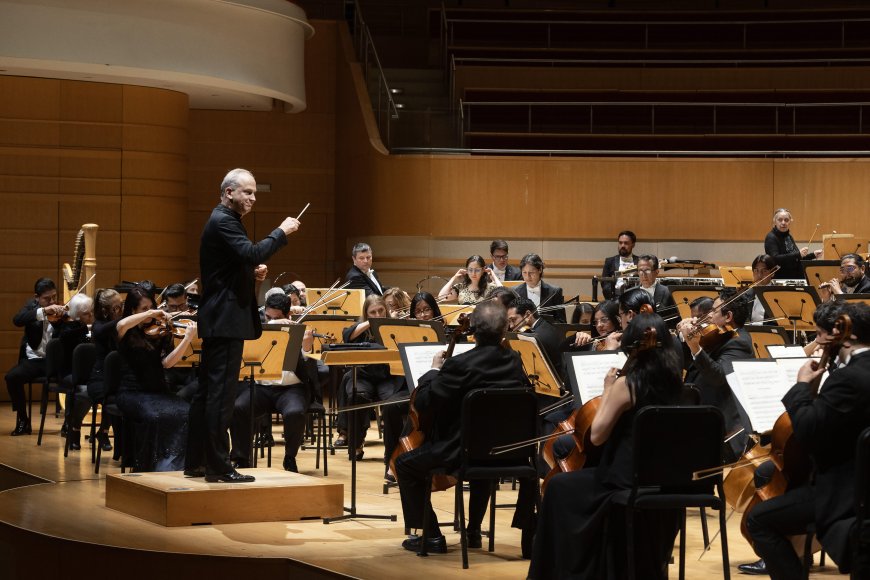
Concertgoers accustomed to tuxedoed, humorless musicians gravely channeling “serious” classical music got a refreshing dose of Latin American culture and virtuosity on Jan. 29 when one of Mexico’s premier orchestras, the Orquesta Sinfónica de Minería, captivated a near-sellout crowd at Renée and Henry Segerstrom Concert Hall in Costa Mesa. The orchestra’s unusual name (Minería means “mining” in Spanish) and low profile outside Mexico proved no hurdle for this tight, top-flight troupe with personality to burn.
Sinfónica de Minería takes its name from its original performance venue, Mexico City’s Palacio de Minería, which opened in 1813 to house the Royal School of Mines and Mining. Regarded — along with Orquesta Sinfónica Nacional and Orquesta Filarmónica de la Ciudad de México — as one of Mexico’s best orchestras, Minería’s players comprise a dozen nationalities, and its music director for nearly two decades, Carlos Miguel Prieto — who is also music director of the North Carolina Symphony — hails from a five-generation family of musicians.
Among Minería’s more than 20 recordings since 1986 is its 2022 Deutsche Grammophon release Estirpe, featuring Venezuelan trumpeter Pacho Flores performing Cuban-American Paquito D’Rivera’s 20-minute “Concerto Venezolano,” a wildly inventive fusion of American and Latin jazz (first movement), Venezuelan merengue (second movement), Cuban danzón (third movement), and sheer improvisation (fourth movement). Like three prominent California-connected conductors — Gustavo Dudamel (Los Angeles Philharmonic), Rafael Payare (San Diego Symphony), and Domingo Hindoyan (LA Opera) — Flores is a product of Venezuela’s vaunted El Sistema and was principal trumpet for its Simón Bolívar Symphony Orchestra (formerly the Youth Orchestra).
Performed to close the evening’s first half, “Concerto Venezolano” gave Flores multiple opportunities to shine (D’Rivera wrote it for him in 2018) and, in the final movement, to jam and vamp with Venezuelan Héctor Molina, a virtuoso on the small four-string guitar-like cuatro, as well as Minería’s principal double bassist Freddy Adrián and percussionists Rodrigo Duarte and Raúl Delgado (maracas) and Samir Pascual (snare drum). Among the gleaming variety of instruments arrayed next to him onstage was his go-to Stomvi four-valve B-flat trumpet, whose extended timbral range and alternate fingerings enabled Flores to unleash a volatile palette of colors.
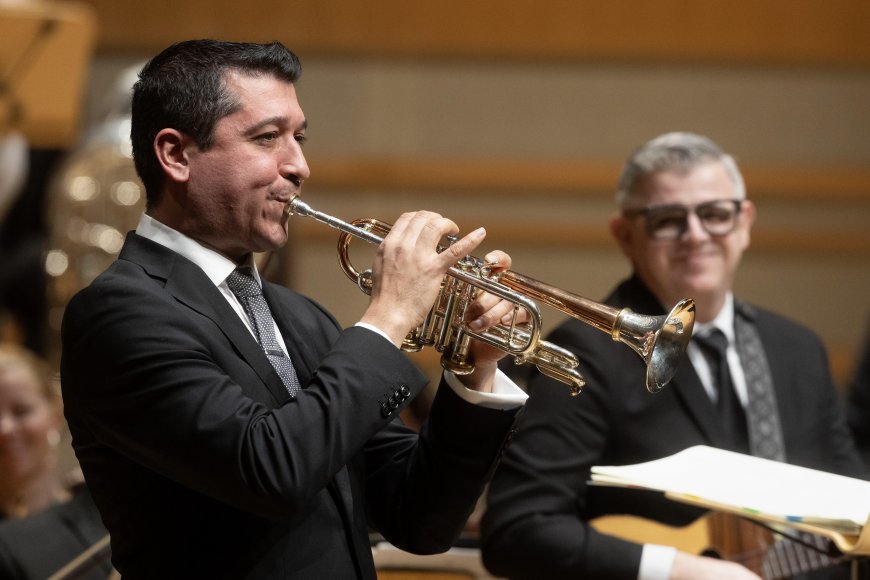
“Concerto Venezolano” is exuberant, well-wrought, and stylistically ambitious. Famed as a saxophonist and clarinetist, D’Rivera obviously learned composition well in his Havana musical education. In performance, however, the concerto’s episodic, open-ended structure occasionally devolved into a stylistic kitchen sink: plushy, Mantovani-esque light listening here, no-holds-barred improv partying (including an audience call-and-response on a Mozart melody) there. To experience a more coherent, thrilling “Concerto Venezolano,” listen to these same performers’ recording on Estirpe. In his encore, Flores’s gorgeously plangent take on Astor Piazzolla’s “Oblivion” (1982) redeemed all.
As Prieto admitted in the pre-concert talk, Flores’s opening solo piece, Haydn’s Trumpet Concerto (1796), was programmed to show Flores’s and Minería’s familiarity with canonical works. In tonal refinement and security, cantabile voice, nuanced shading, and a regal, penetrating clarity, Flores, supported by Minería’s idiomatic playing, showcased comfortable authority in traditional repertoire.
Minería musicians play with joy and spirit. James Ready’s trumpet, Iain Hunter’s trombone, and Gerardo Díaz Arango’s horn rivaled any brass-famous ensembles you care to name in muscular unity. Timpanist Gabriela Jiménez earned special mention not merely for her deft playing but for the rocking, swaying body English that she smilingly brought to the music even when she wasn’t playing. The concert ended with a violist shouting “¡Viva México!” while hoisting the Mexican flag. It’s refreshing to see an orchestra have such a good time.
Fittingly bookending the program were two of the best-known works of arguably Mexico’s most important composer, Silvestre Revueltas (1899–1940). Minería, which has begun recording Revueltas’s orchestral works, opened with “Sensemayá” (1937–1938), a piece based on a poem by Cuban Nicolás Guillén. Driven by syncopated rhythms, insistent tom-toms, braying horns, and the tuba’s earthy serpent-like growl, “Sensemayá” is a kind of humid, more ritualized, and relentless Rite of Spring — and quite a feat for an artist who’d only begun composing in earnest eight years before.
The evening’s closing bookend was the even more primeval “La noche de los mayas” (1939; arranged 1960). This brawny, rhythmically protean film composition, written just months before Revueltas’s untimely death in 1940, was extensively re-orchestrated by José Yves Limantour to challenge any orchestra’s grit and color.
Minería ate it up. Bassoonist Christian Coliver’s serpentine line in the first section, trombonist Iain Hunter’s baleful totemic calls, the dark, almost Mahlerian string color, the double basses’ snap pizzicato to open the fourth section (“Noche de encantamiento”), Javier Pérez Casasola’s impressive volume on the caracol (conch shell) — all helped this spellbinding piece build to a terrific climax.
Minería’s encore was a sweeping, bravura performance of José Pablo Moncayo’s “Huapango.” In a moment when the evening’s three cultures — Mexican, Venezuelan, and Cuban — are troublingly in the news, Sinfónica de Minería helped transcend the present with vital music.