Update: The US Tour of "Sutra" has been cancelled due to injuries recently sustained by central members of the cast. A documentary on the work's choreographer, “Don’t Put Me in a Box,” will be screened on Friday, Nov. 7 during the SF Dance Film Festival.
“Sutra,” the family-friendly production that fuses contemporary dance with ancient martial arts, is traveling to the West Coast.
The collaboration of Belgian choreographer Sidi Larbi Cherkaoui, British visual artist-sculptor Antony Gormley, composer Szymon Brzóska, and 20 Buddhist monks of the Shaolin Temple, “Sutra” had its world premiere in London in 2008, and some 250,000 people have seen it since. In its first decade, “Sutra” was performed more than 200 times in 66 cities and 33 countries.
The West Coast tour began last month in Santa Barbara, and will continue into November. The production will land in Los Angeles on Nov. 2 and culminate at Cal Performances in Berkeley from Nov. 8-9.
For Cherkaoui, who has been artistic director of Grand Théâtre de Genève since 2022, “Sutra” was a turning point.
“Back in 2007, I experienced artistic burnout,” he explained in a Zoom interview with SF Classical Voice. “I was feeling I was done with dance, done with creating art. A friend of mine said he knew the people of the Shaolin Temple, and [that they were] looking for experiences with artists… I thought, ‘Maybe that is where my salvation lies, in the temple.’”
And thus began the remarkable creation of the work that has been hailed by The New York Times as a “mesmerizing blend of spirituality and physicality, [that] invites audiences to reflect on their own journey through life.”
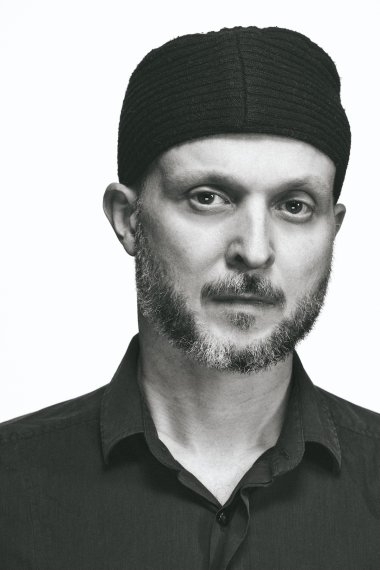
Weaving the Shaolin Temple’s splendid traditions — flying kicks, acrobatic backflips, and shadow-boxing — into an original and profoundly moving fable, the work is about a European outsider’s journey into the heart of a timeless monastery. Inspired by the monks’ daily practice of meditation and their training in martial arts, Cherkaoui combined the two disparate disciplines to achieve both spiritual stillness and feverish energy.
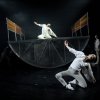
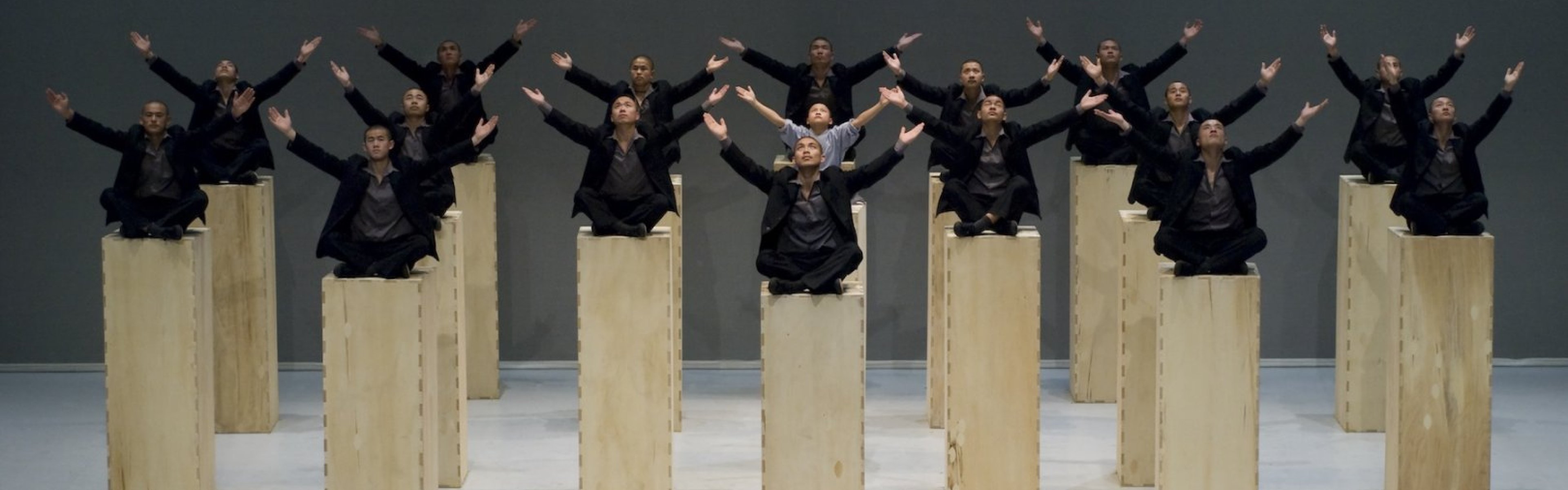
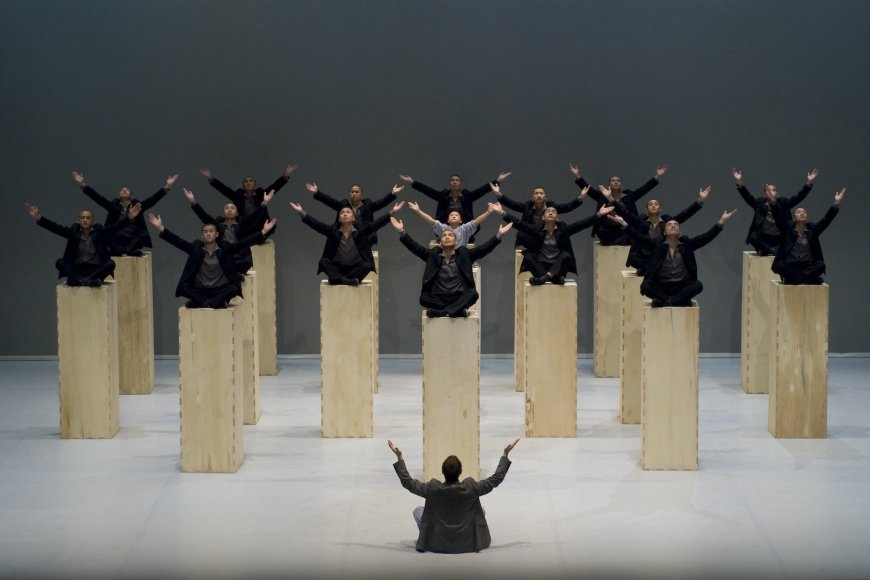
“Sutra,” which refers to the sermons of Buddha, utilizes a myriad of boxes made by Gormley. The monks lay inside them, manipulate them, and stand atop them, occasionally hoisting the boxes onto their backs.
“I was very conscious of Antony’s boxes, that this one looks like a boat, or a podium, or a pagoda or tomb,” Cherkaoui recalled. “All these were possible. My whole existence is looking at things and trying to find meaning. I see things and I see a connection.”
When Cherkaoui visited China for the project, he instantly thought to include composer Brzóska, whom Cherkaoui had met years prior. “When I was there and I saw the poetry of the space, I thought of him. This was one of his biggest projects as a composer, [and] everything fell together,” Cherkaoui said.
“He’s from Poland, Antony is from England, I’m from Morocco,” added the dancemaker. “I felt there was something about all these very far away people from each other, feeling the same things. [Brzóska] still comes back as a pianist to do this.”
Indeed, the meditative score is performed live behind a translucent screen, and features a chamber ensemble of violin, viola, cello, and a percussionist, who uses gongs and other instruments from the temple. With Brzóska on piano, the score is a gorgeous melding of eastern and western sounds.
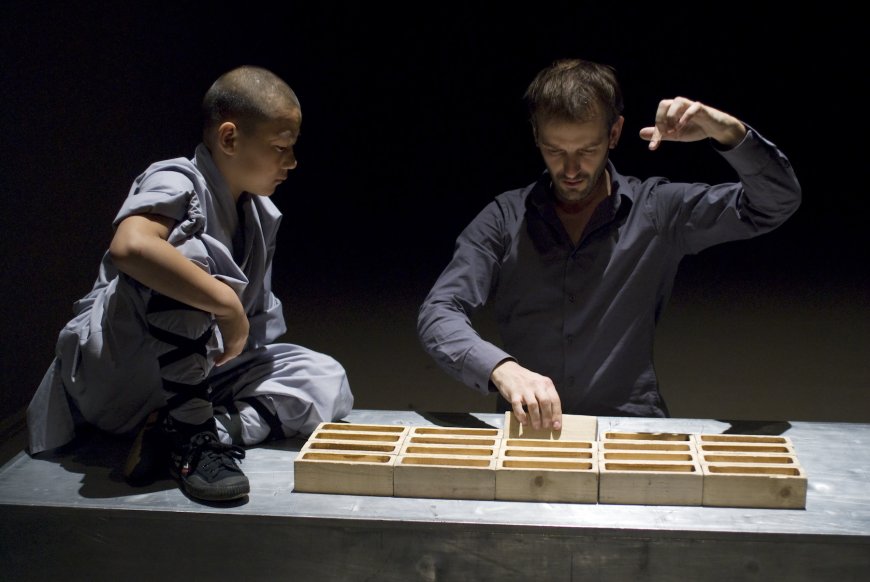
Comedy is also part of the “Sutra” performance. According to Cherkaoui, there are moments that are “cheeky, endearing and funny, [and] it brings people into their own childhood.” With Italian-Tunisian movement artist Andrea Bououthmane performing the role of The Westerner — which the choreographer himself used to dance — the comedy is found in her interactions with Gormley’s afore-mentioned boxes and a young Shaolin monk, who guides Bououthmane into his world.
Ultimately, the hour-long “Sutra” allows people from disparate cultures to come together and share in what can only be called a life-affirming experience. For Cherkaoui, the “Sutra” ride has been a rich one.
“The monks made me believe again in myself as an artist,” he acknowledged. “It’s also a work that makes you want to move. It makes you want to be part of it.
“Every time I was down or upset or lost in this world, movement brought me out of it. Movement is not just fun, it’s actually that one needs to move. I’m really a firm believer of that [and] the monks are the best at that. Everything is based on fundamental energy that goes through the body. I hope the audience can feel that and be more inspired to be inside of their own bodies, and to feel like they would [also] like to move.”