
Most everyone who hears it knows what instrument lures them into Gershwin’s Rhapsody in Blue. Only a clarinet could produce that seductive slide up from a low trilling rumble to an exultant, party’s-on yawp.
While that may be the instrument’s most familiar trademark, it’s largely a one-off. In the mainstream repertoire, the woodwind is generally less demonstrative. Whether it’s the becalmed legato opening of the Adagio in Brahms’s Symphony No. 3, the chittering fairies in Mendelssohn’s A Midsummer Night’s Dream, or just a few plangent phrases in any number of works, it’s always a pleasure when the suave, nimble voice of the clarinet gets to speak up, however briefly.
But what if a clarinetist steps forward into the spotlight — not for a concerto or chamber piece as part of a longer bill, but for an entire program? Does the instrument have the expressive range to sustain a 90-minute performance?
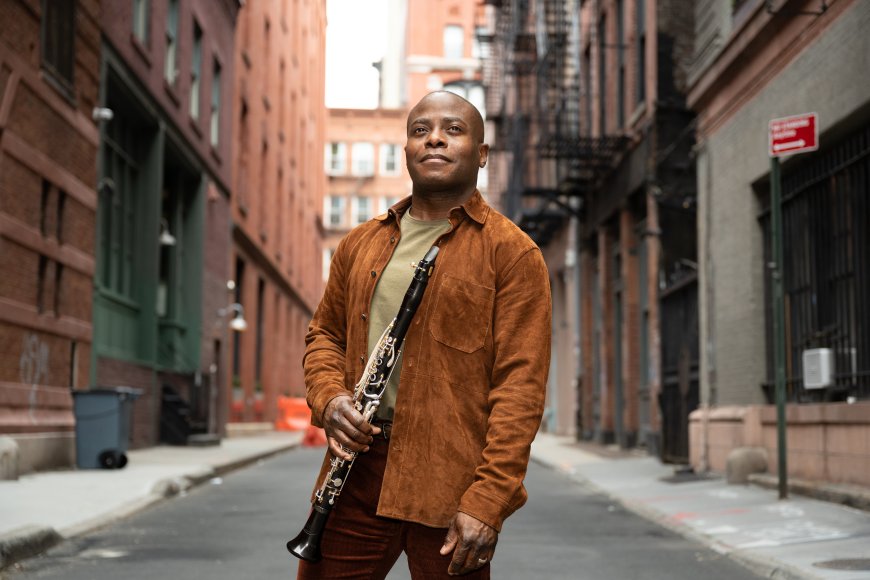
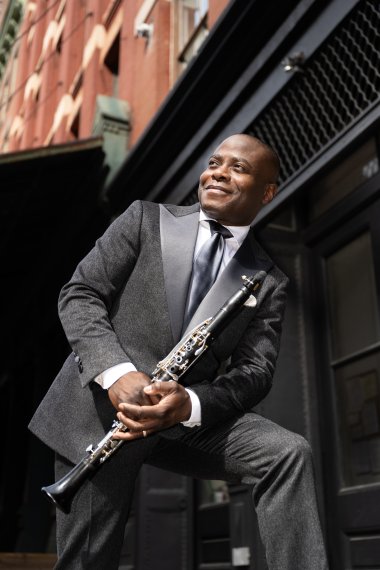
There may be no one readier for that challenge than Anthony McGill, Principal Clarinet of the New York Philharmonic. In a program marked by technical command, seamless passagework, sensitive dynamics, and seemingly effortless breath control, this gifted, engaging artist was joined by the superb pianist Gloria Chien in a Friday, April 3 duo recital presented by San Francisco Performances at the Herbst Theatre.
The first half of the program, which was devoted to French composers, opened with Debussy’s First Rhapsody for Clarinet and Piano — the “First” turned out to mean “only.” In this singular showpiece, full of sinuous chromatics, a wistfully lyrical section reminiscent of “Clair de Lune,” and some vaulting migrations between the low and high registers, it was clear early on that McGill and Chien, a longtime musical partner, were in close accord.
The clarinetist confirmed it in one of his brief remarks from the stage.
“We keep finding new sounds and harmonies,” McGill said.
A piece by André Messager was next — per the program book, the composer is “almost unknown to American audiences today.” His Solo de concours may be a small sample, but its inventive charm made one want to hear and know more from him. After gracefully powering through some scale-like passages, McGill unfurled a warm, song-like melody, voiced as if by an alto. He and Chien exchanged some particularly striking dynamic shifts before a bravura ending.
Camille Saint-Saëns’s Sonata for Clarinet and Piano, written near the end of his life, proved to be a succinct delight from a composer who can be long-winded at times. The performers brought an impish verve to the opening Allegretto and a sunny high-to-low-register brio to the next movement. Chien’s softly rolling chords cushioned the Lento dirge. A brisk final movement quoted the opening one, as if to neatly tie up this gratifying package. McGill and Chien gave the entire piece a sense of light playfulness without eliding its tender moments.
Robert Schumann’s Fantasiestücke and a Brahms Sonata for Clarinet and Piano comprised the second half of the bill. Both works paired the two performers more equally, with the piano taking a more prominent role than it had in the French pieces.
The Schumann opened with a broad, stately theme that developed some delectable exchanges. The composer’s ebullience broke through in the second movement, the finale as mordantly tuneful as one of the composer’s lieder.
The more substantial Brahms work stormed out of the gates, with some early turbulence in the piano. McGill handled the rapid passages expertly and the allegro appassionato with the requisite fire. There were a few flaws — several opera notes turned harsh.
As the recital neared its end, I did find my focus drifting a bit. Apart from the Schumann work, which was composed in 1849, the evening’s music all dated from the very late 19th-century to the early 20th-century. I wondered if something contemporary — there’s a Renée Esmail clarinet-piano sonata that’s gotten favorable attention, among many others — might have better displayed McGill and his instrument’s versatility.
That said, no one got anything but full value from the performers. They polished off the evening with Florence Price’s “Adoration,” a parting song in McGill’s caressing voice.