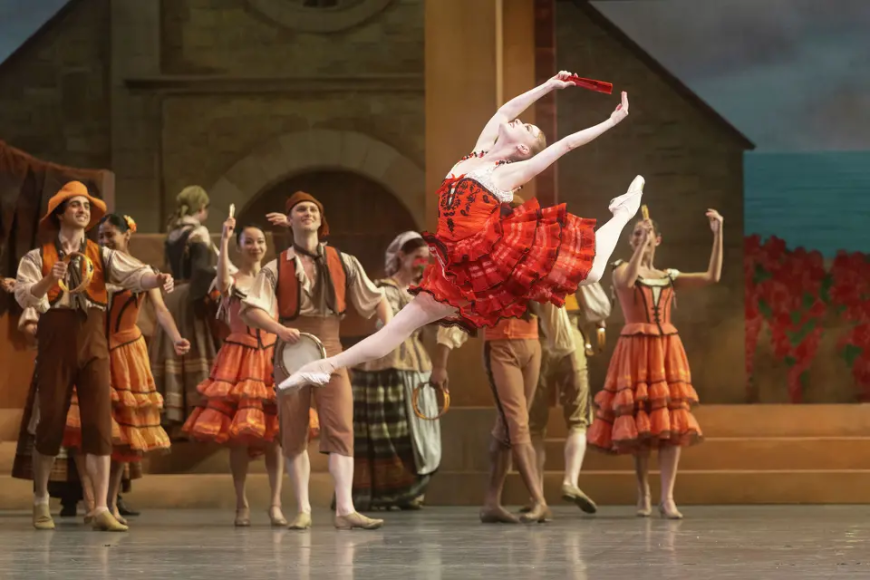
Think classical ballet is too remote, gushily romantic, or confoundingly abstract? Don Quixote may just be the ticket to change your mind. Abandon Netflix for a night and give San Francisco Ballet’s revival, running at the War Memorial Opera House through March 29, a whirl.
And a whirl it is — of dynamic character dances, Olympic-caliber solos and pas de deux, color-saturated costumes, multiple full sets, an easily followed storyline, a bevy of heart-tugging “Little Cupid” students from the San Francisco Ballet School, a comic suicide, and a few dashes of slapstick.
Maybe you’re keen to see live animals onstage? You get those, too (no spoilers of what kind). The only thing missing is someone belting out “The Impossible Dream.”
As a rule, ballet dancers don’t sing. But the company does make some noise, with occasional hard stomps, the clatter of tambourines, bursts of rhythmic clapping, finger snapping, and the soft patter of toe shoes. For an atmosphere more Spanish than anything this side of Carmen, the cape-waving toreadors and castanets clicking away in the orchestra pit seal the deal.
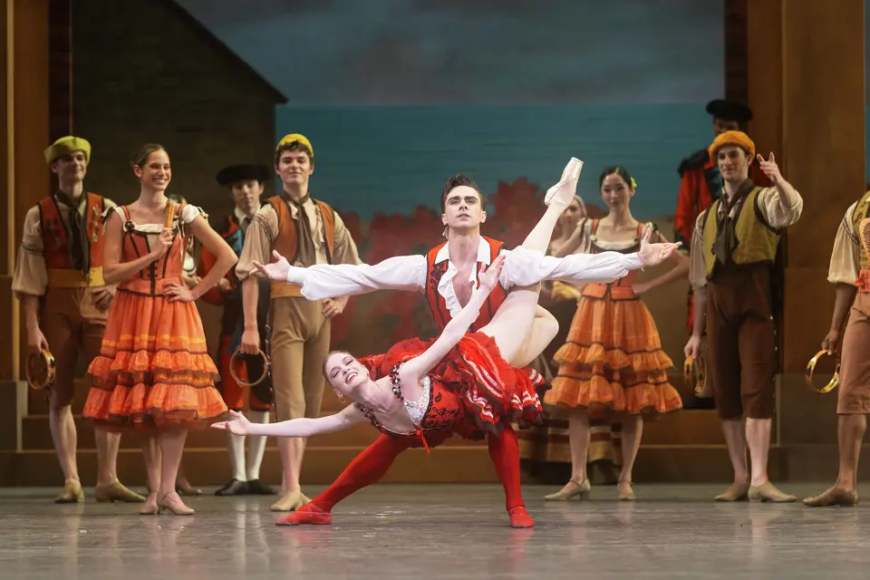
Does it all sound a bit overstuffed? Well, it is. Even ballet fans might admit that for all the stage-filling dances and individual star power, there may be a too-muchness about this production. Don Quixote won’t be to everyone’s taste (as if anything is). But submit to it, and you can’t help having a fine time.
The story is sourced from Miguel de Cervantes’s 17th-century novel about the deluded hero’s quest for love and adventure. SF Ballet regulars of a certain age may recall when Don Quixote first came into the company’s repertory in 2003. Choreographed by then-artistic director Helgi Tomasson and then-principal dancer Yuri Possokhov, it was based on the original 1869 ballet by Marius Petipa, revised by Alexander Gorsky in 1900.
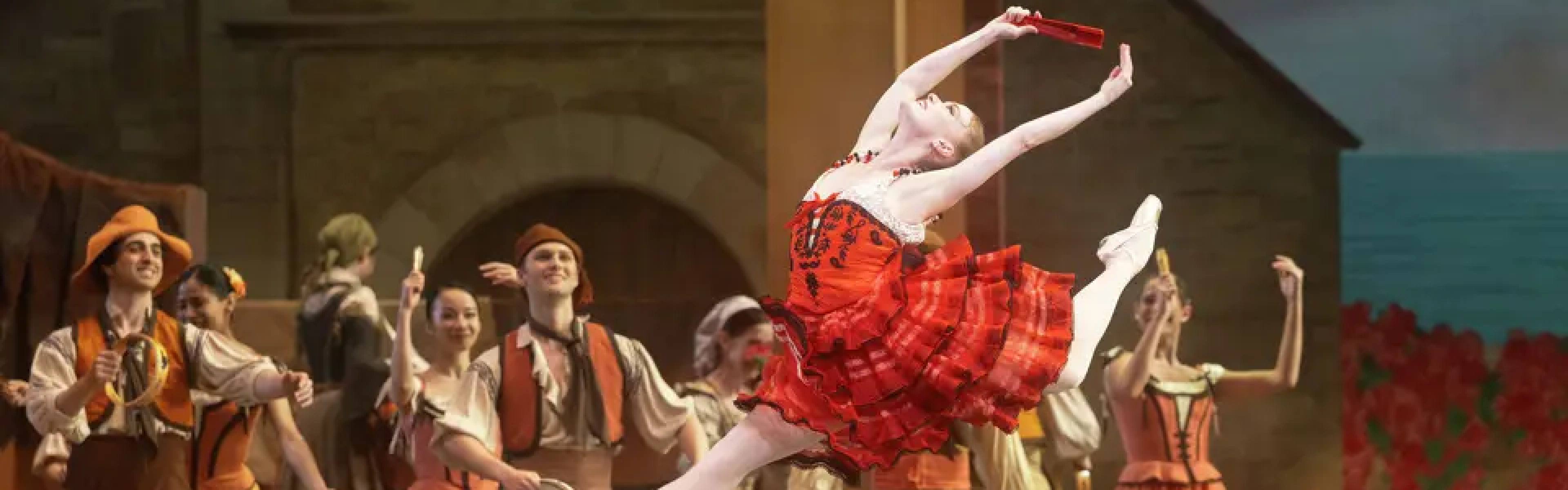
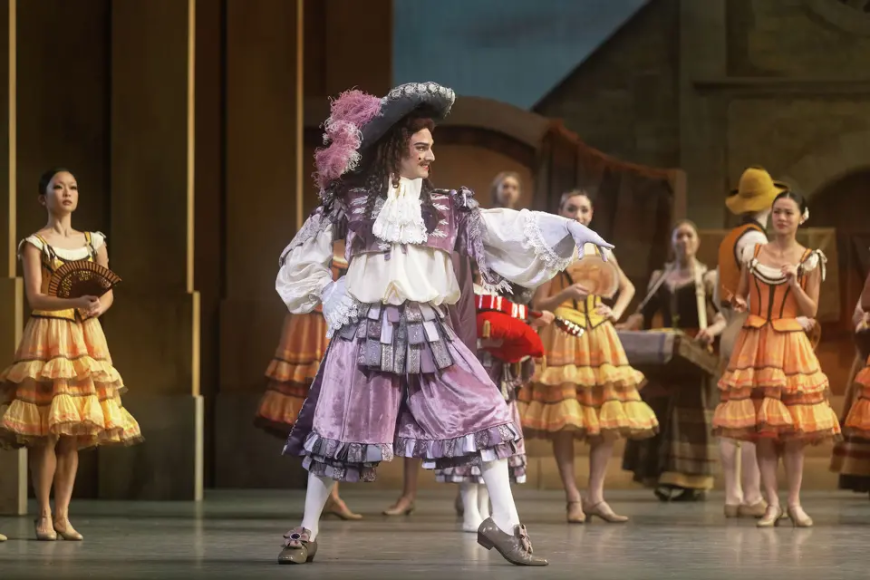
The current sets and costumes — the latter a nonstop astonishment of ruffles and pancake tutus, technicolor toreador pants, feathers, and faux armor by the Broadway costuming veteran Martin Pakledinaz — amped up the visuals in 2012. Don Quixote has returned to the War Memorial stage about once every four years, most recently in 2022.
Things get off to a slow start in the Prologue, as the title character (a perpetually tottering Nathaniel Remez on opening night) cooks up the fevered notion of pursuing his dream date — his Dulcinea. Sancho Panza, Don’s quickly recruited squire played by a padded Pascal Molat, is portrayed as a bustling action figure — a ballet Super Mario, if you will. After some comic business that mostly fell flat at the March 19 opening, the pair makes their way to Act One.
In a Barcelona town square, Don spots his would-be Dulcinea, whose name is actually Kitri (Sasha De Sola). His hopeless hopes are complicated by the fact that Kitri is in love with the barber Basilio (Francesco Gabriele Frola). Not to mention Kitri’s father (Val Caniparoli) wants her to marry a ridiculous, wealthy fop (Myles Thatcher as Gamache, appropriately costumed in baby blue with a bad wig).
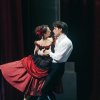
The lovers both wear red, as if we needed any more clues to their passion. In the town square, De Sola was all impudent hip thrusts and flipped skirts, one of them baring her backside to Gamache. Frola, here and through the evening, was a highflyer, his jumps hanging just a fraction longer in the air, his spins too rapid to count — a quad king on his own terms.
Kitri and Basilio’s lavishly celebrated love is the ballet’s beating heart, and these two delivered on it. In one transporting scene, De Sola and Frola danced a wonderfully languid duet, gently passing a guitar back and forth like one of their future children.
Meanwhile in a field, in a tavern, and later in an alfresco wedding scene, the company dancers pour forth, dancing a seguidilla here, a Romani folk dance there, a fandango, and even a courtly minuet. On opening night, the company exuded high spirits with an occasional stutter in step coordination.
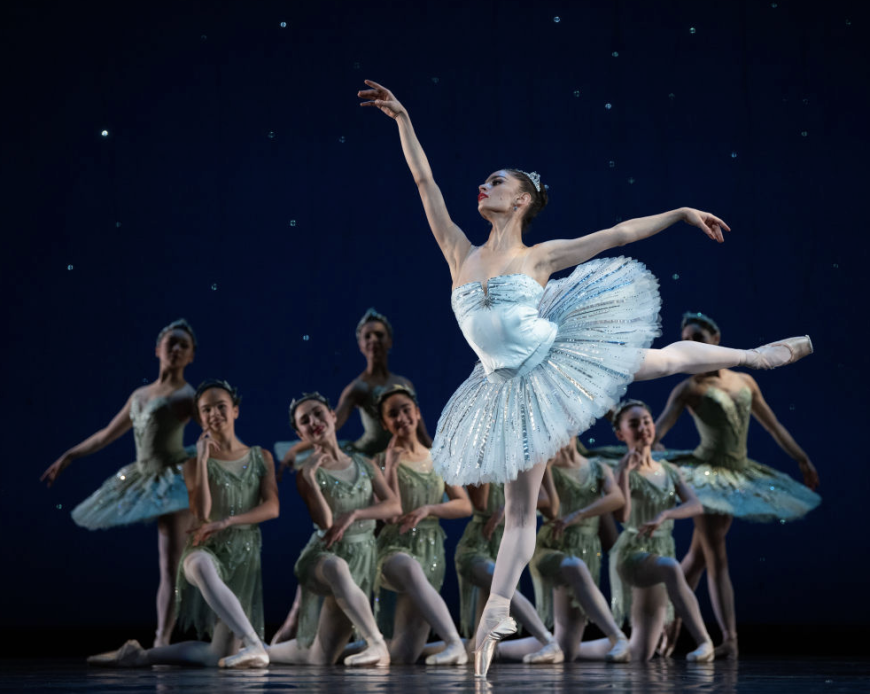
The Act Two dream sequence is the ballet’s luminous idyll of calm and contemplation. Floating about in white tutus, the female corps were led by a buoyantly playful Julia Rowe as a bewinged Cupid and the regal Frances Chung as Queen of the Driads. In a touching conclusion, the corps slowly retreated offstage on pointe, leaving the bereft knight longing and alone.
The wedding celebration was a showcase of bravura dancing in ensembles but especially in the main couple’s grand pas de deux. Everything moved with quicksilver speed and exuberance. For people keeping score, nothing may have drawn a bigger gasp than Frola’s 540 — a rotation-and-a-half jump in a layout position.
That feat, it turned out, would leave a poignant mark. A few minutes later, Frola grabbed his thigh and limped offstage, not to return. Citing dancers’ privacy, an SF Ballet spokesperson declined to comment on the nature of the injury or when Frola might return to the stage.
Artists and athletes in equal measure, dancers train, rehearse, and perform to the brink of possibility. When De Sola took a curtain call she would have shared with Frola, you could almost feel her conflicted feelings — gratitude, fulfillment, distress. A partner was down, and she wanted to be with him.