
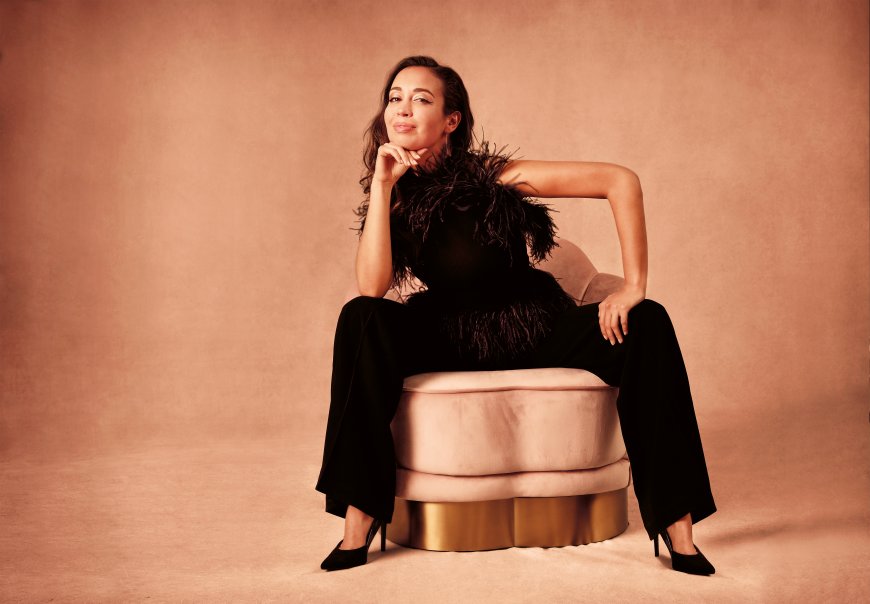
Nadine Sierra’s voice rings inside your head. The resonance of the American soprano’s unamplified singing fills a room and seems to vibrate through your body.
It is an uplifting and thrilling experience to hear her live, much like the communal rush at a massively amplified rock concert (sans the eardrum damage) or, at the other end of the spectrum, a ruminative December walk in piney woods.
The effect was unmistakable at Sierra’s recital at Stanford Live’s Bing Concert Hall on Friday, March 13, which proved not just triumphant but exhilarating. At the end of five encores, the audience enthusiastically called her back to the stage. For that final one of the night, the soprano sat down for Stephen Foster’s “Beautiful Dreamer” — because her feet were hurting.
“We’re here all night,” she joked.
Any fatigue stopped at her heels, her voice remaining strong. If only Timothée Chalamet could have heard it.
Sierra mentioned the Oscar-nominated actor while reflecting on her profound relationship with opera and her artistic collaborators as well as on the depth of training the art form demands. Then she added he should “get his ass to the opera house.”
At 37 years old, Sierra is an established star in the opera firmament. She has sung at major opera houses around the world, won awards and laurels by the bushel, and released two albums with Deutsche Grammophon — with a third on the way. She was a great catch for the Drs. Ben and A. Jess Shenson Recital Series, one that should raise the series' profile.
The first half of Friday’s concert was comprised of familiar opera arias that tested the soprano’s full vocal range, from the low A in Mozart’s “Deh vieni non tardar” (from The Marriage of Figaro) to the interpolated E-flat above the staff in Verdi’s “Sempre libera” (from La Traviata). While the A sounded a mite thin, there was no loss of vocal presence throughout those two-and-a-half octaves, even when she playfully held a note for 10 seconds or more in the second half.
The darker, lyrical quality of her sound — like a mezzo-soprano in some ways — allowed her to sing “Ah fors’è lui,” the slower, midrange-centered movement in the Traviata aria, with ease. It was almost surprising to hear the same voice ignite into sprays of fleet, flexible coloratura a mere moment later.
Sierra spoke to the audience with familiarity, extending a personal connection she had already established musically. She introduced her excellent collaborative pianist, Bryan Wagorn (a friend from her time as a Mannes School of Music student in New York), and her beloved voice teacher César Ulloa, who was in the audience — both of whom she’s known for more than 20 years. She walked onstage arm in arm with Wagorn and repeatedly addressed Ulloa in her remarks. Those deep connections are clearly foundational to how she makes music and a part of her support system.
In the second half (or maybe middle third, given the number of encores), the Spanish songs and Heitor Villa-Lobos’ Portuguese “Melodia sentimental” allowed her to draw on a wider range of emotions. She was just as artful in her interpretations, using rubato (a slight stretching of tempo) to sharpen an interpretive point or portamento (a continuous glide from note to note) in Joaquín Rodrigo’s Cuatro madrigales amatorios to bring out the lyrics’ sensuality.
She was broadly comic in “¿De dónde venís, amore?” (Where have you been, my love?), chastising a wandering lover. By the time she invited the audience to sing along in the chorus of the world-famous “Cielito lindo,” there were plenty of audience members — including Ulloa and his partner — who were happy to oblige.
There was one more relationship that Sierra introduced to the audience during the encore set: her handsome beau, French-Austrian double bassist Marc André, who had flown all the way from Vienna, where he had a gig.
The pair performed an arrangement of Consuelo Velásquez’s “Bésame mucho” that they had worked out together, a marvelously imaginative turn that showed why he’s having such an impact in Europe.
Even a catastrophe wouldn’t have changed the vibe in the hall. I faced an hourlong drive home, but I would gladly have gone twice as far to be a part of Sierra’s transportive recital.
This review has been provided in partnership with San Francisco Chronicle.