Opera San José has run the gamut of the great Mozart-Da Ponte trilogy.
The company opened its 2022 season with Le nozze di Figaro and its 2025 season with Così fan tutte. They’ve now arrived at Don Giovanni, perhaps the most difficult of the three to mount successfully, owing to the large number of characters and complex, interlocking plot strands.
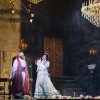
For this Don Giovanni, director Alek Shrader, who also directed Così, impressively balanced the comic and tragic elements of the story and carefully delineated the class dynamics. At the first performance on Sunday, Sept. 13, soprano Yulan Piao’s Donna Anna stood out for the brilliance, size, and fluidity of her voice and the nobility of her bearing.
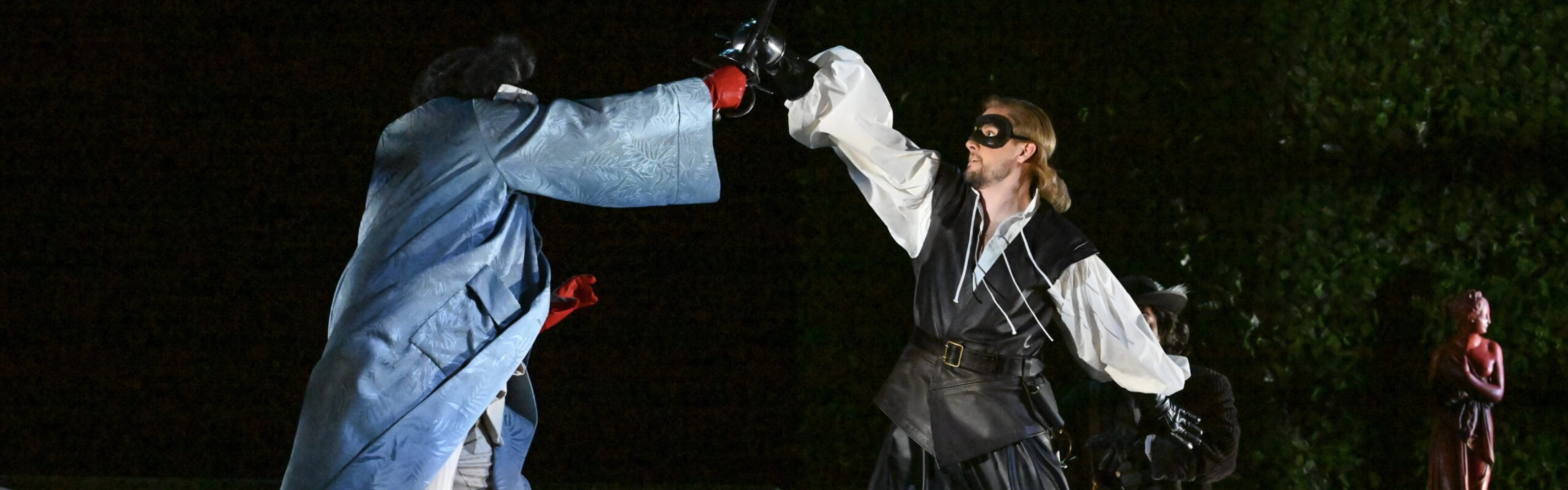
Shrader chose a traditional staging, with the characters in 18th-century clothing. It’s funny without being gratuitously jokey, serious without being grim. Shrader brings plenty of nuance to each character; for example, Donna Elvira’s fury at Don Giovanni for deserting her is very neatly balanced with subtle — and sometimes not so subtle — longing to once again be in his arms. In addition, under his direction, the large cast, chorus, and supers form a coherent dramatic ensemble, with excellent timing and interrelationships.
Bass Wm. Clay Thompson is tall and handsome, moves gracefully, and has a smoothly beautiful voice, making him an ideal Don Giovanni. Thompson’s Giovanni is the still center of the production; while he’s often in motion, he’s just as often observing the tumult around him.
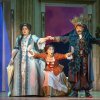
His height also contributes to one of the funniest sequences in the opera, during the extended sequence where Don Giovanni and his servant Leporello (bass-baritone Phillip Lopez) swap outfits so that the disguised Leporello can lure Donna Elvira away while Giovanni attempts to seduce her maid. (You have to feel even more sorry for Elvira as they play this cruel, Così-level trick on her.) Shrader takes advantage of the height discrepancy between the men in a most amusing fashion.
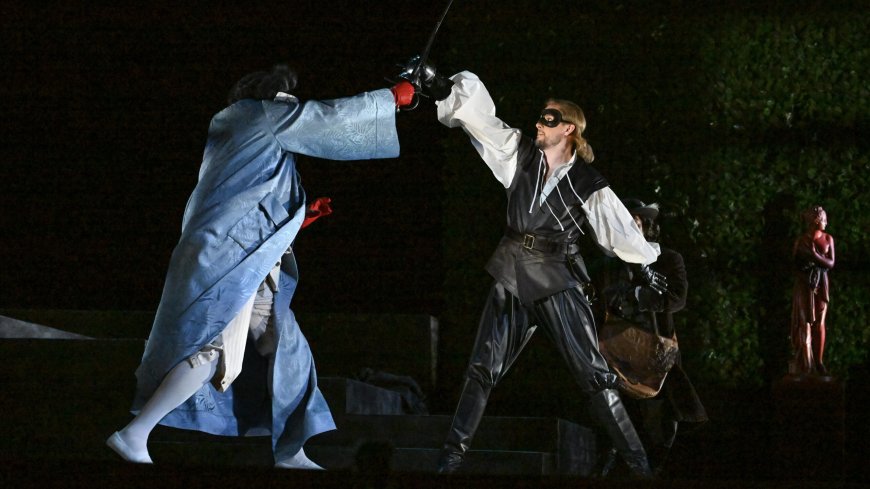
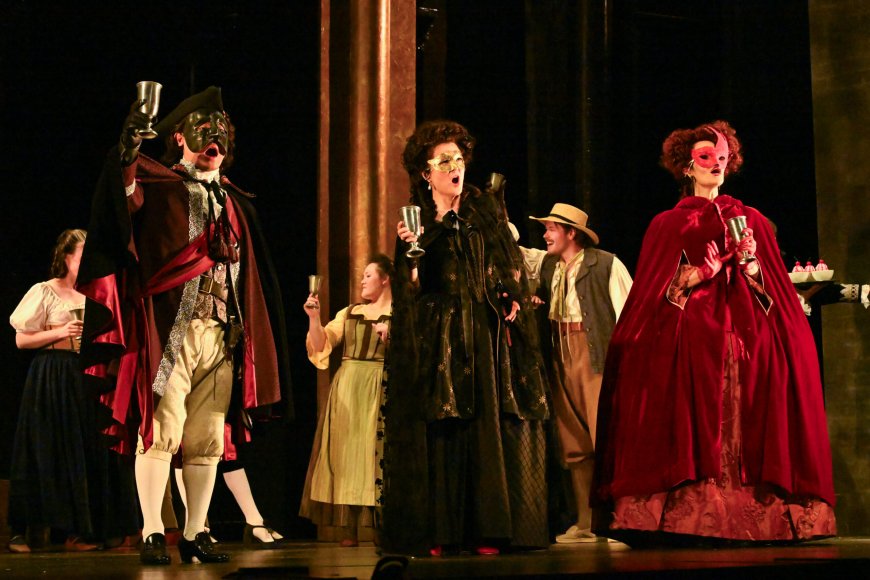
You could question some of Shrader’s choices. If you put weapons in the hands of Donna Anna, Donna Elvira (soprano Maria Brea), and Don Ottavio (tenor Jonghyun Park) when they appear in masks toward the end of Act 1, it’s implausible that Don Giovanni, cornered at close range, escapes with his life. I wasn’t convinced that he could caress his way out of that particular situation.
It’s not the only time that weapons are drawn on him without being used, and you’ll find yourself wondering whether the Chekhovian gun will ever be fired. The answer is yes, and you’ll likely be surprised when it finally happens.
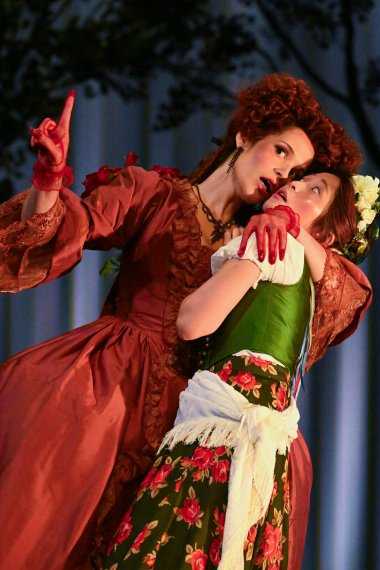
As for the class issues in the opera, Don Giovanni casually and intermittently abuses Leporello and the peasant Masetto (bass-baritone Joseph Park), tries his best to take advantage of Zerlina, Masetto’s bride (soprano Nicole Koh), while treating Ottavio, Anna, and Elvira with far more respect — well, except when he’s trying to rape or seduce the women.
The leads are largely well cast. Lopez sounds enough like Thompson that vocally, they’re convincing when they swap clothing, plus he’s extremely funny as Giovanni’s comic foil. Jonghyun Park’s beautiful tenor seems to have darkened a bit since his Ferrando in Così and he was dignity itself as Ottavio. (The production included “Il mio tesoro,” but not “Dalla sua pace,” a sensible choice.)
Koh’s light, clear soprano was an excellent contrast with Joseph Park’s dark tone and they were dramatically well matched as well, between her naïve charm and his frustration over how Giovanni treats them. Kenneth Kellogg sang imposingly as the Commendatore, but the placement of his entry at the end of the opera reduced the impact of his singing, which should have been terrifying. Maria Brea was an amusing and varied Elvira, but unfortunately, she could not sustain a good line or consistent tone.
Musically, perhaps the production needed a bit more rehearsal time. Stage-pit coordination went awry a surprising number of times, largely at the start of arias. Music director Joseph Marcheso’s tempo choices were sensible and well proportioned, but his first act had more boldness and vigor than the second. The scene where Giovanni is dragged to hell was certainly loud, but would have benefited from more mystery.
Steven C. Kemp’s good-looking and efficient unit set provides numerous doors for exits and entrances and allows for scene changes using large elements that glide on and off stage. The set is positioned fairly far back on the stage of the California Theatre and in some places doesn’t have a flat reflecting surface, both of which could have contributed to some voices having less impact than they might have. The costumes, designed by Caitlin Cisek, fit the period and clearly indicated class. Donna Anna’s black mourning dress, with bright red shoes and a red cross, was especially eye-catching.