Before he skips out the door to the New York Philharmonic, Gustavo Dudamel gave Los Angeles one last blockbuster project last week.
To start his final run through Walt Disney Concert Hall as the LA Phil’s music and artistic director, Dudamel tackled Richard Wagner’s Die Walküre. He presented two cycles with one act per performance, totaling six days in all.
This is a really good idea for the performers — especially the singers who can give their vocal cords a good long overnight rest between acts. It is also a good idea for the thoughtful among us in the audience, giving us space to contemplate the world of ideas and depictions of human nature that Wagner overwhelms his listeners with.
It may not be so good, though, for music lovers on tight budgets who will have to buy three tickets in order to see a single opera.
The bittersweet feeling in Disney Hall for Act I on Tuesday night (May 19) was not just about Dudamel’s impending departure. It was also for the late Frank Gehry, who died last December at 96 just after completing the set designs for this nearly fully staged production, which is now dedicated to him.
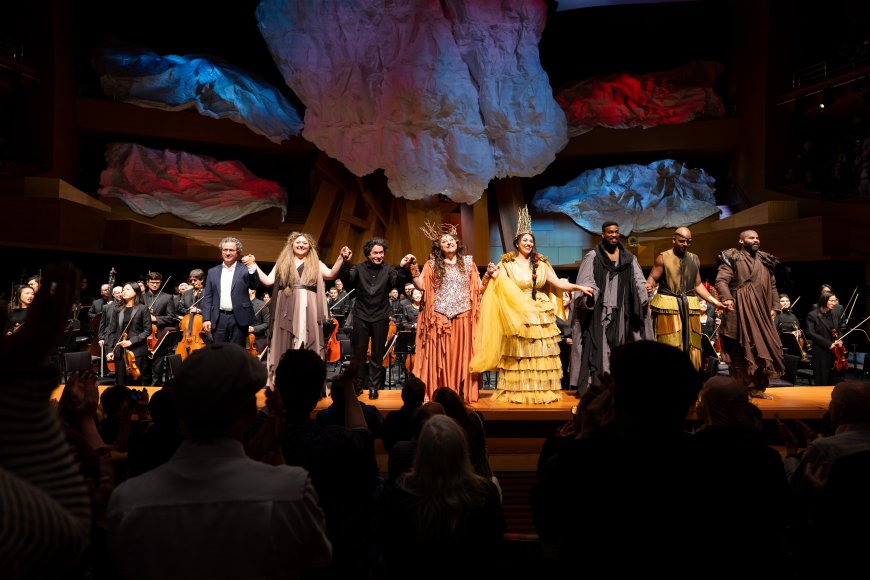
But on the other hand, I wouldn’t dwell too much on loss. Dudamel is not leaving L.A. high and dry; he’ll return for four weeks per season at Disney Hall and the Hollywood Bowl, bearing, as of Tuesday, new titles — artistic and cultural laureate of the LA Phil, and founding director and conductor laureate of YOLA. And Gehry’s presence remains with us via his dazzling hall, now a living memorial.
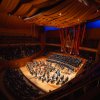
In his designs for Das Rheingold at Disney Hall in 2024, Gehry tried to transcend the limitations of a concert hall not designed as an opera house. For Act I of Walküre, he went even further.
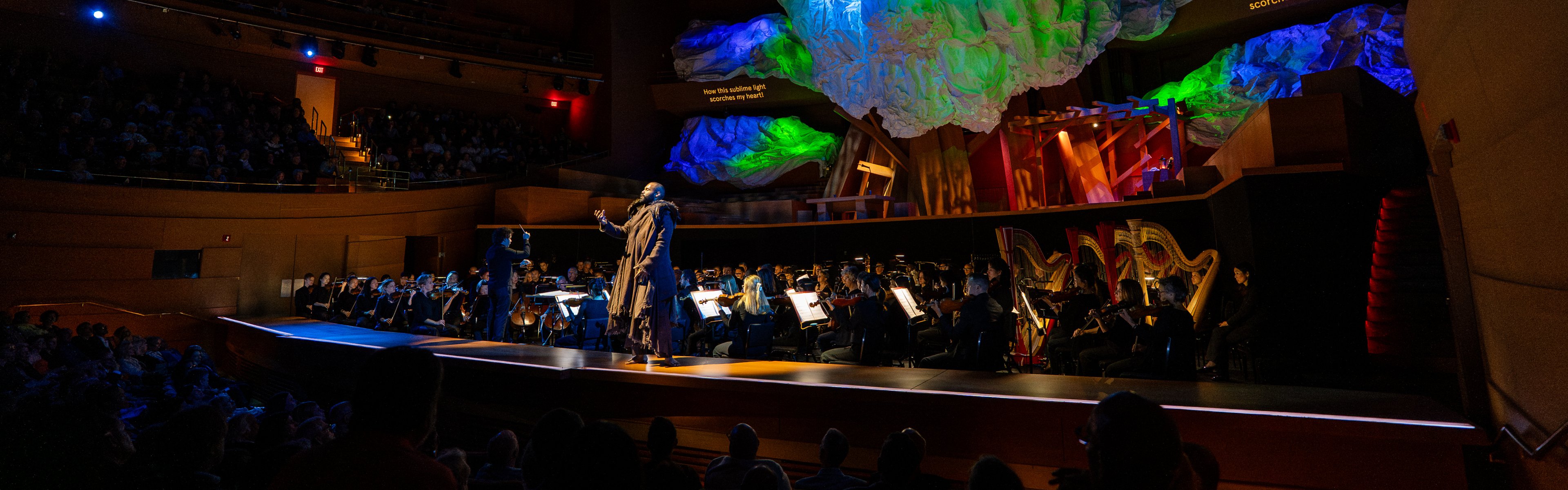
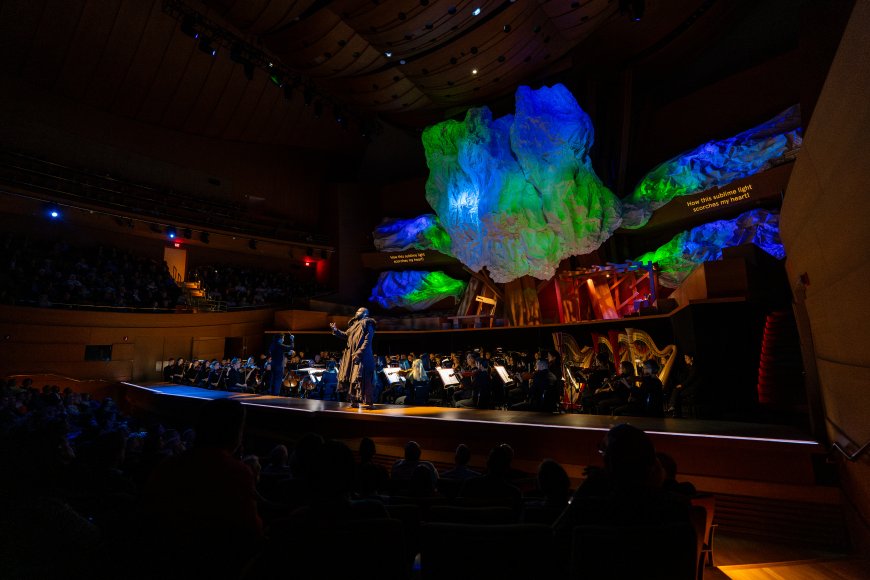
Upon entering the hall, we see Tomas Osinski’s huge, puffy paper “clouds” pressed against the back wall that at first resemble massive wrinkled bedsheets. Onstage is a simple wooden table with chairs, and a few wooden stairs that recall the Rheingold set.
Soon, the clouds appear to resemble the spread of the tree in Hunding’s hut, with trunks that extend, blend with, and echo the wooden pipes of Disney Hall’s one-of-a-kind pipe organ. Once subjected to the magic of Shutter Cut Lighting Design, the clouds are lit in strikingly moody colors of fluorescent green and purple. It’s another example of Gehry using ordinary and technical materials in an abstract design that nevertheless touches the viewer in a humanistic way.
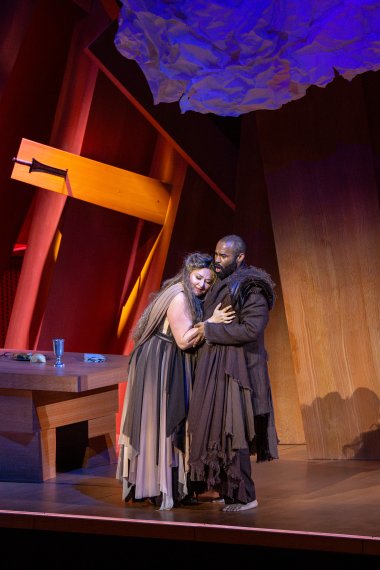
Beyond the distinctive Gehry touch, Act I of Walküre — like Rheingold before it — was another traditional Alberto Arvelo production; faithful to the libretto, with no Regietheater ego trips, no updated time frames, and no ideological scores to be settled. It also had one advantage that a traditional production seldom has — the chance to hear Wagner’s lusciously lyrical score played in an acoustically fine hall by one of the country’s leading symphony orchestras instead of musicians trapped in a pit. There was a pit, to be sure, but a large, shallow improvised one, fronted by a narrow, curved catwalk.
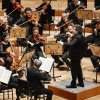
With luxury-class orchestral resources at his command, Dudamel took the Prelude at a very fast, even breakneck pace with strong accents, as if Siegmund were racing through the forest in a Ferrari. Later, Dudamel could relax and get comfortable with Wagner’s soaring lyrical rhetoric, saving his more aggressive energies for the end as he whipped up the final bars into a huge, entirely characteristic (for him) frenzy. The LA Phil as a whole played splendidly, with particularly rich, deep, soulful chords from the French hornists doubling on Wagner tubas.
There was, as always in Disney Hall opera productions, the issue of balancing voices placed way back in the hall behind the orchestra. But the elevated stage high above the instruments provided a decent balance between the singers and instruments from the perspective of Orchestra Level 3.
As for the three vocalists, they displayed plenty of power, but I honestly can’t say that I was bowled over by their performances. Tenor Jamez McCorkle’s Siegmund had a baritonal color, scoring with the most immediate intensity when he was on the catwalk. His rendition of the beautiful “Winterstürme wichen dem Wonnemond” passage, though, sounded distant and not particularly ardent. Soprano Jessica Faselt, who sang the part of Freia in Rheingold two years ago here, turned up as a rather shrill Sieglinde in her upper range, and bass Soloman Howard’s Hunding had sufficient menace, along with often approximate pitch.
The vocal reinforcements in Acts II and III do look promising, with the return of Ryan Speedo Green’s Wotan (from Rheingold) and one of the world’s reigning Brünnhildes, Christine Goerke — plus a gaggle of Valkyries. We’ll see.