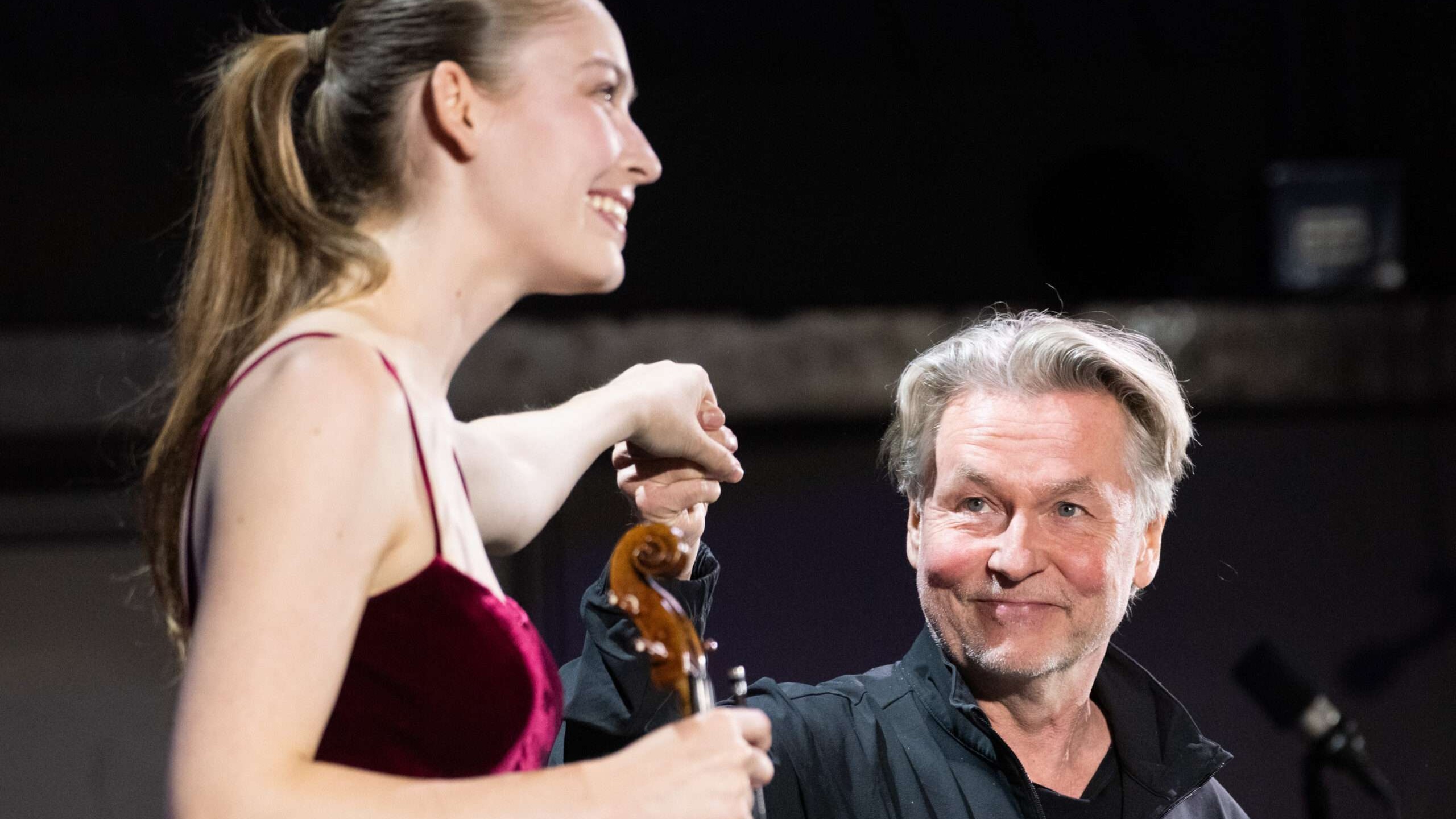
When Esa-Pekka Salonen was announced as the music director of the 2026 Ojai Festival, it was thought to be just a pit stop on the highway out of San Francisco toward who-knew-where.
How things have changed since.
With September’s announcement that Salonen was starting the job of creative director of the Los Angeles Philharmonic, his third Ojai gig was transformed into a de facto Southern California homecoming celebration. All his concert appearances, and many of the satellite events, were sold out.
With Salonen came the promise of adventure, of a peek into his composing room, and of increasingly masterful conducting as he nears his 68th birthday June 30. Most of all, it was Salonen’s ever-sharpening talent as a programmer, in tandem with retiring Executive and Artistic Director Ara Guzelimian, that made this festival special. The web of cross-connections that they wove between compositions, composers, teachers, students, colleagues, friends, and more was amazingly complex and thought-provoking throughout the four days, June 11-14.
Yet age and status may be having a mellowing effect upon Salonen in some respects. There were none of the monkeyshines that he and the Toimii Ensemble cooked up at the 1999 festival (dressing up in bunny-rabbit suits and hopping around the stage). Also, he spoke not a word to the audience in any of his three evening concerts.
Salonen’s late fellow composer-conductor Oliver Knussen was represented on the Friday morning program, first by Knussen’s Reflection (2016) — lyrical meanderings suited for a morning concert — and then by Salonen’s own Arabesques for Olly (2022), in which an offstage cellist (Andrew Yee) played distant trilling drones underneath the solo elegy from onstage cellist Jay Campbell.
One of Salonen’s teachers, Franco Donatoni, turned up next in Ave, with its pleasing, glittery, atonal sonorities for piccolo, glockenspiel, and celesta. Though not a direct tribute, Iannis Xenakis’s Komboi contained the most exciting music that morning, with wonderfully typical Xenakis aggression on bongos (Jonathan Hepfer) and harpsichord (Todd Moellenberg) as a liftoff.
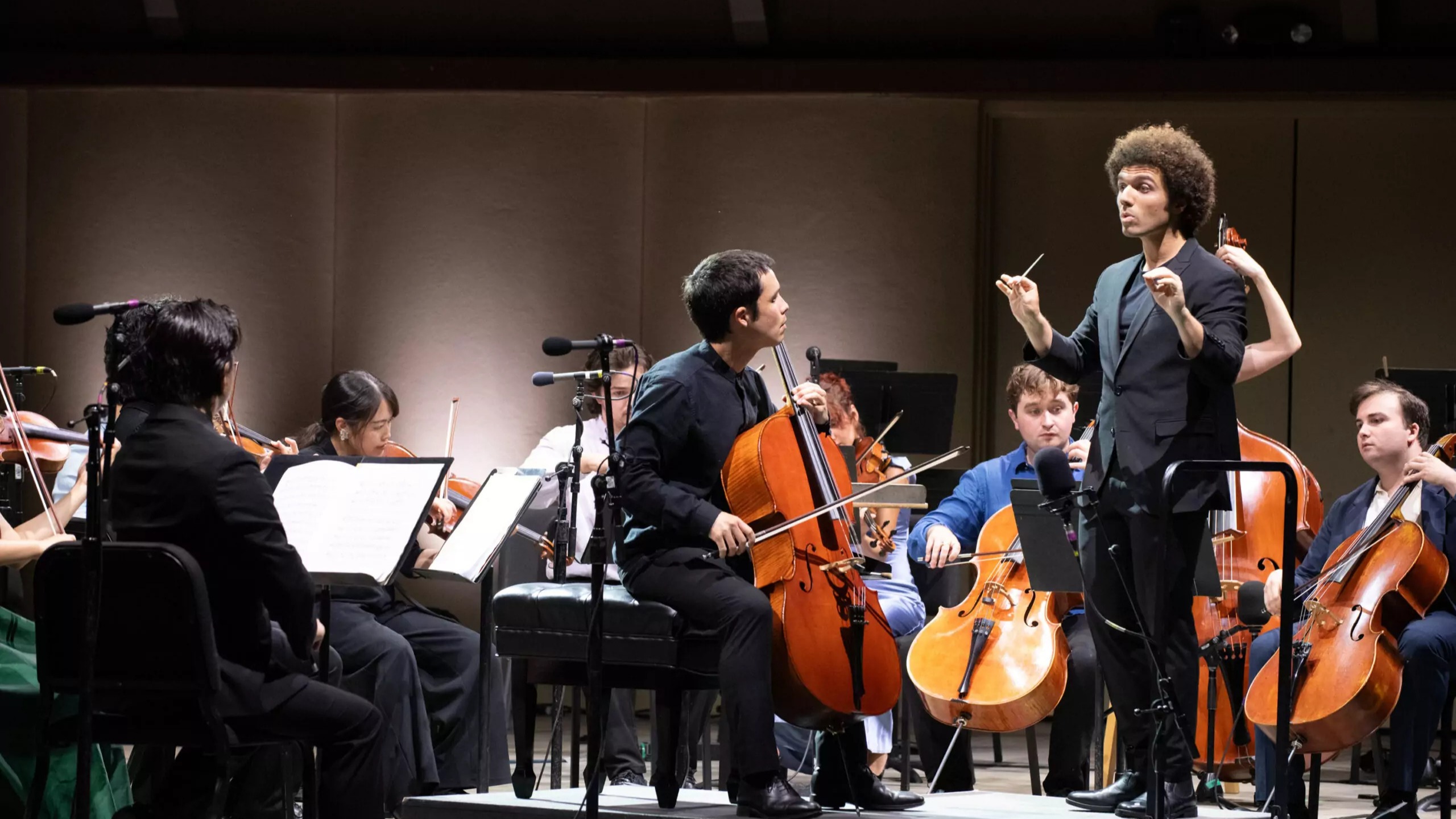
Two more composer friends of Salonen’s were remembered on Friday evening. Steven Stucky, the LA Phil’s former resident composer who died tragically at 66 from a brain tumor 10 years ago, had become a master of pastiche. His Colburn Variations (2002), based on the spelling of Colburn in musical notes, took Salonen and the Colburn Orchestra strings on a tour of 20th-century styles, going in with textures a la Schoenberg’s Verklärte Nacht and coming out the other end with neoclassical Stravinsky: musical kleptomania at its finest.
The great Witold Lutoslawski was represented by his tense Grave for solo cello and string orchestra, as conducted with big, emphatic gestures by one of Esa-Pekka’s students, the formidably talented composer-conductor Mert Yalniz. And what should come at the end of that concert but Salonen leading the Colburn strings in the real Verklärte Nacht, loaded with expressionistic rage and acres of nuance early on, if a touch of unruly ensemble playing toward the end.
A couple of Salonen’s Sibelius Academy schoolmates were represented. Magnus Lindberg’s Related Rocks (1997) for two keyboard players and two percussionists tumbled along abstractly in an exploration of ringing timbres that culminated in boogieing momentum Saturday night, June 13. That morning, the feathered rustlings of Kaija Saariaho’s Sept Papillons (2000) appropriately caught the attention of a yellow butterfly that flitted to and fro to the sounds of Jay Campbell’s cello. Only at Ojai.
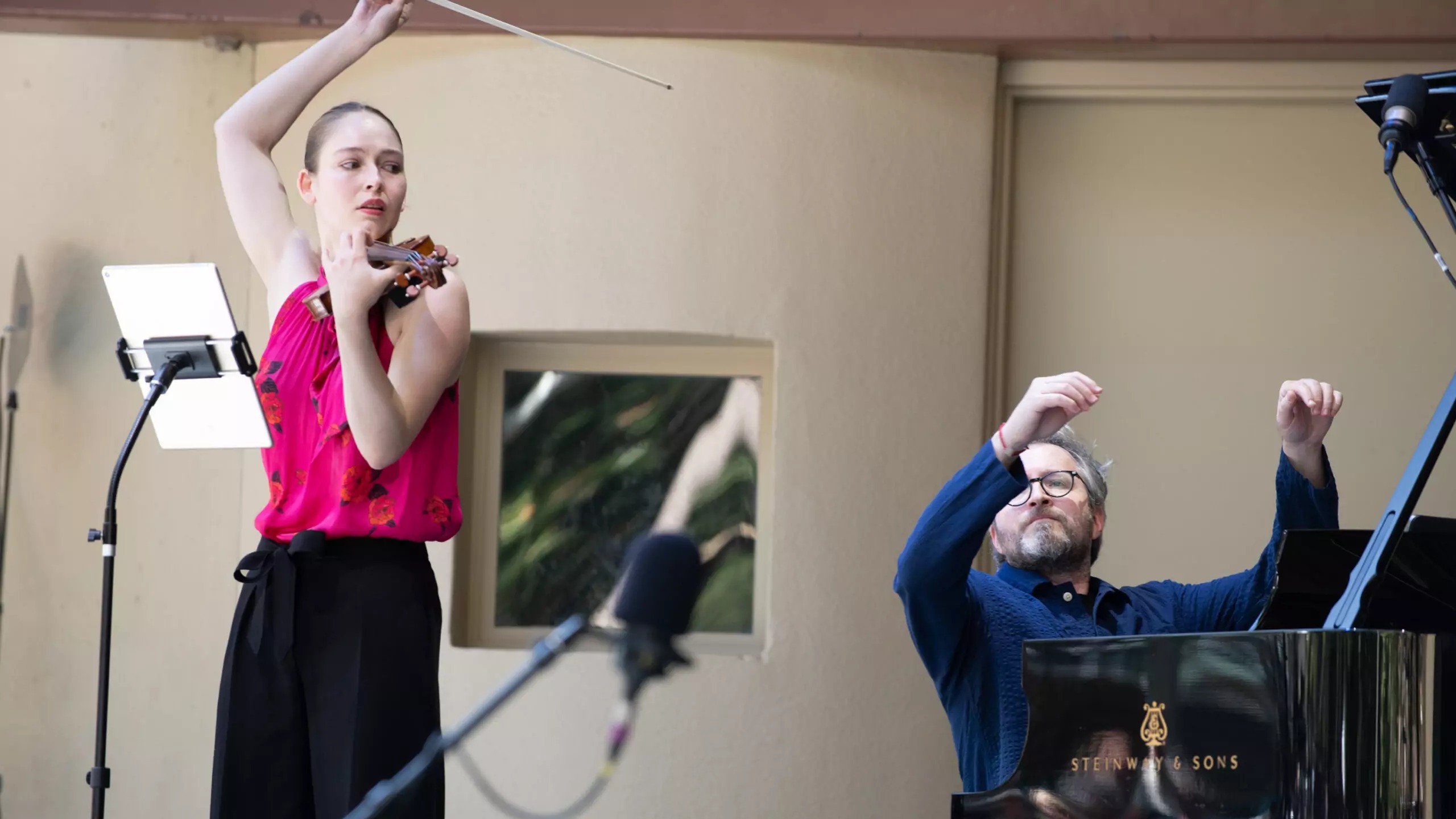
When architect Frank Gehry turned 90 in 2019, his friend Salonen wrote a piece for him, Fog, based on Gehry’s initials. A fantasia on the Preludio from J.S. Bach’s Partita No. 3 for solo violin, Fog is a luminously orchestrated dreamscape that Salonen led with the Colburn Orchestra in the closing Sunday concert, June 14. Preceding Fog was the very first music to be heard in Disney Hall, the Preludio itself, beautifully played from a position on a hill to the left of Libbey Bowl by the festival’s featured solo violinist, Geneva Lewis.
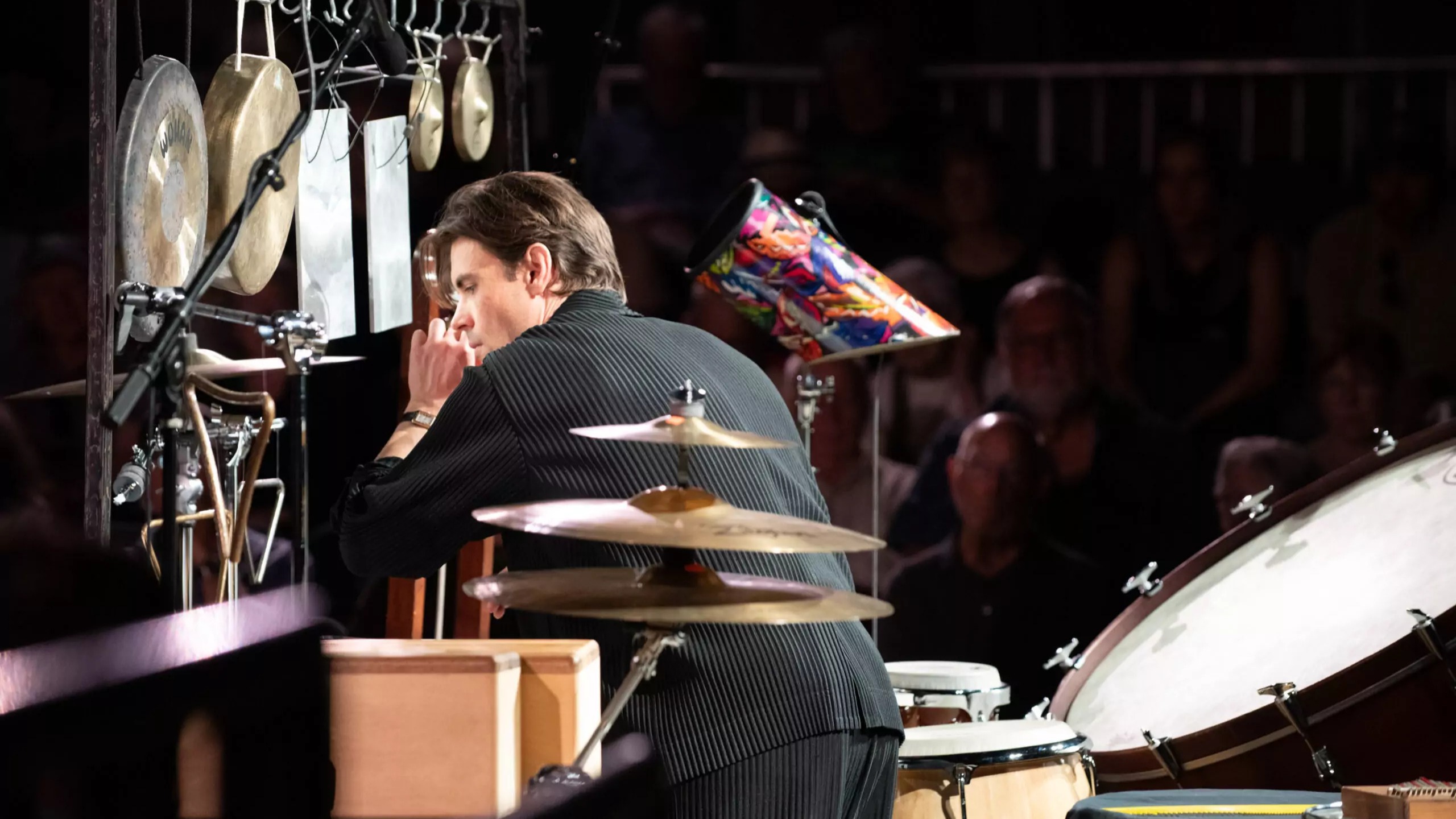
Fog was one of two Salonen orchestral works on the festival, the other being kinema, patched together from a film score that Salonen wrote during the COVID shutdown. It may well be the most alluring, most audience-friendly score yet heard from Salonen, a de facto five-movement clarinet concerto that gave soloist Anthony McGill a mellow, dynamically caressing showcase Friday night.
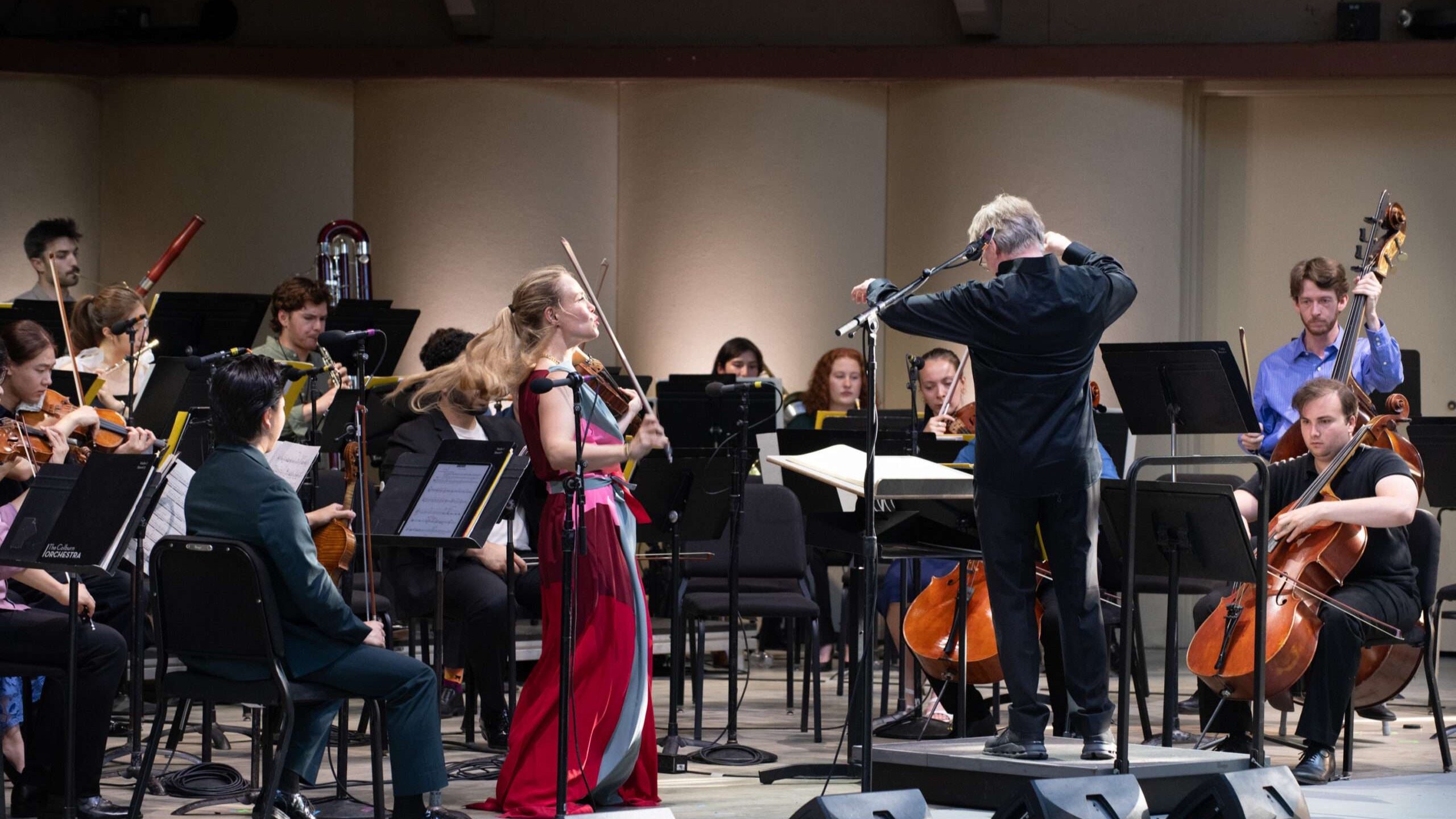
Everything ultimately pointed to the final two works on the traditional Ojai late Sunday afternoon closing concert. The fearless Leila Josefowicz devoured György Ligeti’s Violin Concerto (1992), playing the difficult contemporary work from memory, going at the extroverted movements with feverish intensity as Salonen emphasized the humor in the mimicking winds and brasses and the notoriously weird, blaring ocarinas.
Wrapping it all up, Salonen unleashed a brightly paced performance of Igor Stravinsky’s Pulcinella, always aware of the composer’s acerbic wit, urging his young orchestra up to and, at times, beyond their capabilities. Bridget Esler (soprano), Eric Finbarr Carey (tenor) and Abdiel Gonzalez (baritone) were the capable vocal soloists. And so, the last connection to be made was with one of Ojai’s earliest music directors as Festival No. 80 went into the books.