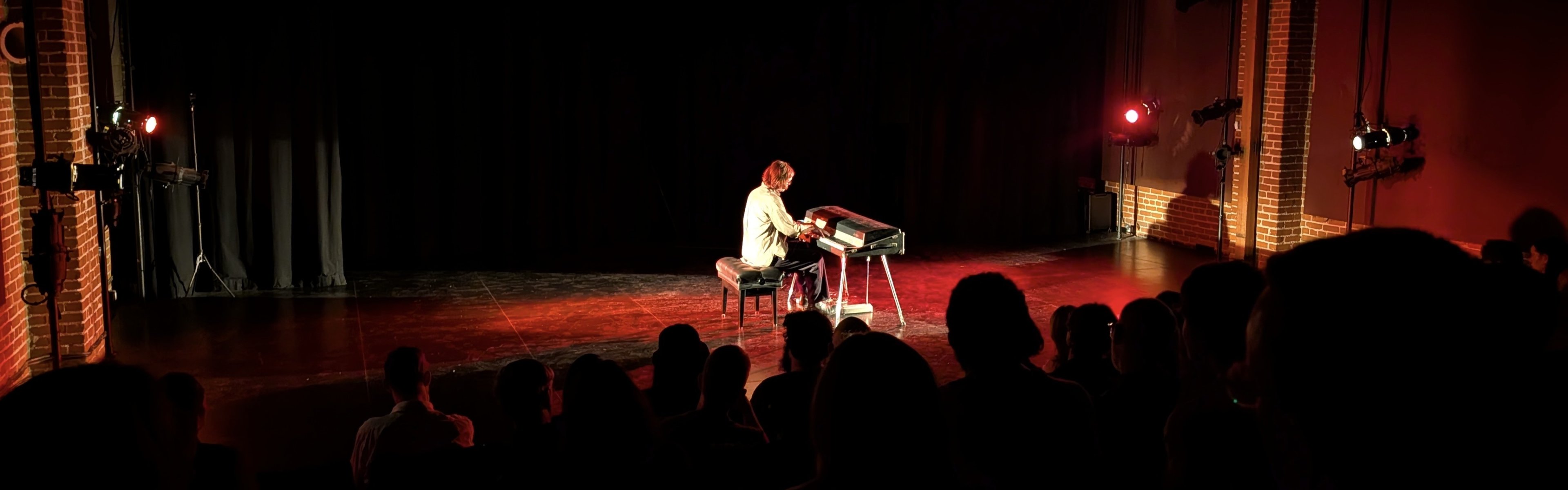
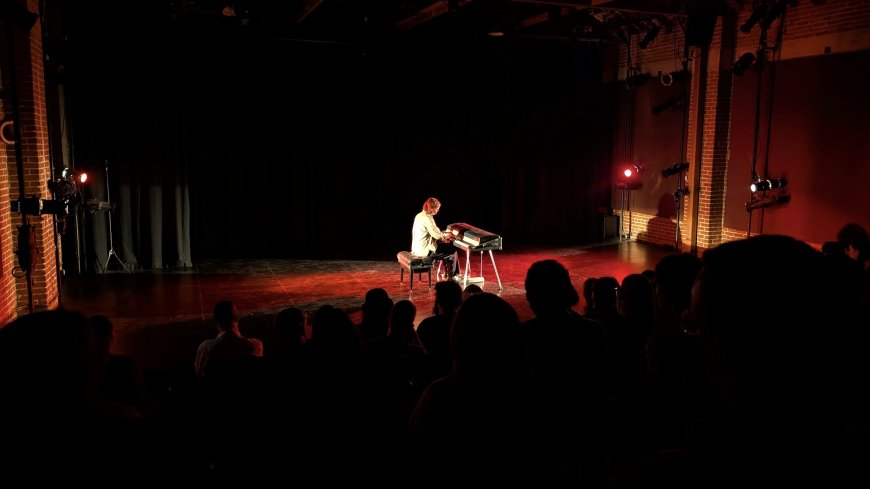
Last week, 2220 Arts + Archives ushered in an incredibly special night of modern classical music. The event was spearheaded by performer and composer Erik Hall, who communicated a poignant and relevant dichotomy through his performance of Simeon ten Holt’s Canto Ostinato (1976) on a Rhodes keyboard: the intersection of humanity and technology.
Through a deep understanding of the Rhodes keyboard, as well as a technically pristine, dexterous, and dynamically masterful performance, Erik Hall hypnotized his audience with glittering textures, mesmerizing sonorities, and impossibly interweaving lines. It was a performance which implored the audience to tune into the almost imperceptible changes from moment to moment, a refreshing change from our everyday lives in which we are bombarded with stimuli, and a rare gift touching the highest precipices our sonic art can reach.
Before there was any music, the Rhodes keyboard took on its own persona as it sat on the empty stage. The electronic pedals and cables of the instrument were beautiful in and of themselves, and seemed to be imbued with life of their own, which further begged the question: Does art performed on a piece of relatively new technology detract from how that art expresses our humanity? Can things that are so opposite somehow coalesce? It was a question that would be answered through the following performance of Canto Ostinato (1976).

When Erik Hall entered the stage, he approached the keyboard humbly and with a small smile, in a fashion which almost dismissed himself and his own virtue. In opposition to classical piano-playing etiquette, Hall did not bow before he played, nor did he take a long, dramatic pause to center himself before the performance. He simply played.
The hypnotic, bassy tones immersed the full audience in a slowly spinning universe of evolving keyboard sounds. Through the keyboard, the warm harmonies emanated effortlessly. Hall was as lost as the audience in the undersea sonorities, almost as if he were merely an observer of the art dancing from his wrists and past his fingertips. As the music proceeded with masterful gradients in sound, color, and texture, the performer always held the fragile awareness of the audience with grace and compassion. Erik Hall listens as much as he plays, a rare and winning quality.
Hall sat incredibly still as he played. It was a dramatic choice that allowed the audience to divorce themselves from their sense of time, separate from their own expectations, and become completely open to any sonic possibility. Hall’s masterful execution of dynamic gradients was achieved through his sensitive touch, blending unrelated harmonies and emerging textures flawlessly, independent lines somehow becoming part of the same whole: Erik Hall is a sonic alchemist.
Especially notable was his subtle use of the sustain pedal. He carefully introduced unexpected and delicious dissonances which grew into driving, pulsating bass ostinatos, causing all heads to nod in sync. The music did not seek to achieve a form, nor to create and thwart any expectations; the music’s purpose was to simply be. It was a notion so strong within the performance and the music itself that it permeated the mind of the audience as well. When the music suddenly ended, it was completely unexpected and unanticipated. It disappeared like it was never there.
Performances such as these are rare. Hall’s playing brought to mind dichotomies like wet and dry, light and dark, consonance and dissonance, mankind and its technology: ideas that are independent and interconnected. Their opposing characteristics are what let the other exist, making each an inextricable part of the other.
Fitting and ever-present as the music itself was the shadow cast on the far wall during the performance: It was Erik Hall and his Rhodes, melded together as one.