

Sarah Kirkland Snider’s latest album, Forward into Light, evokes wonder while traveling across time and place. The power of her music lies in her meticulous compositional technique and her ability to draw us into an immersive experience.
Much of the music on the album feels like a gradual process of revelation, like stories spun by the evening fire light. Themes emerge from the dark into the firelight, if only for a while.
The title track, “Forward into Light,” is inspired by the women of the American suffrage movement. It simultaneously captures intense yearning and deep purpose. Swirling harp figures, echoing strings, and clarion trumpets function as gateways that reach back into history, revealing the inner lives of countless pioneers who toiled for justice, dignity, and the long, unfinished promise of equality.
Themes in “Forward into Light” gather emotional mass, reaching higher, to perfectly capture the emotional and physical work of social progress. By the end, a quieter, more resolved tune unobtrusively makes itself known: a quotation from “March of the Women,” a song composed in 1910 by British suffragette Dame Ethel Smyth. Its arrival feels less like catharsis than it does the prayer that sustains continued efforts toward a better world. It quietly says, “The work continues.”
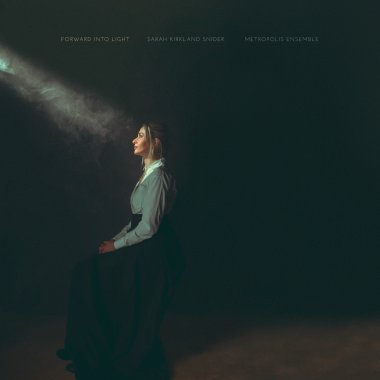
Though the second work on the album, “Drink the Wild Ayre,” shares a harmonic soundworld with “Forward into Light," it is a more present, swaying dance. Where the title track feels spectral, “Drink the Wild Ayre” is far more solid. Yet it evokes the same sense of ephemeral wonder. Melodies glow like summer sun through closed eyelids. Through impeccable counterpoint and delicate orchestration, Snider shapes our listening with remarkable precision, focusing our attention exactly where she intends.
“Eye of Mnemosyne” moves into more concrete territory, though no less beautifully wrought. A collaboration between Snider and visual artist Deborah Johnson, its eight movements explore the theme of photography “as conduits for the evolution of American storytelling and visual identity,” according to the composer’s website. Snider’s trademark writing is poignantly cinematic throughout. The dancing pizzicato strings in the fourth movement, entitled “Vive: ‘Power of the Snapshot,’” are especially captivating.
The striking thing about Snider as a composer is how she seems to conjure musical stories from thin air. The music on Forward into Light is very consistent: in harmonic color and in melodic style it all very much sounds like “Sarah Kirkland Snider.” Yet she finds so much nuance and subtle variation of color.
The final piece, “Something for the Dark,” positions itself as the album’s shadowed, more brooding offering. A meditation on resiliency and endurance, it weaves between quietly peaceful moments with tumultuous interruptions. Its ending closes the album with a quietly unresolved air, as if to say, “There is still much to be done. Time to get back to work.”