

Contemporary orchestral music from Iceland often evokes the grandeur of volcanic nature and the immensity of geological time.
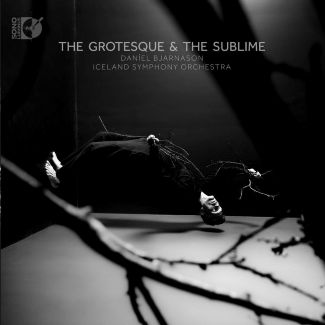
Much like Anna Thorvaldsdottir, the high priestess of contemporary Icelandic composers, Daníel Bjarnason belongs to what journalist Andrew Mellor calls the “First Icelandic School.” In his notes for Bjarnason’s latest orchestral album, The Grotesque and the Sublime (Sono Luminus), Mellor claims the music of these composers unfolds in “gradual transformation on a vaporous orchestra.”
Bjarnason, however, aims for a middle ground between orchestral textures and programmatic signposts. As he leads the excellent Iceland Symphony Orchestra, he molds the thick orchestral swathes of his own compositions into clearly defined episodes.
 That is especially true of FEAST (2022) — Bjarnason’s second piano concerto and the strongest work on the album — which uses an unassuming rising motif to effectively string together seven movements. His vast sound palette creates a far-reaching work, that is always fresh and unpredictable, despite conjuring inscrutable moods.
Edgar Allan Poe’s short story, The Masque of the Red Death, gives the album its name: “I try to inhabit Poe’s world of the fantastical, the grotesque, and the sublime,” the composer writes in his program note.
The piano writing for FEAST is lean, almost methodical, which contrasts effectively with the spaciousness of Bjarnason’s orchestration. When the tempo quickens, the agitated solo part serves the larger architecture of the piece, ramping up to crashing summits or slowing down to desolate valleys. Frank Dupree is the heedful soloist, ruminative in the slow sections, and clinically precise when he mixes with the full ensemble in the faster ones.
The work launches in medias res with skeletal percussion and a distinctive rising motif, which Dupree hammers out with aplomb. Woodwinds murmur in the distance, giving way to a more introspective piano section that anticipates a slow second movement. When the pace picks up again, rumbling piano ostinatos form a backbone that pushes toward an ingenious danse macabre, in which the piece’s recurring motif is reversed and developed. FEAST ends in anxious silence, with the uneasy ticking of a dying clock in the percussion — a sinister appendage to an enthralling piece.
Fragile Hope is a tribute to composer Jóhann Jóhannsson, who died in 2018 at 48. Angry double basses and choked percussion set this atmospheric piece in motion. The strings introduce hazy, winding textures that accumulate intensely and mix with jittery percussion patterns. The piece’s stirring high point is a quotation from Jóhansson’s Odi et Amo, a short respite of functional harmony in the middle of much dissonance.
Inferno (2022), a three-movement percussion concerto which Bjarnason revised in 2024, also has the composer’s characteristic textural sound, though the piece uses solo instruments to underscore musical benchmarks. The score emphasizes marimba and timpani, while also calling for drum kit, wood blocks, Japanese taiko drums, kick drum, and txalaparta (unpitched wooden planks), all of which are deployed by Vivi Vassileva with attentive elegance and perceptive interplay with the orchestra. The percussionist provides a clattering end to a worthy documentation of new music from Iceland.