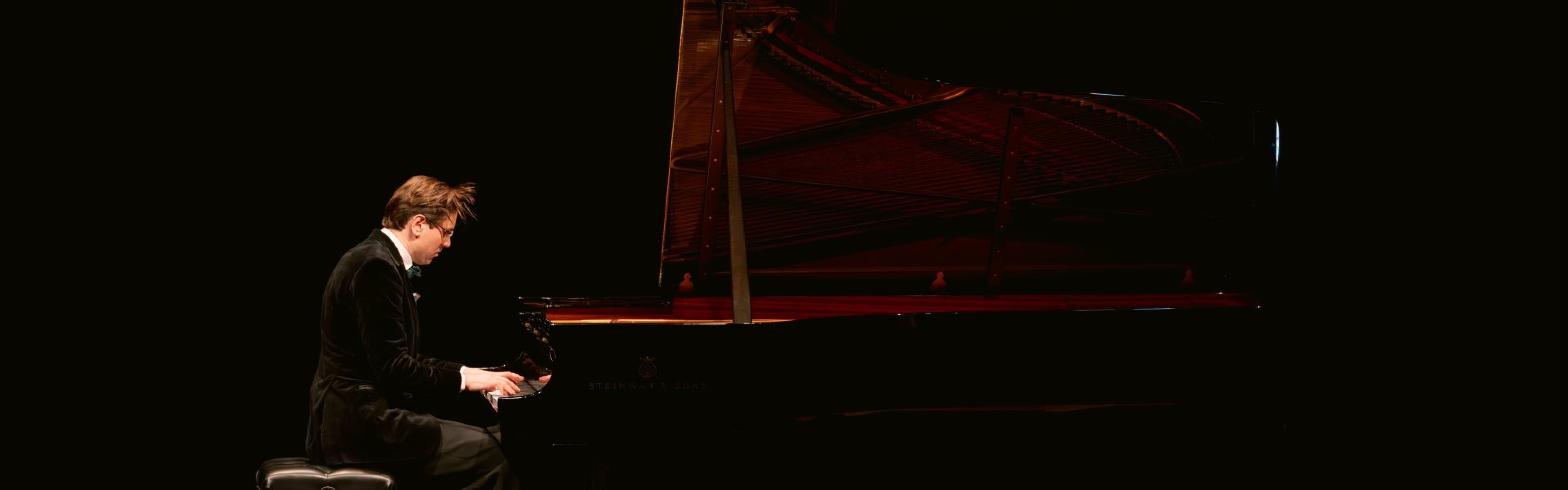
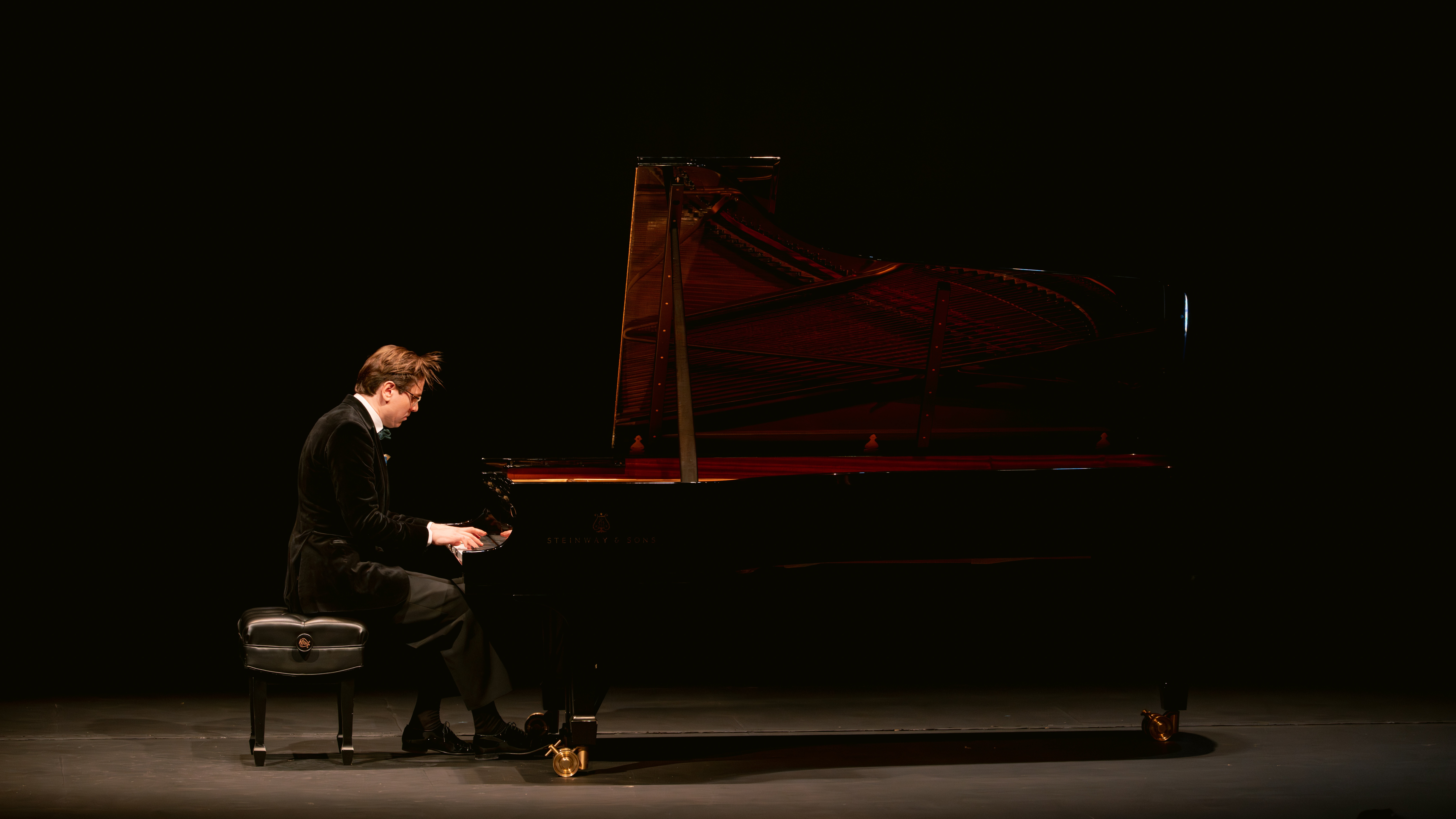
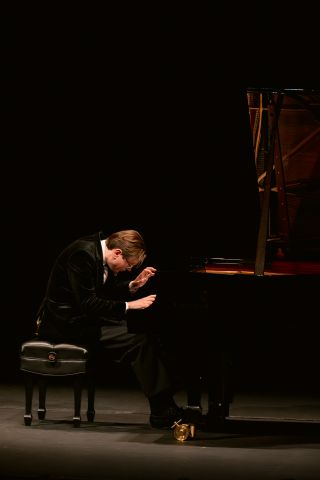
Víkingur Ólafsson has become a regular in Bay Area concert halls in the last few years, playing the two recent John Adams piano concertos, touring Bach’s Goldberg Variations, and appearing earlier this season with the Philharmonia Orchestra in Beethoven and Ravel piano concertos under Santtu-Matias Rouvali. He returned to Cal Performances' Zellerbach Hall on April 29 with a program he has been touring for some time, called “Opus 109,” after the Beethoven piano sonata.
As Víkingur noted in spoken comments at the end of the program and in his program note, it’s common for pianists to play the last three Beethoven sonatas — Opp. 109, 110, and 111 — on a single program, but he chose different organizing principles for this program. First, each of the works was in the key of E major or minor; second, he hoped to call attention to a musical through-line running from J.S. Bach through Beethoven and Schubert, not to mention highlighting Bach’s influence on Beethoven and Beethoven’s influence on Schubert.
It’s a fairly tall order to put this agenda across to an audience of ordinary listeners. While I can accept his thesis as arguable, without the pianist’s prompting, I doubt I could have derived it from hearing the works themselves.
Víkingur opened with Bach’s Prelude in E Major from Book 1 of The Well-Tempered Clavier. His playing was on the studied side and made clear which voice he considered most important — the bass line was by far the most prominent.
Beethoven’s Sonata No. 27, Op. 90, is brief, just two contrasting movements. Víkingur played the first movement as a study in contrasts, alternating stormy and quiet themes and phrases. The second had some sweetness to it, but less than you’d expect. There was a surprising amount of blurring in the left hand. The pianist did bring a good deal of lovely rubato to his playing in both movements.
For this listener, Bach’s Partita No. 6 in E Minor was the highlight of the program. The opening Toccata – which segues into a fugue after a free opening section — was beautifully played, neatly pedaled with no attempt to mimic harpsichord articulation, and with plenty of drama. Throughout the work, Víkingur pedaled lightly, clearly playing voice against voice. Sometimes this worked well, and at others it seemed eccentric. Perhaps there could have been more of a sense of dancing in the Tempo di Gavotta and Gigue.
Schubert’s Sonata, D. 566, is an odd work, apparently published in editions with different numbers of movements, depending on whether the editor chose to flesh out its two complete movements or not. Víkingur played just the first two, in E minor and E major respectively.
The first movement is full of grand pronouncements and also the lyricism of Schubert’s greatest works, creating dramatic contrasts that suited the pianist well. The second, though opening with that same lyricism, veered off into even more high drama and lost compositional coherence. Perhaps that’s the reason it’s not played much.
The performance of Beethoven’s Op. 109, toward which the program had been building, was oddly unsatisfying. The first movement went well, with its alternating vivace and adagio sections played with appropriate dramatic contrast. Víkingur dashed through the prestissimo middle movement.
The variations of the last movement, based on a tranquil theme that’s to be played expressively, with singing tone, came across as somewhat mannered. The theme and first variation sang; the pianist made the buoyant second variation playful. But the third, reminiscent of a Bach two-part invention, was blurry, which continued into an overpedalled fourth variation.
Víkingur was fierce in the fugal Allegro and quiet in the cantabile reminiscence of the theme, but the closing variation felt like a mad rush to return to the theme, with far too much blurring in the bass.
At the end, Víkingur spoke about the Opus 109 project and then came back for three exquisitely played encores: his own arrangement of Bach’s Air on the G String, Jean-Philippe Rameau’s Le Rappel des Oiseaux (The conference of birds), and Philip Glass’s Etude No. 6. The directness and clarity of Ólafsson’s readings made me wish he had played entire concert that way.