
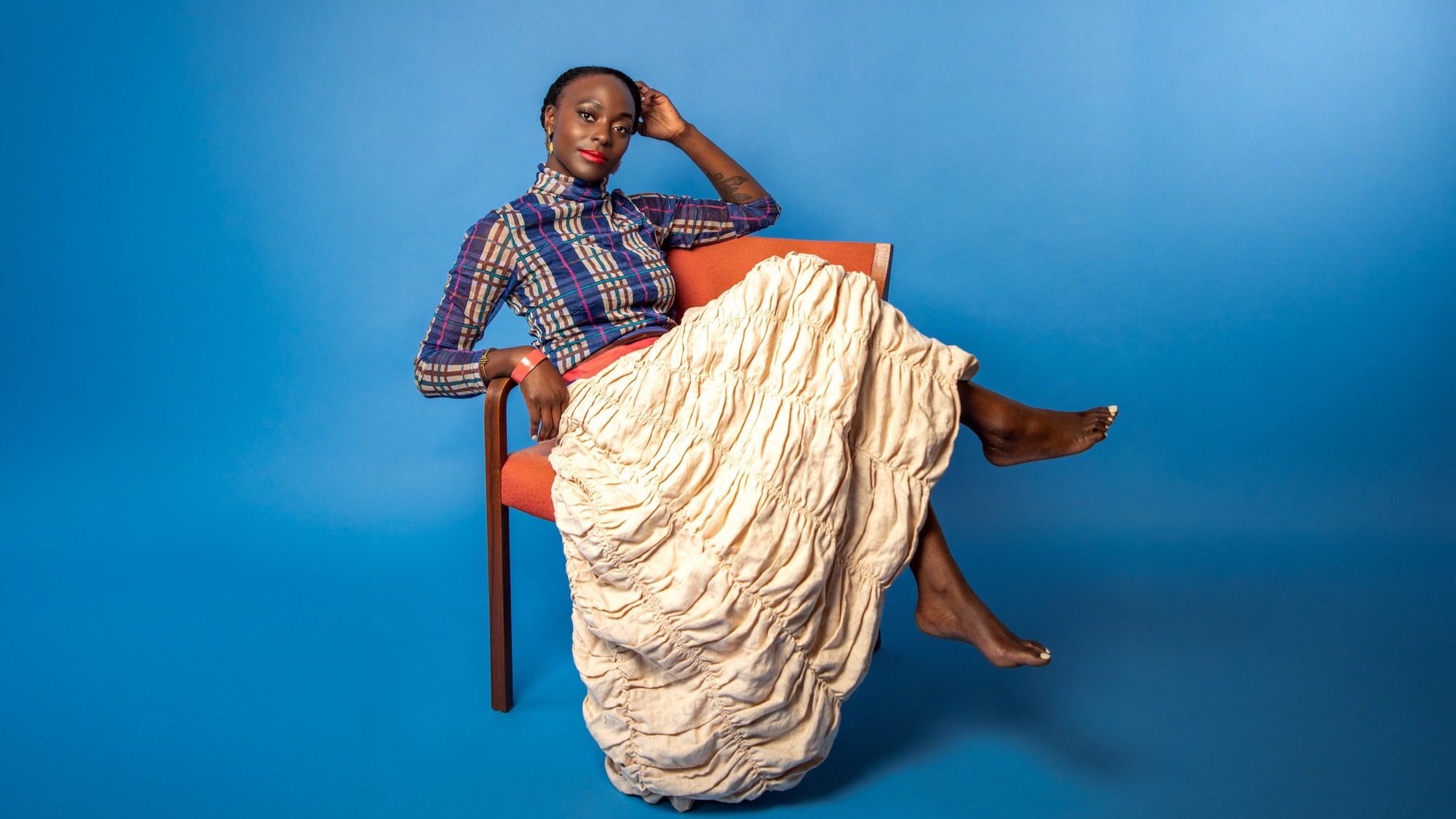
Standing in front of the stained-glass windows of San Francisco’s Noe Valley Ministry on Saturday night, Nathalie Joachim invited her audience to travel to another church more than 3,000 miles away, in her hometown of Dantan, a tiny farming village in Haiti.
Blending the near and the far, the present and the past, electronics with an onstage string quartet, and a recording of the village girls’ choir with the live audience — who had learned the song’s refrain just a few minutes earlier — Joachim led the collective in a song of hope and perseverance, beaming and swaying as she sang in French, “I have searched for you so much through the night, and you told me you were life. So I sing Alleluia.”
This song, which came halfway through Joachim’s performance of Fanm d’Ayiti (Women of Haiti), is representative of her work. While suffused with hope and determination, Joachim’s songs are never saccharine or cliche. The eclectic rhythm of the electronics and the tumbling motif in the strings posed an unexpected backdrop for a sacred hymn; the girls’ chorus did not quite line up with Joachim’s resonant voice; and the song ended with stray clangs and pops of percussion. All as if to say: Isn’t this life — unpredictable, imperfect, glorious?
Joachim embarked on Fanm d’Ayiti after her beloved grandmother died in late 2015. She traveled around Haiti interviewing women artists and recording local songs in order to craft a genre-defying “sonic portfolio,” as she calls it, of her own compositions and arrangements of historic Haitian songs. The album received a Grammy nomination for Best World Music Album in 2020.
On Saturday, Joachim told her audience the stories behind the songs. She shared how her grandmother, Ipheta Fortuma, taught her that music is for truth-telling. Haitian Creole was not standardized as a written language until the late 1970s, Joachim explained, so song was a crucial way of preserving history, memory, and identity.
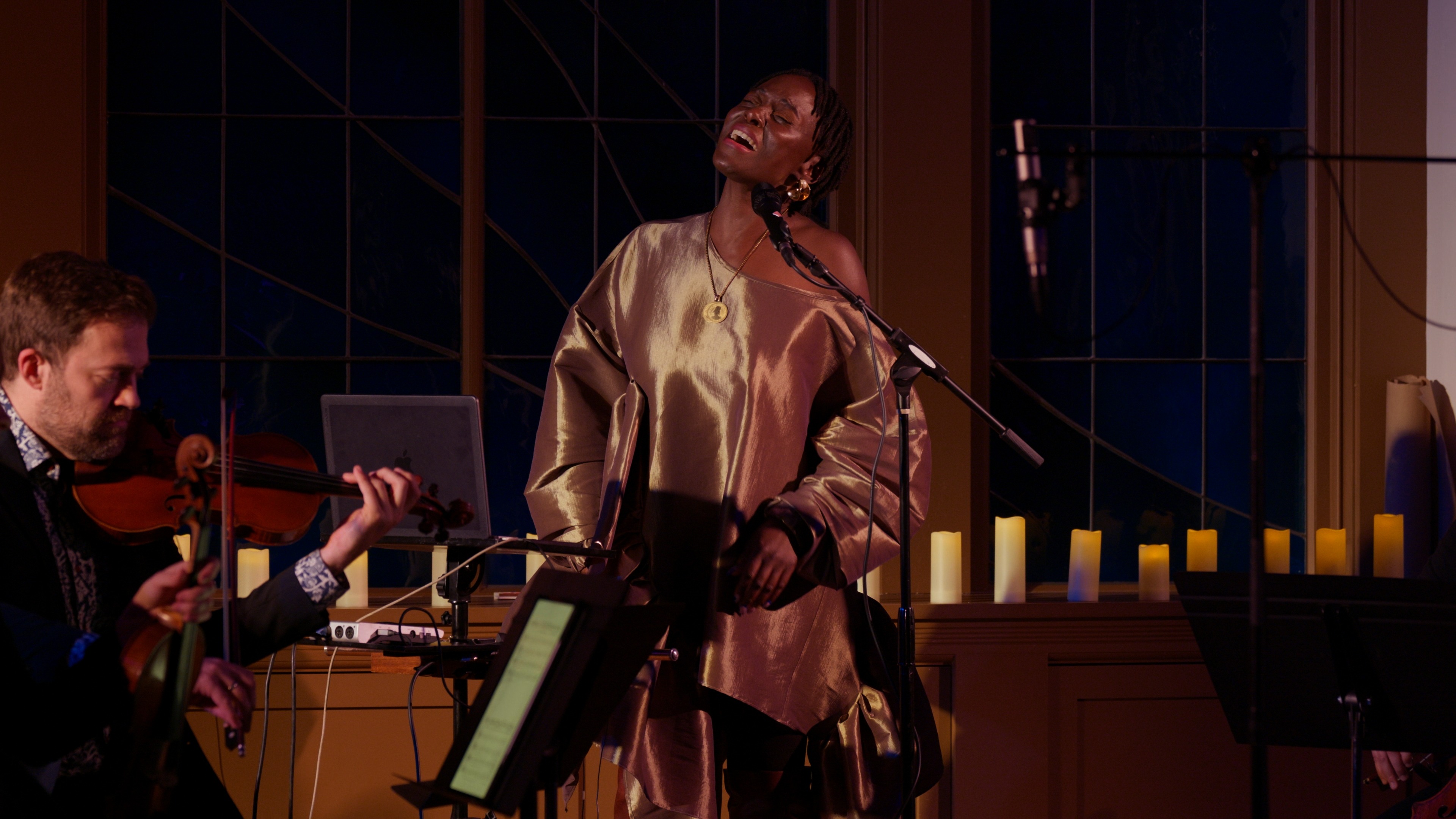
She shared one of her grandmother’s original songs, an autobiographical sketch of a woman who, widowed at a young age, was castigated by her village for refusing to remarry: “Mrs. Bellegarde is judged/Yes, she is judged/She’s judged before sinners/She is not judged before God.” In the granddaughter’s hands, Fortuma’s song was tender and expansive, floating in a pool of rich harmonics and flowing lines. Joachim knew her grandmother’s truth: that the town’s judgment was nothing compared to the peace of knowing she was right with her Maker.
The rest of the evening brought celebrations of Haiti’s great Vodou spirits with songs like “Papa Loko” and “Legba na konsole,” and reimagined works by great Haitian women artists, such as Emerante de Pradines’s “Manman m voye m peze kafe.”
Joachim was joined by a quartet comprising members of Decoda, Carnegie Hall’s affiliate ensemble. Onstage Saturday were violinists Clara Lyon and Owen Dalby, violist Meena Bhasin, and cellist Hannah Collins. The quartet was admirably at ease with the demanding orchestration — bows skating lightly over whistling harmonics, stacking up lush chords, galloping through syncopated rhythms — and blended seamlessly with the electronic elements emanating from Joachim’s laptop.
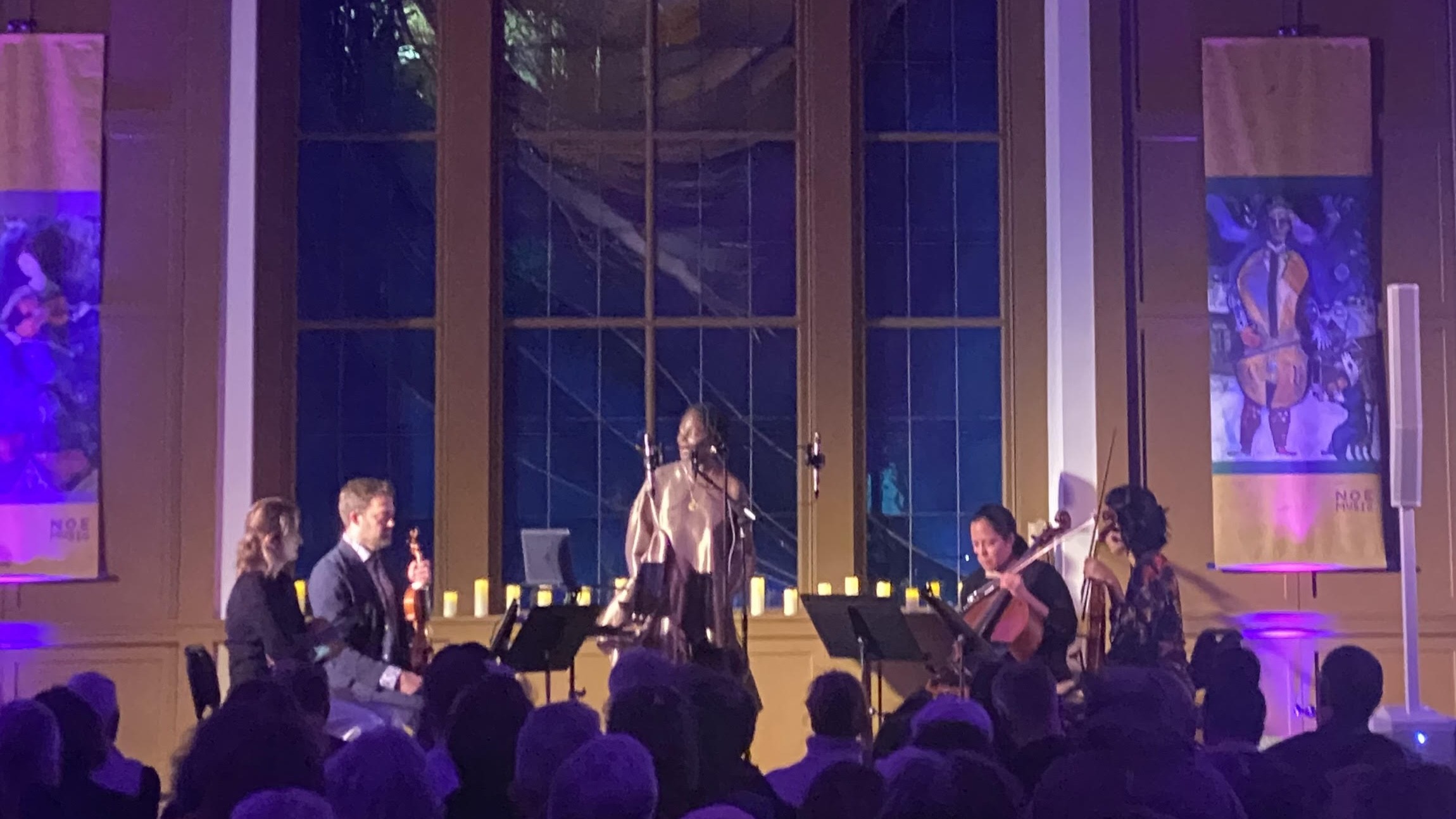
Dalby and Bhasin are also co-artistic and executive directors of Noe Music, which hosted the concert. One of Noe Music’s missions is to serve San Francisco families holistically, and earlier that day, the musicians performed the concert first for children, and then for autistic and neurodivergent kids and their families.
For the adults, however, the evening came with a somber edge. Bhasin introduced the program with a nod to the current political angst in America, noting that this week had shown “many examples of what power ought not to be” and that Fanm d’Ayiti offered “an alternative expression of power.”
Near the end of the night came “Lamizè pa dous,” an old Haitian song in which the singer laments, “Turn here, there’s water; turn the other way, there’s other water.” The singer is drowning. Joachim urged her audience not to despair, but rather “to remember this song and those people, and to think ahead to all the people that we don’t know, but that we have to love enough to believe in something better.” Because the song does not end there. The waters are deep, but the task does not daunt the singer, or her community. They sing: “We will carry rocks to fill the sea.”