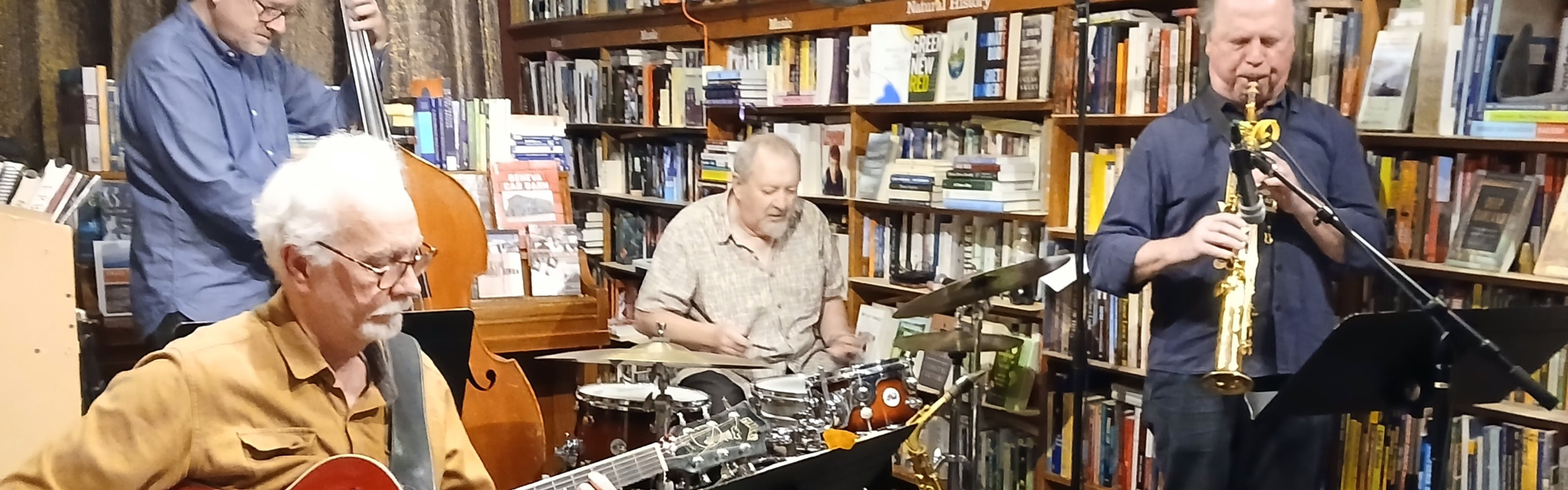

A New York jazz stalwart for more than four decades, drummer Ron Vincent is best known for his long, productive stint with baritone saxophone great Gerry Mulligan, propelling the saxophonist’s quartet and the Re-Birth of the Cool Tentet from the late 1980s through Geru’s death in 1996. In recent years Vincent has been making regular summer sojourns to the Bay Area. His itinerary usually includes a night at Bird & Beckett Books and Records in Glen Park, an invaluable San Francisco cultural outpost that provides a cozy home for musicians local and touring.
A standing-room-only audience showed up for the drummer’s Aug. 28 visit to the shop, where Vincent was joined by New York saxophonist Bruce Williamson, whose emergence on the Bay Area scene was capped by work with pianist Art Lande and trumpeter (now film composer) Mark Isham, in Lande’s acclaimed ensemble Rubisa Patrol. The Bay Area’s Brad Buethe and Noah Schenker, on guitar and bass respectively, rounded out the formidable quartet.
Vincent is also a fine composer and arranger who puts his stamp on every piece. Highly interactive, he’s particularly eloquent on brushes. Opening with Duke Ellington’s rarely played Latin gem “Angelica” from the classic 1963 album Duke Ellington & John Coltrane (the maestro also recorded the piece several months later as “Purple Gazelle,” orchestrally expanded on 1963’s Afro-Bossa), the quartet established its bright but softly transparent sound.
Vincent’s arrangement of Jerome Kern’s “Pick Yourself Up” would have confounded the dancing Fred Astaire and Ginger Rogers, with a pregnant pause before each phrase adding a stutter-stepping cadence to the ode to resilience from 1936’s Swing Time. His original piece, “Ray’s Hat Trick,” moved quickly from a passage of free-form disorder to episodic adventure carved by Williamson’s lustrous soprano sax work.
Throughout the set the playing was consistently impeccable, but part of what made this particular ensemble so engaging was the wide dynamic shift between full-quartet numbers and trio pieces where Williamson laid out. With Buethe out front rather than playing soft, buoyant chords in accompaniment, the energy shifted from crackling to glowing, while Vincent’s supple cross-accents became more evident.
He closed the first set with “Martha’s Prize,” a gem by pianist Cedar Walton that featured all of the composer’s bounteous gifts for crafting memorable, singing themes. The quartet navigated the piece with loving attention to Walton’s details, keying on Buethe’s piquant responses to Williamson’s lines.
An unflashy master of form and rhythmic function, Vincent can’t get back to the Bay Area soon enough.