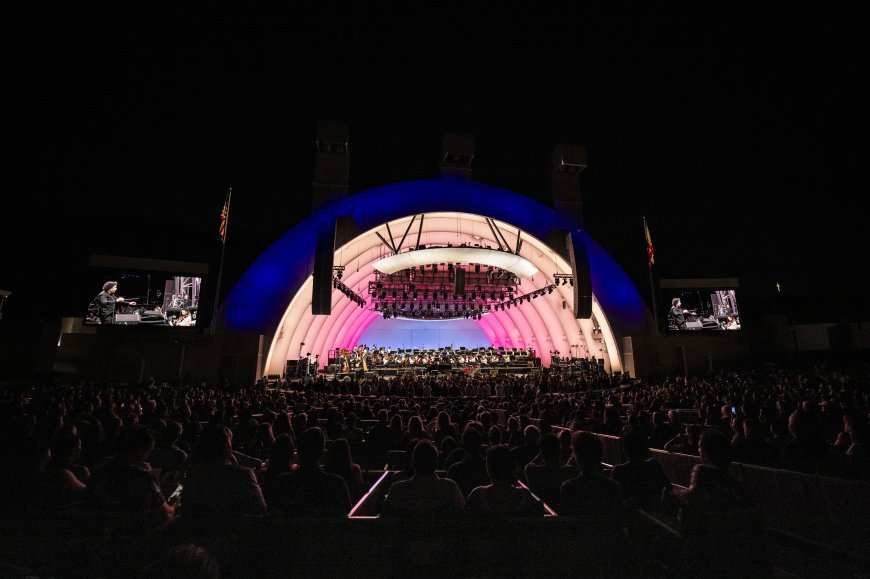
The Los Angeles Philharmonic usually goes out of its way to bid farewell to its music directors with a celebratory finale, always within the context of so-called classical music. Zubin Mehta went out with a nostalgic Viennese evening of Mozart and Johann Strauss Jr. at the Hollywood Bowl. Carlo Maria Giulini chose Beethoven’s uplifting Seventh Symphony as a parting gift, telling the assembled crowd at the Dorothy Chandler Pavilion, “Arrivederci!” (postscript: he never returned). André Previn, alas, didn’t get a proper sendoff, given the acrimonious manner in which he left. Esa-Pekka Salonen did, leading an all-Stravinsky affair semi-staged by his perennial co-conspirator, Peter Sellars.
But there has never been a sendoff as elaborate as the multicultural festival that Gustavo Dudamel got at the Bowl over the past weekend. And there likely will never be one like it again—unless, perhaps, the day comes when Gustavo leaves the New York Philharmonic.
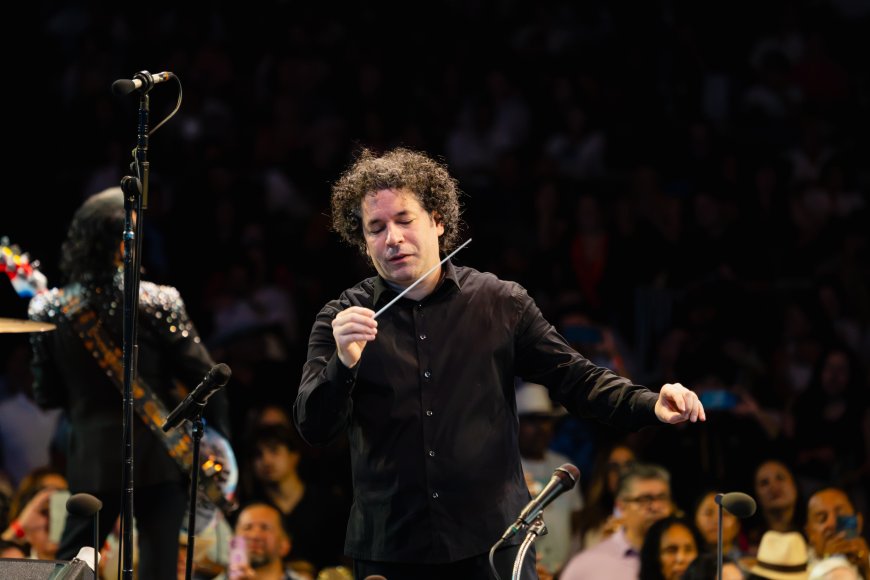
All four “Celebrating Gustavo at the Bowl” concerts sold out—or looked like they sold out—the vast 17,500-seat amphitheater. The merch tables hawked Gustavo-branded gear and expensive vinyl LP editions of Dudamel recordings previously available only as streams or downloads. Thousands of flashlights on mobile phones lit up the nights at certain “intimate” moments the way cigarette lighters once did at rock concerts. Come to think of it, these were rock concerts, or variants thereof, with Gustavo seemingly relishing the role of honorary rock star as per the hype that has accompanied his rise to fame.
It was an evolving, fluid project that at times felt as if some of its components were being made up on the spot. There was one fixed star in the firmament: Dudamel was going to conduct Beethoven’s Ninth Symphony on Thursday night, Aug. 20—the same piece with which he began his music directorship at the Bowl in 2009. But later, the Phil added a companion piece, a world premiere of Hymns of the Heart, a cantata written for the occasion by the team of film/TV/video-game/theme-park composer Michael Giacchino, poet and Biden inaugural reader Amanda Gorman, and arrangers Jeff Kryka and Ljova.
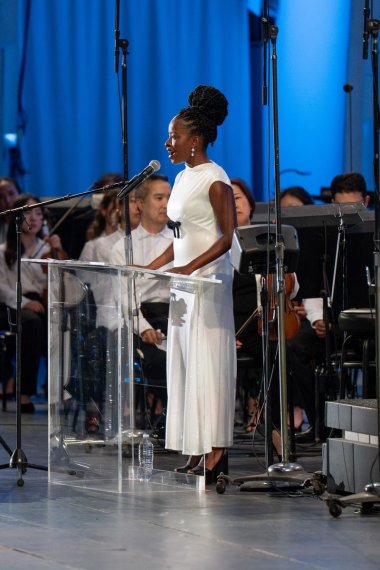
One can’t really fault the motives of Hymns of the Heart, which in 21 minutes tried to build temples of understanding, truth, brotherhood, and sisterhood as a running mate to the sentiments expressed in the finale of Beethoven’s Ninth. Gorman was eloquent as always in her narrations; the kids of the Los Angeles Children’s Chorus sang sweetly; students from Education Through Music–Los Angeles tapped on miniature xylophones. But that score was just so much soaring, opening-credits-style pablum, relieved only when two savvy studio veterans, bassist Abe Laboriel, Sr. and percussionist Alex Acuña, generated a brief, cooking Latin groove toward the end of the piece. No más, please.
Beethoven’s Ninth, of course, has been a familiar calling card of Dudamel’s from the beginning, the middle, and now the end of his tenure. Here, the Dudamel brand of energy, joy, and limited introspection remained largely in play, with tempos occupying a middle ground between his measured first steps in 2009 and the speedway pace of 2019. Up until the entrance of the voices, it had been a decent, adequately played rendition, but after bass-baritone Ryan Speedo Green woke up the performance with his commanding entry in the choral finale, it became extraordinary all the way to the feverishly paced finish line.
The second concert in the series Aug. 21 was originally titled “Dudamel’s Playlist,” where Dudamel was supposed to act as “host” to a bunch of his favorite (unnamed) performers. But that evolved into “Gustavo’s Fiesta,” where artists and groups from Mexico, Colombia, and Spain took turns in the spotlight, with Dudamel and the almost inaudible LA Phil not turning up until the final quarter of the concert.
Then on Aug. 22, Dudamel, the Phil, and some elite members of Youth Orchestra Los Angeles (YOLA) turned out to be far more involved—and surprisingly compatible—accompanists for the long-running rock group Foo Fighters, who sit winningly at the intersection of punk, pop, and grunge.
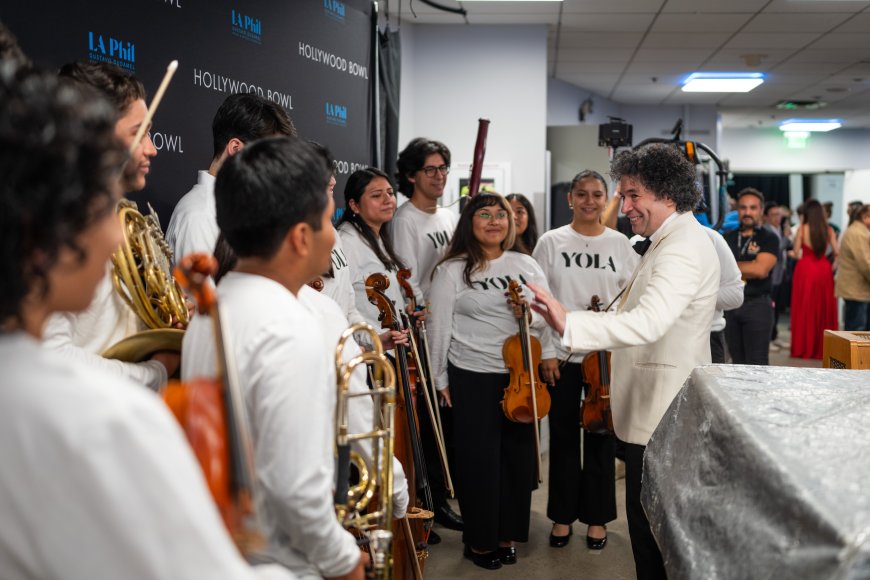
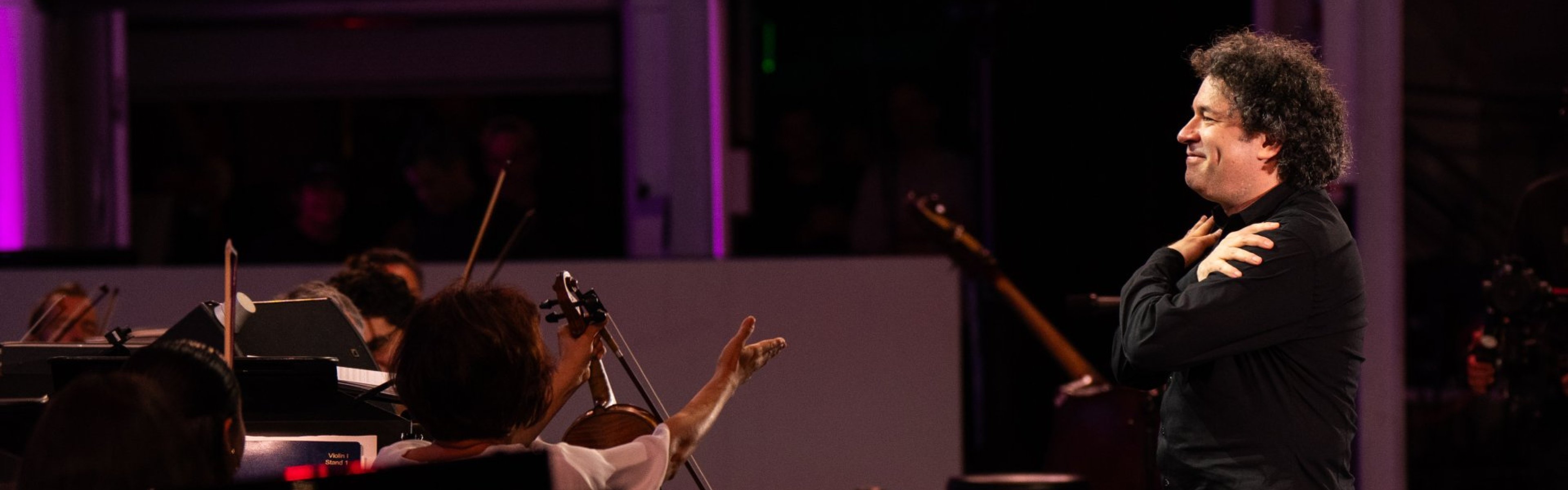
Finally, there was the actual farewell concert Sunday evening, Aug. 23—or should I say not-so-farewell, a point Dudamel acknowledged in lengthy (for him) speeches in which he proclaimed, “I am an Angeleno,” kidded himself about his famous mop of curly hair, and promised to his adopted hometown, “There will never be a last [concert].” This event also had a previous title, “A Musical Legacy,” but the catastrophic June 24 earthquakes in Dudamel’s birth country converted his last concert as LA Phil music director into “A Concert for Venezuela: A Benefit to Support Earthquake Relief.”
The lineup of performers was heavily slanted toward Latin American pop, but some of the promised classical elements emerged, more or less, from the void. For me, the musical high point was a delicious juxtaposition of the symphonic and popular by the late Venezuelan composer Aldemaro Romero, “Fuga con Pajarillo” from Suite para cuerdas, a piece he conducted at the 2004 Gustav Mahler Conducting Competition in Bamberg, the win that launched his career. In this performance, which was a repeat from the previous evening’s concert, the swaying orchestral riffs in triple meter were interrupted by a terrific jam on a quintessential Venezuelan groove from a quintet of Venezuelan musicians.
Also subjected to interjections from Latin America was a wacky Paul Desenne arrangement of Johann Strauss Jr.’s Tritsch-Tratsch-Polka.
On a more serious note, cellist Gregorio Nieto was the expressive soloist with the Phil in the heartfelt “Stella Aria” by actor Anthony Hopkins, whose hitherto-little-known compositions are on Life Is a Dream, a just-out Decca album by Dudamel and the Philharmonia Orchestra. A video of the devastation in Venezuela reminded us of the cause this concert had been reshaped to serve.
Among a bill that ran to more than a dozen guests, we heard Beck on acoustic guitar in a folk-rock ballad; rapid-fire singing from Carlos Vives (who looks a lot like Gustavo); and singer Natalia Lafourcade, who always comes with genuinely fascinating charts for the Phil. The last 30 minutes were dominated by surprise guest singer Chris Martin (of Coldplay), whose adoration of Dudamel verged upon the embarrassing. Martin even put him on a “throne,” which Gustavo eventually hauled off the stage himself.
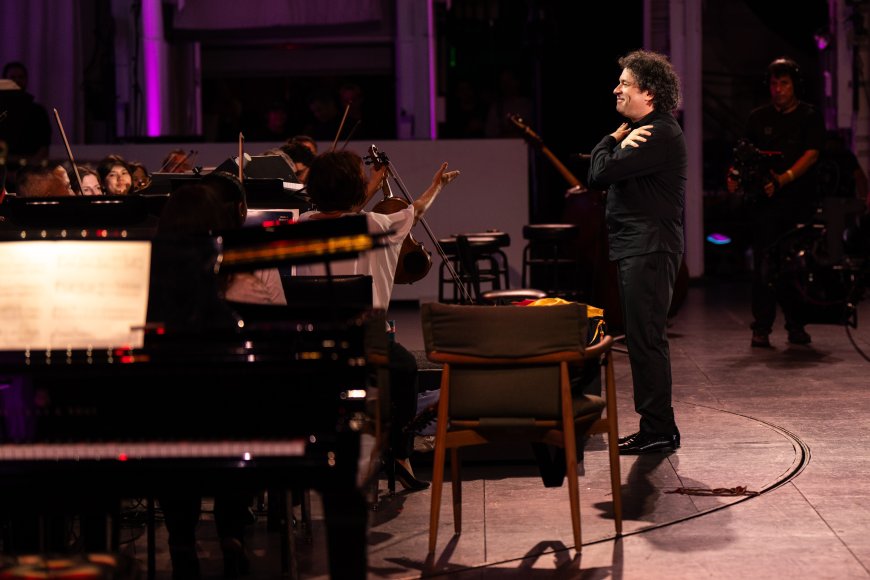
It was all in fun and affection, to be sure. And it cements what we’ve long suspected. Gustavo is a rock star, a unicorn in conductor-land. But his desire to unify the world through music may come at the cost of obscuring his other legacy as a fearless expander of the classical repertoire. We’ll see how New York reacts.