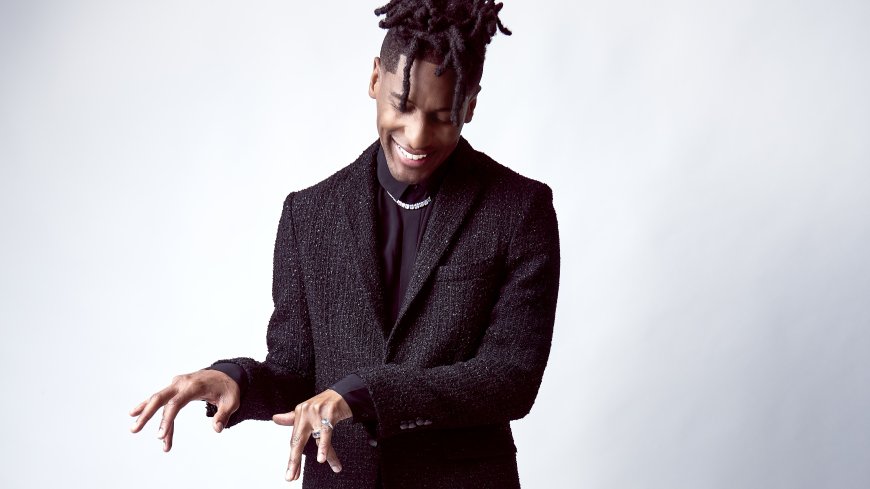
A generational talent like Jon Batiste hardly needs an introduction.
The celebrated pianist, vocalist, composer, and bandleader is as prolific as he is uncategorizable. His prodigious musical output straddles classical, jazz, gospel, R&B, and folk genres with a facile ease entirely his own.
For his latest project, the Batiste Piano Series, the musician reimagines canonical classical piano works by infusing them with Black American music, a concept he first explored in Beethoven Blues (2024).
Aug. 14 marked the release of several new albums connected to the series: Monk Meditations, Monk Movements, and Black Mozart.
After performing on The Late Show with Stephen Colbert, Batiste rocketed to fame when We Are won the Grammy Award for Best Album in 2022. Ever indefatigable, he has released musical projects at a breakneck pace ever since. Later that same year, the musician gave the premiere of his American Symphony at Carnegie Hall, as dramatized in the 2023 Netflix documentary of the same name.
In 2025, Batiste performed at Davies Symphony Hall twice and headlined Festival Napa Valley’s “Arts for All Gala.” Though Batiste recently canceled three Bay Area concerts scheduled for this week, his Oct. 3 performance at the Greek Theatre in Berkeley remains on the calendar.
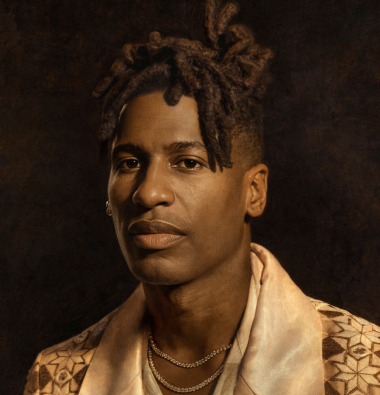
The musician spoke with the SF Classical Voice ahead of his album release about mental piano practice, redefining what is considered “classical,” and whether it is time to consider Batiste this generation’s Black Mozart.
Tell me about your Batiste Piano Series.
We’re very grateful to extend the traditions with what we’re doing, and also extending the canon. I see Mozart and Thelonious Monk on the same level. When we call music “classic,” in the canon of great human achievement, including music from the Black American diasporic traditions of classical music like jazz, gospel, R&B, folk, spirituals, hymns, this music should also extend the concept of what we consider “classical.”
How did these re-compositions come to be in Beethoven Blues and Black Mozart? Did they begin as improvisations that you solidified later?
I was thinking a lot about Sydney Bechet, the great clarinetist and composer who was one of the first important instrumentalist-improvisers in American music. He comes from New Orleans and spent his late life in France. He was known to work in all genres, similar to how Mozart worked in all of the genres of his time, from opera to symphonies, to even comedies.
Bechet had this ability to create the perfect long-form improvisation over any kind of music, it could be the most complex music, or a 12-bar blues. His improvised line would have the most brilliant logic and poetry. To prepare, he would also sit and learn the piece and improvise on the horn before he’d play it. He would take in what the other musicians were playing and then he would construct, in his mind, the perfect summation and continuation of everything that had just happened.
I thought, “Wow… what if you could take Mozart, Beethoven, or Monk, and be in conversation with that?” Like, if we were sitting around the bandstand or the piano, trading bars, expanding the essence of this music.
That’s what these albums are all about. I don’t want to lose the essence of the canon, but expand it. I want to express the essence of other things I see as canon and bring them all into this beautiful mosaic that can be the soundtrack to people’s life as they go through all the seasons of living.
What does your day-to-day practice look like? How much of it is improvisation?
You know, I learned this from my teacher, the great William Daghlian. He was mentored by Guiomar Novaes. She had this great ability to play all of the works of Chopin by memory.
She was called at the very last minute to do a concert playing Chopin’s piano concerto in C Minor, and she hadn’t played it in a long time, or perhaps not live before. But she was learning it on the way to this performance by looking at the score and practicing in her mind. By the time she got to her destination, she played it flawlessly.
It taught me something, hearing that story. Understanding the music from a structural perspective, the spirit of the music, what you what to bring to it. You can do a lot in your mind.
I’ll have times where I don’t touch the instrument for days… that comes from (my) early days, building the root of my artistry on the instrument.
That’s an incredible answer. It brings to mind synesthesia (a type of neurodivergence where certain senses are linked). A lot of people operating at a high level of music, especially pianists or improvisers, tend to have it.
I have it, too! It’s all images and sensations. It’s all expressing something that feels like a narrative, honestly. It makes sense the way a story makes sense, with all its surprises and twists and turns.
I always strive to make moments that are wrapped in inevitability. I don’t think of anything I do as coming from me. I’m a channel, I’m trying to get out of the way.
Mozart experienced a similar channeling in his performances. Mozart’s humorous side is well-known, but he was also devoutly spiritual.
Yeah, what a life. He died at 35 with 600 compositions. Now being in my late thirties, the level of what these guys were doing at the age that they were is astounding.
I’m inspired endlessly by Mozart in the sense that there’s a deep metaphysical thing that rises within me when I hear his music, especially his later work.
Post Bach exposure!
Exactly. Bach was connected to the divine in many ways. He might have been more from there than from here. That’s what I believe.
He’s very much a channel, and Mozart was a channel.
Beethoven, he very much struggled in life, but when you read his letters and his process of walking in nature, and this regimented way of being available for the signal to come to him, you got the sense he wanted to tap in and attack that signal with reckless abandon, even through being blind and deaf.
There is a striking musical similarity between your work and the music of Final Fantasy composer Nobuo Uematsu, whom you cite as an influence and have met.
Yes! I started playing game music on piano when I started gaming… I consider (Uematsu’s score to Final Fantasy VII) to be the greatest video game score of all time. He was one of the inspirations behind these albums for sure. I’m influenced by other game composers, like Yoko Shimomura, her scores that are both so piano-forward and so connected to the different global canons of music.
That’s what I love about classical music: it’s a form of world music, it’s a form of popular music, it’s very much expansive in all these ways.
What does “Black Mozart” mean to you, as it pertains to the Black artist? The term was applied to 18th-century musician Joseph Bologne, the Chevalier de Saint Georges, but has been criticized for pushing Black classical musicians to the margins without giving proper credit. Are you inverting the meaning of this phrase?
The title can be read in many ways. For one, it is Mozart infused with the music of the Black African diaspora. It also is Mozart and this idea of Bologne being part of the lineage that I come from, Batiste and the Creoles — I could even be related to Bologne.
This idea of doing a callback is taking the lineage that we all come from, including Bologne, and paying homage to him and Mozart as we extend the canon. You might hear some quotes of his work on the album as an easter egg.
On top of it, it is the question of “are you also saying that you are this age’s Black Mozart?” I like the idea of letting the people decide, like people do with figures like Michael Jordan and Lebron James.
When asked, “are you the greatest to ever play?” Jordan would answer, “That’s not for me to say, but we try to be the best in our time.” In music there is no best, but people who set a standard in their time. It would be disingenuous to say we are not trying to be as great as our inspirations.