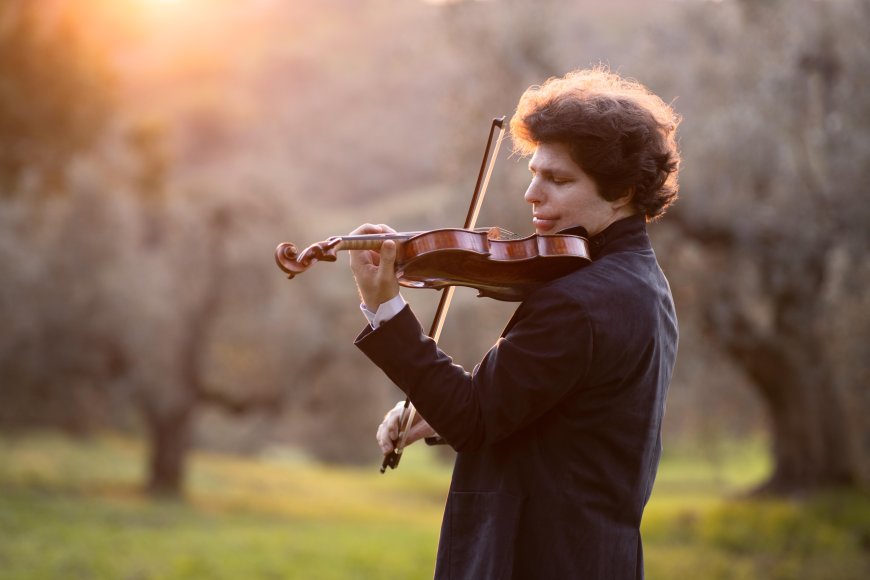
In the 20 years since he burst onto the scene, violinist Augustin Hadelich has continually raised the bar with his thoughtful interpretations, lustrous tone, and seemingly effortless stance.
That bar lifted ever so much higher on March 20 at Herbst Theatre.
Hadelich, now 41, had previously recorded all three of the sonatas on this program, pieces by Claude Debussy, Francis Poulenc, and César Franck. But Friday’s performance — his San Francisco Performances debut — offered new insights to even the most diehard fans.
Take the Franck sonata, for example. Hadelich has always played the first movement beautifully, but here, these simple strains had new color and dimension.
It didn’t hurt that the pianist was Francesco Piemontesi, a Berlin-based virtuoso with a flair for counterpoint and a finger legato to die for. Each passage in the billowing Allegro had a gratifying arc and nimble turns of articulation. The Recitativo-Fantasia, with its searching arpeggiations and drawn-out dissonances, felt almost Wagnerian in scope.
Piemontesi also contributed nifty duo arrangements of Baroque movements to this program: “La Boucon,” a graceful air by Jean-Philippe Rameau, and “Recit du Chant,” a hymn variation by Nicolas de Grigny.

Listening to de Grigny’s verses, which are harmonically adventurous and knotted with trills, it’s easy to see why a young Bach found himself hand-copying the composer’s complete works (a single volume of organ music published before de Grigny’s premature death at age 31). If anything, the counterpoint sounded clearer in this more intimate setting. There was nothing period about the performance, yet its elegance of spirit undeniably evoked something of the 17th century.
Each of these arrangements, along with György Kurtág’s Tre Pezzi — an evocative set of miniatures written in 1979 — segued to one of the larger works. (“I think you’ll know when the Franck starts,” Hadelich quipped.) The sonatas, too, were played mostly without pause. The energy crackled. There was hardly a moment to breathe, least of all during the sonatas by Debussy and Poulenc.
You’d be forgiven for playing this music lightly. Debussy cribbed bravura passages from Andalusian Romani music; Poulenc dipped into salon music. But on the other hand, each work was written in wartime. Military marches echo in Poulenc’s square rhythms, and even Debussy’s lyrical clouds have their corners. On Friday, Hadelich and Piemontesi brought a rare sharpness to these works, particularly the Poulenc selection.
The lyricism of this sonata, which commemorates the poet Federico García Lorca, borders on the indulgent. Sequences very nearly overstay their welcome; melodies return as wispy reminiscences. “Violent,” Poulenc instructs the musicians in the finale, but it’s hard to believe him when the music melts just moments later.
In the end, though, come gunshots. Thunderous piano chords signal Lorca’s assassination by fascists; the violin staggers a cadenza. If this music doesn’t totally square with the jaunty preceding passages, Hadelich suggested, perhaps it’s because the composer was struggling to make sense of a senseless act of violence. The takeaway from this performance? This salon sonata is serious, indeed.