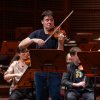
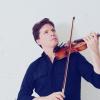
Joshua Bell plays music that people love, and if the crowds he draws are any indication, the people of San Francisco love him back.
The world-class violinist has visited the Bay Area in recent years for concerto appearances with the San Francisco Symphony and tour stops with his London-based chamber orchestra, Academy of St Martin in the Fields. But on Sunday, April 19, his recital with pianist Shai Wosner at Davies Symphony Hall gave the audience the opportunity to reacquaint itself with Bell by way of a good old-fashioned sonata program.
Most of the time, the 58-year-old violinist positively sang with light bows, long lines and rippling vibrato. His stylistic choices were never so ostentatious as to pull attention, yet every piece on the program sounded unmistakably like him.
This was especially true in Maurice Ravel’s Violin Sonata No. 2. Left to its own devices, the first movement’s musing theme isn’t exactly an earworm. But Bell made it so by drawing out and warming certain notes, treating the theme like a first-rate melody.

Later in that same movement, the piano borrows previously established motifs — needling dissonances and disembodied chord sequences — as if from a grab bag. On Sunday, Bell’s sustained line rose blithely above it all. By the finale’s moto perpetuo, it was easy to forget the piano had the theme because Bell imbued his clambering sixteenth-note runs with so much phrasing.
The evening’s earliest music was Franz Schubert’s Violin Sonata in A Major (1817), a sunny and succinct work with striking harmonies. This was especially evident in the central slow movement, whose fantastical modulations keep you guessing until the very end. Bell played up these moments — leaning here, lingering there — but never at the expense of the line.
Whether he’s playing baroque or contemporary, Bell always chooses music with a tune. The evening’s finale, Sergei Prokofiev’s 1943 Sonata in D Major, may have come as a disappointment to fans of the composer’s earlier work (the melodies here, originally written for flute, are airy and approachable with only a hint of sarcasm).
But Bell’s meandering runs in the slow movement, played with a deliberately lethargic left hand, were wonderfully hazy. Meanwhile, the descending sequences of the lilting Scherzo, like successive strains of a waltz, were unusually elegant.
Bell’s sound grew grittier in the darkly passionate first movement of Edvard Grieg’s Sonata in C minor. Accompanied by Wosner’s brittle tremolo and played high on the G string, Bell brought a brusqueness to the work’s whirling melodies. The long notes, sustained with a straight tone, created an austere atmosphere in the concert hall.
But melodies in the hands of Bell are like none other. In an encore that brought the evening together, Tchaikovsky’s “Mélodie” left Davies on a heartfelt note.
Rebecca Wishnia is a freelance writer. This review is provided in partnership with San Francisco Chronicle.