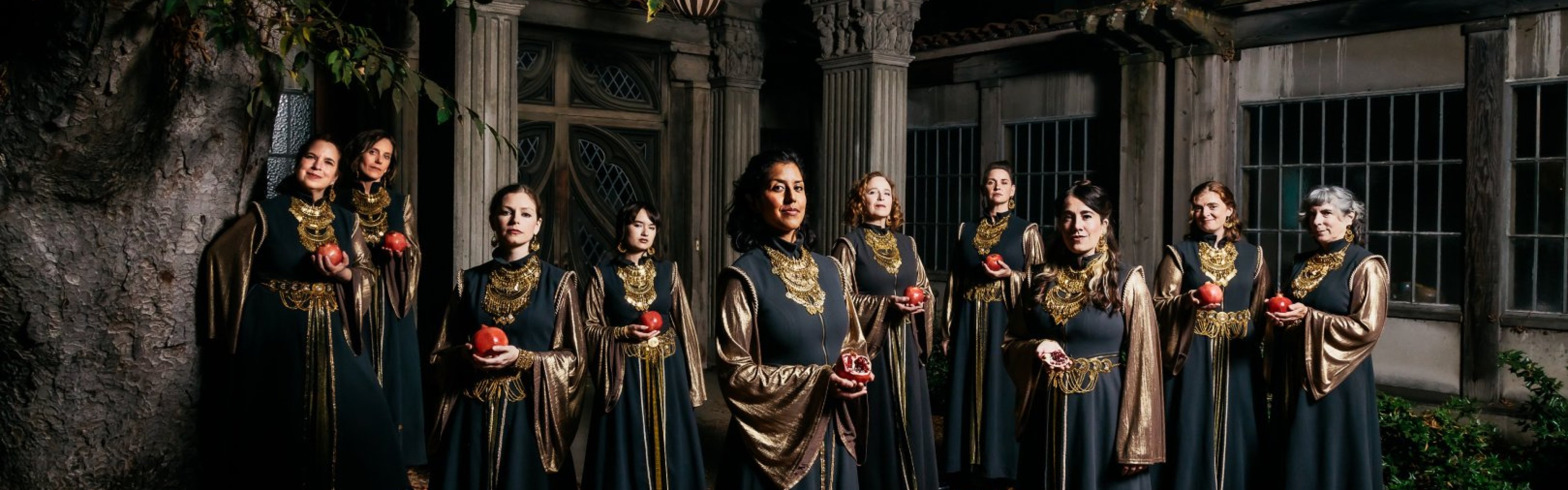
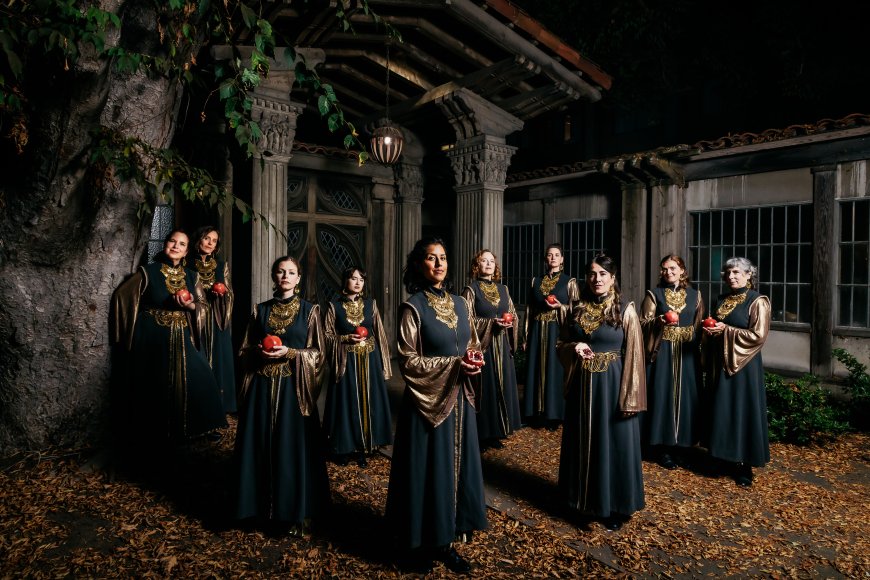
The union of gorgeous traditional song and state-of-the-art innovation in recording was celebrated with an invitation-only listening party last month for Kolo, the latest album by Kitka, the Oakland-based women’s vocal ensemble.
Donors and press gathered for the event in Berkeley at Meyer Sound’s Pearson Theatre, equipped to present the album in Dolby Atmos to best advantage.
As explained by Kitka’s executive artistic director Shira Cion, “we felt we needed to step it up in terms of technology.” BZ Lewis, one of Kolo’s engineers and editors, described Atmos as “an immersive, object-based spatial audio technology,” which introduced a vertical dimension to the familiar horizontal listening experience. With speaker placement at the front, back, sides, and above, the Meyer Sound system results in “expanded emotionality.”
Although most of us can’t afford our own Meyer Sound systems, Lewis assured us that the album sounds awesome through soundbars and headphones. He noted that while previous recordings of Kitka aimed to reproduce the experience of an audience at a live concert, Kolo surrounds the listener with the ten brilliant singers, appropriate to the album’s Proto-Balto-Slavic title, which denotes a circle or cycle.

Kitka has since embarked on its annual Wintersongs concert series in Northern California, promoting the release of Kolo in CD and double-vinyl formats on its own Diaphonica label.
The music of Kolo is drawn from Bulgaria, Corsica, Estonia, Georgia, Latvia, Serbia, Lithuania, and Ukraine, and has been alluringly reimagined by chorister-arrangers Kelly Atkins, Kristine Barrett, and Janet Kutulas. The diaphonic harmonies, sung in numerous languages and song forms, evoke the colorful folk costumes worn by Kitka in performance. The track order, as explained by Cion, parallels the seasons, following the cycle from creation to sustenance to destruction, and back to creation.
The opening “Loomine,” which literally means “creation” in Estonian, is followed by a Latvian celebration of the summer solstice. Tracks from Ukraine and Latvia incorporate the sounds of birds (recorded in Mendocino) and Philharmonia Baroque Orchestra cellist William Skeen (father of Kitka singer Talia Young-Skeen). Ensuing tracks integrate recordings of rainstorms, the ocean, and conversation.
Along with linguistic and musicological variety, Kolo showcases an array of voices and vocal techniques. Lead vocals on the Latvian “Līgo” are ingenuous, girlish, and straight-toned; throaty on the Corsican “O Onda”; and classically full, with prominent vibrato and long sustains on the Georgian “Kakhuri Iavnana.” While Atmos effectively conveys the separation of the ensemble into smaller groups on several tracks, “Mtats’mindis Mtvare,” a love song to the Georgian city of Tbilisi, is a stunning showcase of Kitka in full — a thrilling, faultlessly integrated bouquet of trained, spirited sopranos and altos.
“Matica, Bitutė,” a collage of Serbian and Lithuanian “bee calls,” is arguably both the trippiest track and the most affecting deployment of Atmos. Lewis described the aural scenario: “We hear the bees flying around and then the choir is surrounded by them. Then we hear the villagers” — who’ve been calling out to the insects — “moving from front to back, while celestial voices descend on them. This would be so hard to capture in plain old stereo.”
“Zaklykannja vesny” is perhaps the most stunning acoustic collage. It is a medley of five overlapping Ukrainian songs with the sounds of sirens and explosions, alongside birdsong and the harmonium of chorister Kristine Barrett. In her liner notes, Cion stated, “Kitka offers these ancient song spells in heartfelt solidarity with the people of Ukraine.”
Of the closing track, “Oj, jak že bulo, izpreždi vika,” Cion said, “We close this song cycle with a pagan Ukrainian vision of the world’s mystical birth — a reminder that within every ending lies the seed of a new beginning.”