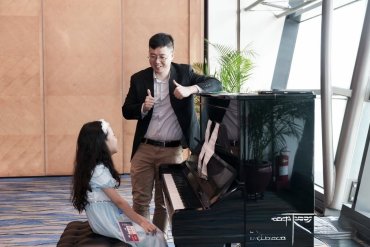
Born in Kuala Lumpur, Malaysia, Dr. Chuan-Li Ko graduated from Texas Tech University with a DMA in Piano Performance. He also holds Associate, Licentiate, and Fellowship diplomas (Special Candidate Award) in Piano Performance, awarded by Trinity College London. During his eight years of graduate study in the United States, Dr. Ko studied with several renowned pianists, including William Westney, Daniel del Pino, Norman Krieger, Elizabeth Pridonoff, Donna Lee, Anton Nel, Asaf Zohar, and Marina Lomazov. He was also a recipient of scholarships and graduate teaching assistantships from various institutions, where he taught Keyboard Skills, Music Theory, and Ear Training.
Dr. Ko has performed extensively as a soloist and collaborative pianist in vocal and instrumental settings, including recitals and competitions. His collaborations over the past few years include a charity saxophone-piano duo recital “Soaring over San Francisco—A Musical Voyage” and a piano-flute duo “Il Cantico delle Creature” in San Francisco, United States; “All-Brahms Chamber Recital” in Medan, Indonesia; “Dream of Flowery Pursuit,” his debut collaboration with Chinese instruments at DPAC Malaysia; “Around the World in 6 Hands and 88 Keys” at the National Taichung Theater (Taiwan); “A Feast of Pianistic Wonders,” where he shared the stage with three other pianists alongside the KLPAC Orchestra; “Connecting the Dots,” a percussion-piano duo recital at DPAC (Malaysia); “Music of the Night,” where he was featured as a soloist presenting Mozart’s Piano Concerto No. 21; “Rach’d,” a joint recital featuring Rachmaninoff’s piano works and art songs at Esplanade Recital Studio (Singapore); and “The Mikado” with James Madison University Opera (United States).
Recognised internationally, Dr. Ko has served as a juror, performer, and consultant at competitions and festivals, including the Macao International Music Festival 2023 finals organised by the Asia International Music Association, the Sandakan International Music Festival 2024, and the GOCAA Music Festival 2025. He is also the co-founder and artistic advisor of the East United International Music Competition 2025, an initiative dedicated to fostering artistic exchange and musical excellence across borders.
Currently based in San Francisco, Dr. Ko runs a piano studio and performs regularly as both a collaborative pianist and soloist in recitals, concerts, and other special events. His piano studio, “Dr. Ko Piano Studio,” was recently ranked first by BusinessRate with “#1 Piano Instructor in San Francisco (2025).” In addition to his performing and teaching, he serves as a music consultant for Polaro, a technology company based in San Mateo that integrates artificial intelligence into music and arts education. Recently, he was featured in Top 10 of Malaysia magazine as one of the top ten most talented pianists in Malaysia.
In addition to his musical endeavors, Dr. Ko is a Professional Member of MISTA (Malaysia International Sound Therapy Association) and a certified sound therapist specializing in singing bowl healing. Through this practice, he strives to refine and elevate his sensitivity toward sound to a level that contributes to the betterment of society, particularly in promoting mental wellness.
37.7202042, -122.4099154
San Francisco , CA (94134)
Full Name:
Chuan-Li Ko
Contact Phone:
Contact Email:
Music Styles:
Classical, Pop
Teacher's Instrument/Voice:
Piano, Music Theory
Instrument/Voice Types Taught:
Piano, Music Theory
Age Ranges:
Pre-School
Elementary
Middle School
High School
Adult
Education:
Doctor of Musical Arts (Piano Performance) - Texas Tech University
Fellowship in Piano Performance awarded by Trinity College of London
Years Teaching:
20
Lesson Rate:
Trial / Regular lessons: $64/$96/$128 per 30/45/60-minute session; Ad hoc lessons: $72/$108/$144 per 30/45/60-minute session
Offers Private Lessons:
Yes
Teaching Method:
Throughout my 16 years of teaching individual piano lessons, keyboard skills, music theory, and ear-training classes, I have always challenged myself to incorporate creative methods into studio and classroom teaching. This innovation stimulates students’ interest in learning and accomplishing their goals. One time, I challenged a student to play a Chopin’s Nocturne more spontaneously by imagining himself as three different contestants playing the piece in a competition. Not only did I request him to make each rendition different and better from the previous, I also compelled him into imagining that “the piece has never been written but it is something that he is improvising as it goes along.” The result was magical as he pushed himself beyond his capabilities. My philosophy of education centers on maximizing students’ potential and strengths. I seek to provide the best possible environment and tools to enhance students’ learning experiences.
“Teach a man to fish and you feed him for a lifetime” has always been my motto. The two main aspects I focus on intensively in self-directed learning are the mindset and strategy developed and employed while working on a piece of music. Though our role as educators is to provide guidance to students of all types, I believe that inspiring students to become independent musicians and lifelong learners can be more beneficial. In order to cultivate autodidacticism, I offer students guidelines and methods that serve as a learning compass outside of the classroom.
Although music interpretation is crucial in a performance, the preparatory work in the practice room determines the final product. Evidently, slow practice has been the practice strategy for many musicians in the pursuit of technical improvement. I very much prefer the idea of practicing a passage rhythmic-less-ly, as it relieves body tension taking place under the restraint of rhythmic complexity. Another modification I take with slow practice is dismantling the passage into small units; taking them out of dynamic, expressive, and rhythmic context; and playing the notes deep into the key bed with full physical engagement. At times, it is necessary to play the passage fast to test-run the fingers in order to understand how different parts and levers of our body work together as a whole.
The body is able to take in much more information during the process of music construction than musicians previously thought. Teaching our body how it feels while executing every single note on the piano and slowly but mindfully digesting the information, will consolidate the learning. While it is good to be goal-oriented in the practice room, it helps to allow our body and mind to experiment and embrace fully our experience with music. I teach my students not to fear or resist technical difficulties, but take time to understand why and how our mind and body react to the music in such a way. Building this mindset for piano practice can lead to a much more engaging, fun, and rewarding learning process.
Similarly in teaching, I prefer to take things slow. Besides setting goals periodically to motivate my students, each week I am able to find new angles and aspects in an old piece to work on. Because I care about what each student can offer differently in their playing, I always provide feedback that brings out their best. I am also open to discussion with students in which they bring in unique, dynamic, and unconventional ideas. As a result, I discover something new from my students daily.
I like to make new concepts fun and easy to absorb. While I constantly assign tasks and pose questions that challenge my students to think critically, I am good at presenting my ideas in a relatable yet profound way.
Teaching is not only about imparting knowledge and skills from a teacher to a learner. As an educator, it is my responsibility to figure out how each student learns and to provide students opportunities to explore, discover, and identify their strengths and weaknesses. Instruction should be adjusted accordingly and tailored to the needs of each student, with the intent to maximize their creative ideas and innovative thinking. By challenging them to cope with difficult and unfamiliar tasks at a higher proficiency level, I contribute to their exploratory process as they discover and develop their own capabilities. Ultimately, I seek to encourage students to continue learning in a life-long passion for music.
Makes House Calls:
No