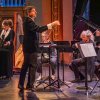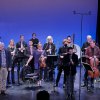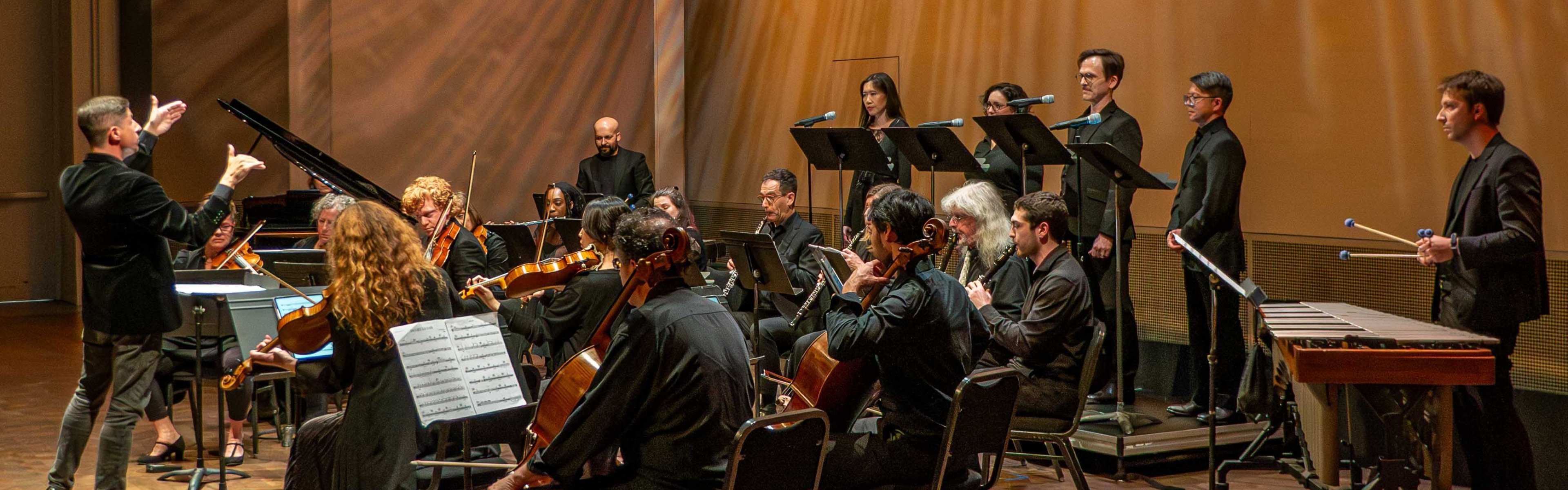

There was relief from this weekend’s bad weather and bad news, awaiting in the San Francisco Contemporary Music Players’ “Steps Toward Ascent” program, presented in the lovely Taube Atrium Theater atop the Veterans Building.
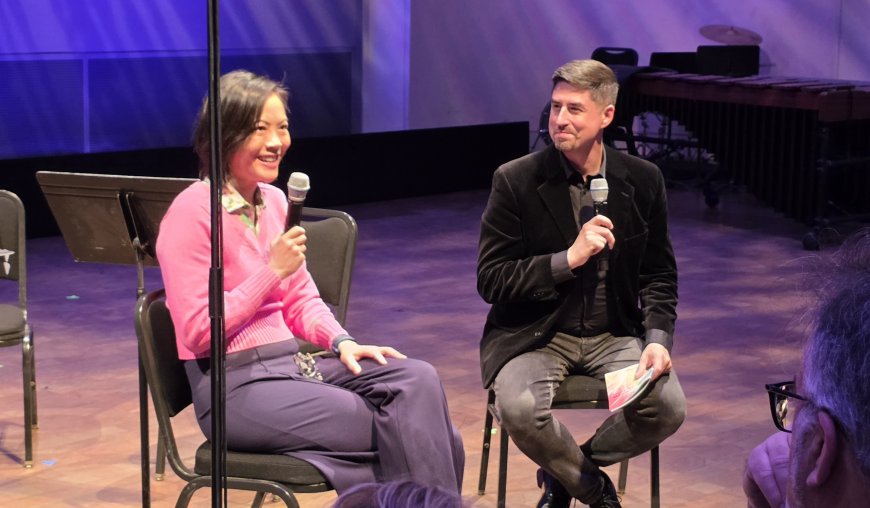
The good vibes began with a cheery collegial exchange between Artistic Director Eric Dudley and Vivian Fung, the ubiquitous San Francisco-based composer whose Ominous got its West Coast premiere as part of Saturday’s program. Fung’s declared mission of “testing what’s possible” with an ensemble of “very virtuosic players” was successfully shared by all four of the evening’s composers, and by the packed audience
The opener, Music for Small Orchestra, was written early in Ruth Crawford Seeger’s career, before she met and became the second wife of musicologist and composer Charles Seeger and stepmother to his sons Pete and John. Now celebrating its centenary, the piece, in its slower first section, displayed an innovative ambiance evocative of Darius Milhaud’s contemporaneous La création du monde, the 10 instruments awakening with a collective yawn.
The players, engagingly conducted by Dudley, showcased Seeger’s modernist layering of themes, and her notations for dreamy deployment of the strings. The second section, marked “In roguish humor,” created a playground, with sprightly figures by pianist Allegra Chapman that then bounced among the woodwinds, the whole ensemble delectably delighted.
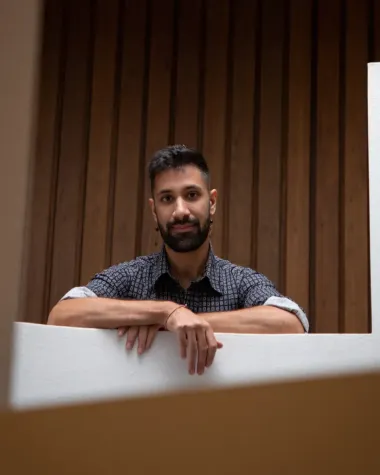
Afghani-American Seare Ahmad Farhat, the program’s youngest composer, heard Muzzahaimat receive its West Coast premiere, three years after its commission by Copland House. The title comes from a word meaning “the state of being disturbed.” Its pianissimo opening, with avian murmurs from clarinetist Peter Josheff, and the prominent role of silence between sounds commanded attentive listening from both players and audience. Josheff and violinist Kevin Rogers were deployed in shortened, aborted themes, which the composer’s notes described as “sending signals into the dark, only never to be fully realized in satisfying response.”
The ensemble increased from four to 13 for Fung’s Ominous, with Dudley returning to conductor’s duty. In her preconcert remarks, Fung had revealed her inspiration in coping with her mother’s dementia, and Dudley had responded with similar challenges from his father’s mental decline.
The piece irresistibly evoked unstable climatic patterns within a mind, heard at first as sustained distress in Brittany Trotter’s flute and Sarah Rathke’s oboe. The strings shivered, before Divesh Karamchandani’s marimba, and James Beauton’s percussion launched a Stravinsky-esque theatricality. As with Seeger’s piece, but more powerfully, orchestral themes were excitingly strange but artfully layered.
Although only 12 minutes long, Ominous functioned as a generous gallery exhibition of its composer’s panoply of talents. Accumulating acoustic mass, it attained a tangible though ragged pulse, here with smoky, twirling ascending melody lines, there with fortissimo neural bursts. The figuration was often fascinating, and there was a lively, lovely interlude for strings. After the finish, applauded and cheered by the audience, Fung came forward to hug Dudley and applaud the ensemble.
After a chatty intermission (the Taube Atrium seems to encourage more convivial exchange among attendees than do most concert spaces), the second part of the program was devoted to Jacob’s Ladder, a 2023 work by Steve Reich, who will turn 90 in October. The large assemblage of musicians, 17 instrumentalists and four vocalists, included two vibraphones, whose pulsing at the beginning was familiar Reichian territory.
But as the piece proceeded, and the rhythm patterns were adapted in lovely fashion by the strings and woodwinds, there was an evolution past stereotypical minimalism toward something more generous . The fullness of the orchestration and the luminous harmonic hopefulness seemed fitted for Dvorak’s New World Symphony, or maybe a movie score. An extended passage worked ascending scales with altered intervals, perhaps leading up the titular ladder to different perspectives. A patient liturgical vocalization of the brief Hebraic text, with soprano Winnie Nieh a vibrant standout, affected an oratorical grace.
Correction: This article originally misstated the name of the flute player in Ominous. It was Brittany Trotter.