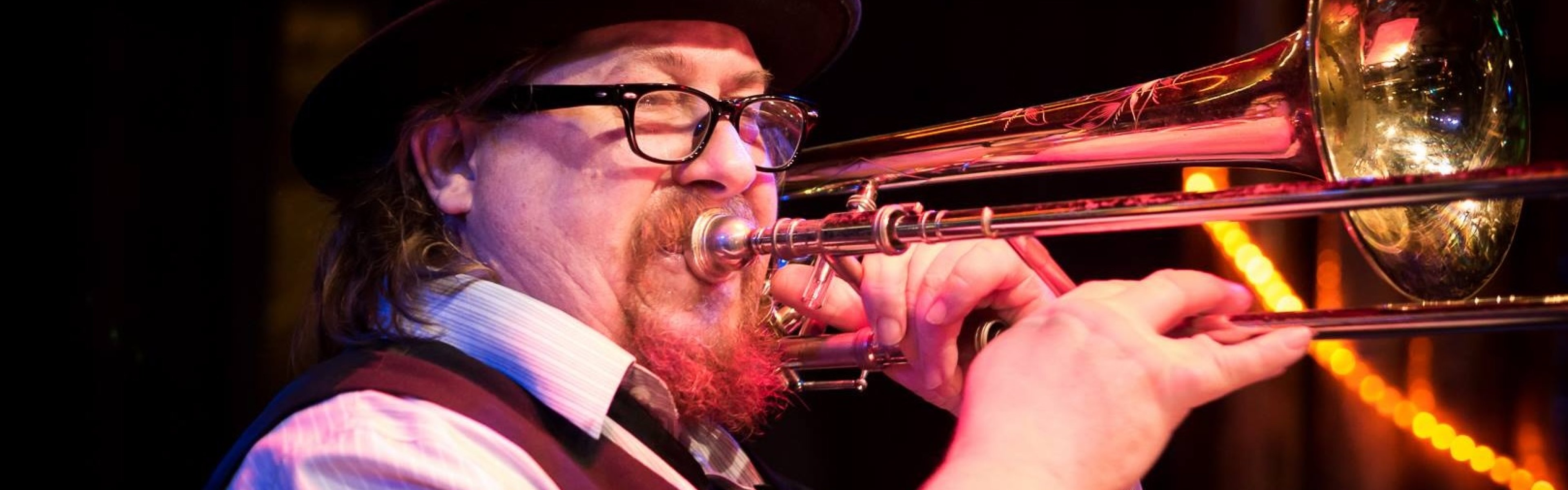
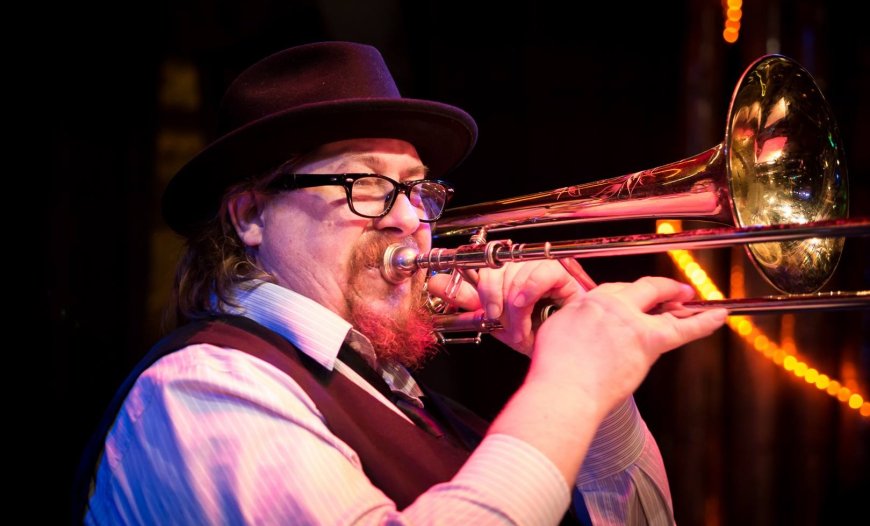
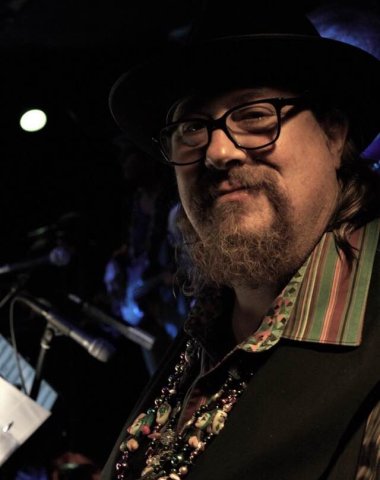
In a horn section, Mike Rinta is hard to miss. Usually bedecked with a black fedora and a natty vest, his brown hair falling past his broad shoulders, Rinta wields his trombone like a conductor’s baton. Treating every gig like a party, he’s the guy having a blast.
Over the past four decades, he’s been a ubiquitous figure on the Bay Area music scene. Whatever the genre, Rinta gets the call. What he doesn’t tend to receive is a listing on the marquee. Rinta is also a force behind the scenes, a versatile arranger whose punchy charts transform gigs from pedestrian events into inspired encounters.
His sole album as a leader is a 2009 New Orleans brass project titled, puckishly, Eponymous. He’s not bothered that most listeners don’t know his name. By his own estimation, he’s living the dream. He hasn’t had a day job in decades, ever since he quit throwing pizzas for Round Table Pizza back in the 1980s.
“I knew I wanted to prioritize music in my life,” he said. “All I wanted to do was play trombone and get better at it. I’ve never auditioned for a gig in my life. Everything I’ve done is word of mouth. I decided I wanted to play all genres. I listen to music, hear how it goes, and figure out what makes it work. I know how to make things fit in.”
And he knows how to make tracks stand out. Rinta was a crucial player on the debut album of the Oakland-based Pacific Mambo Orchestra, which rocked the Latin music world in 2014 with an upset victory at the Grammys. Triumphing over heavyweights with major-label backing like salsa stars Marc Anthony and Carlos Vives, the band earned the award for Best Tropical Latin Album with its self-titled, crowdfunded release. It opens with an instrumental track by PMO co-leader Christian Tumalan and shifts into overdrive with Rinta’s arrangement of Rubén Blades’s hit for Héctor Lavoe, “El Cantante,” delivered with requisite swagger by Spanish Harlem Orchestra vocalist Willy Torres.
“I considered it divinely inspired, coming from that place when you’re in the flow,” Rinta said, noting that he was hesitant to take the assignment at first because “everybody plays that song.”
He transcribed Lavoe’s original 1978 track, translating the string parts for the PMO’s saxophones. The mambo groove was borrowed from a Latin jazz piece — “Mambo Valentin” by Puerto Rican pianist José Lugo. It’s impossible to know whether “El Cantante” tipped the Grammy balance, but Rinta’s arrangements opened the next two PMO albums.
It’s a project of which he’s particularly proud, but his discography is studded with plum sessions, including the psychedelic blues of guitarist Harvey Mandel (Snakes & Stripes); Boots Riley’s radical hip-hop (The Coup’s Steal This Album); the deep soul of Howard Tate (Rediscovered and Live); the rollicking R&B of the California Honeydrops (A River’s Invitation and Soft Spot); the Latin soul of Pete Escovedo (Back to the Bay); the scorching blues of Chris Cain (Raisin’ Cain); and the classic swing of Taj Mahal (Savoy).
“After the Taj date, I was high on that for two weeks, playing with that rhythm section — Ruth Davies, Danny Caron, and Leon Joyce,” said Rinta, who prides himself on sight-reading charts rather than rehearsing them. “I went in with little warm-up and rode the wave.”
In the next few weeks, Rinta performs with guitarist and vocalist George Cole and His Orchestra at SFJAZZ Center’s Joe Henderson Lab Dec. 18–21 with the program “Nat King Cole’s The Magic of Christmas.” He’s at the Sausalito Seahorse on Jan. 11, 2026, with Conjunto Karabali led by Latin percussionists Karl Perazzo and Michael Spiro.
You can catch him in North Beach every Sunday with Mark Naftalin’s Blues Power at the Saloon, the oldest blues spot in the Bay Area. And he’s a charter member of the Local Edition Jazz Orchestra, which holds forth in the historic Hearst Building’s basement nightspot every Tuesday.
Rinta’s body of work has made him a go-to cat for several key Bay Area studios. At Kid Andersen’s Greaseland Studios in San Jose, which has become the West Coast’s hottest destination for hard-core blues artists, Rinta has crafted horn arrangements for sessions with Wee Willie Walker, Diunna Greenleaf, Big Harp George, and Tia Carroll, among many others.
He’s also part of the Wide Hive Records constellation in Berkeley, which Gregory Howe, a local percussionist, producer, and composer, has turned into an international force with releases by jazz greats such as guitarists Larry Coryell and Calvin Keys, saxophonist Roscoe Mitchell, and drummer Mike Clark. Rinta was on the first album Howe released on Wide Hive, 1998’s Dissent, and he quickly became part of the label’s house band, co-writing tunes on six albums by the Wide Hive Players.
“He’s always contributing and his energy is always killer. He’s a 100-percenter,” said Howe, who noted that Rinta’s unerring ear made him invaluable when multi-tracking horn parts. “His pitch for self-harmonization is meticulous.”
Rinta, 60, was born in San Francisco and grew up around the East Bay, graduating from San Ramon Valley High School. At Chabot College, he came under the wing of the excellent jazz pianist and arranger Frank Sumares, “who taught me everything I know about jazz harmony,” Rinta recalled. “All my arranging chops come from him.”
His first regular gig was playing salsa four nights a week with Franco Brothers y Su Orquesta Actualidad at a basement Latin dance club in San Jose called Boogaloo. He honed his chops in the early 1990s playing jazz on a cruise line, and when he returned to the Bay Area, a friend introduced him to the North Beach blues scene.
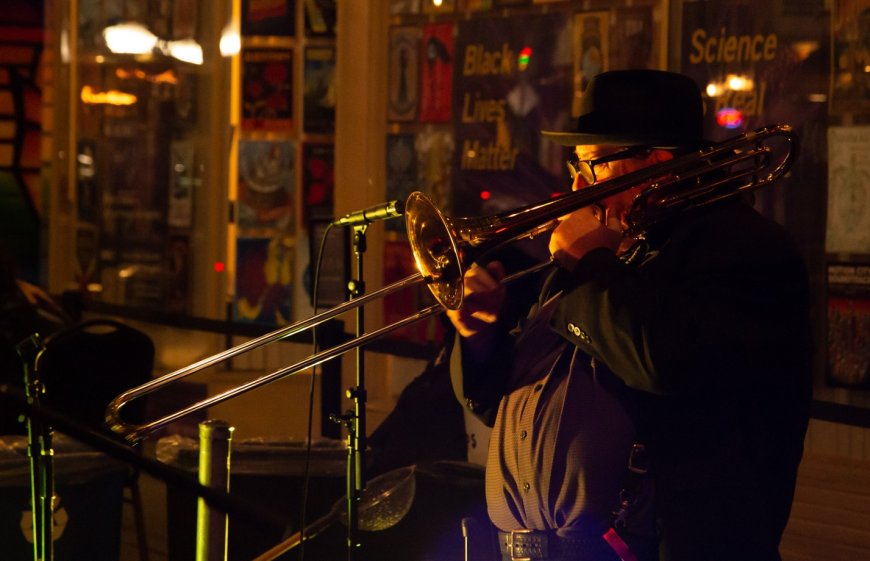
Sitting in regularly at the Saloon and Grant & Green, he started making a name for himself, which led to joining the Cyclops Blues Band. Gigs with guitarists Harvey Mandel and Tommy Castro spread his reputation, and he ended up touring and recording with Howard Tate, a powerhouse singer from the 1960s soul scene who was on the cusp of a career revival.
Given his ubiquity, it seems fitting that his favorite gig is with a band that never performs in public. As a featured soloist and arranger for the Jazz Therapists, he plays swing-era standards in nursing homes and assisted living facilities several days a week. The group is funded by a bequest from Bob Schwartz, an inventor, saxophone player, and Oakland community leader who played in the band well into his 80s. For Rinta, it’s an opportunity to swing and “sing” with his horn, reaching audiences with songs they remember from their youth.
“We’re constantly adding new tunes,” he said. “What I like to do is listen to different versions that were recorded and give props to people that came before us. I see music as being like a language, and we’re speaking what was taught to us from what came before.”